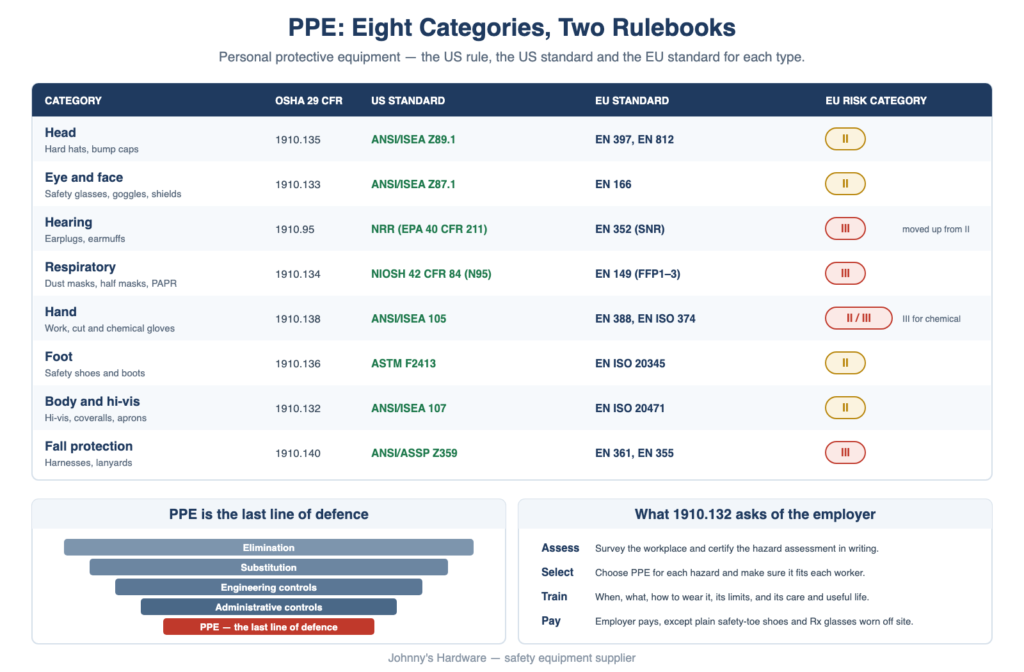
PPE stands for personal protective equipment: anything a worker wears to reduce exposure to a hazard that cannot be removed or controlled at its source. Hard hats, safety glasses, earplugs, respirators, gloves, safety shoes, hi-vis clothing and fall-arrest harnesses are all PPE. In the United States the rules sit in OSHA 29 CFR 1910 Subpart I; in Europe, in the PPE Regulation (EU) 2016/425.
The definition is the easy part. What matters in practice is that each type of PPE has its own performance standard, and the American and European standards for the same product rarely line up. That is where sourcing goes wrong, and it is what this guide maps out.
The eight categories of PPE
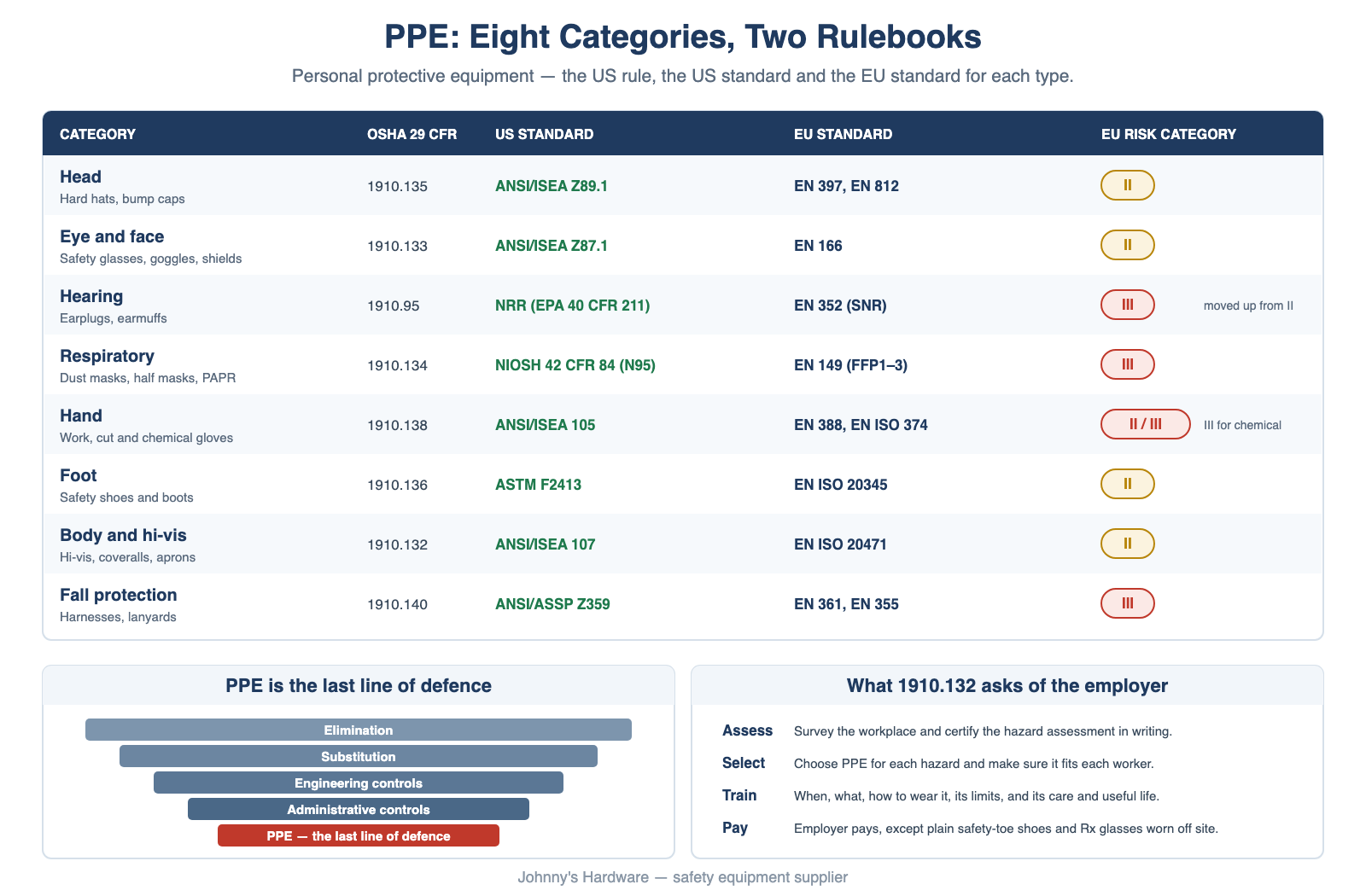
| Category | OSHA 29 CFR | US standard | EU standard | EU risk category |
|---|---|---|---|---|
| Head Hard hats, bump caps | 1910.135 | ANSI/ISEA Z89.1 | EN 397; EN 812 for bump caps | II |
| Eye and face Safety glasses, goggles, face shields | 1910.133 | ANSI/ISEA Z87.1 | EN 166 | II |
| Hearing Earplugs, earmuffs | 1910.95 | NRR labelling under EPA 40 CFR 211 | EN 352, rated in SNR | III |
| Respiratory Dust masks, half masks, powered respirators | 1910.134 | NIOSH approval under 42 CFR 84 (N95, P100) | EN 149 (FFP1 to FFP3) | III |
| Hand Work, cut-resistant and chemical gloves | 1910.138 | ANSI/ISEA 105 | EN 388; EN ISO 374 for chemicals | II; III for chemical |
| Foot Safety shoes and boots | 1910.136 | ASTM F2413 | EN ISO 20345 | II |
| Body and hi-vis Hi-vis garments, coveralls, aprons | 1910.132 | ANSI/ISEA 107 for hi-vis | EN ISO 20471 | II |
| Fall protection Harnesses, lanyards | 1910.140 | ANSI/ASSP Z359 | EN 361; EN 355 for lanyards | III |
Two columns in that table deserve a closer look. The OSHA column is the legal duty — what an employer must provide. The standard columns are the technical definitions of what a compliant product has to pass, and it is those that a buyer actually specifies. OSHA does not make or approve PPE; it points to consensus standards written by bodies such as ANSI, ISEA and ASTM, and to NIOSH approval for respirators.
PPE is the last line of defence
Occupational safety works through a hierarchy of controls, and PPE sits at the bottom of it. In order of effectiveness:
- Elimination — remove the hazard altogether.
- Substitution — replace it with something less dangerous.
- Engineering controls — isolate people from it: guards, extraction, barriers.
- Administrative controls — change the way people work: procedures, rotation, signage.
- PPE — protect the individual when everything above still leaves a risk.
PPE comes last not because it is unimportant but because it is the least reliable. It only works if it is the right item, fits the person, is worn every time and is replaced before it fails. That is why the rules around it are mostly about assessment, fit and training rather than about the products themselves.
What OSHA requires of employers
The general rule is 29 CFR 1910.132, and it sets four duties that apply across every category:
| Duty | Paragraph | What it requires |
|---|---|---|
| Assess | (d) | Survey the workplace for hazards that call for PPE, and certify the assessment in writing — naming the workplace, the person certifying and the date |
| Select and fit | (d) | Choose PPE that protects against the identified hazards, tell employees what was chosen, and make sure it fits each person |
| Train | (f) | When PPE is needed, what is needed, how to put it on, adjust and wear it, its limitations, and its care, useful life and disposal |
| Pay | (h) | The employer provides PPE at no cost to employees, with narrow exceptions |
The payment exceptions are worth knowing because they shape how safety footwear and eyewear are sold. An employer need not pay for non-specialty safety-toe footwear or non-specialty prescription safety eyewear, provided the employee is allowed to wear them away from the job site. Everything else — hard hats, gloves, respirators, hearing protection, harnesses, and specialty footwear such as metatarsal boots — is the employer’s cost. That split is why safety boots often reach the market through retail and voucher programmes while most other PPE is bought centrally.
How Europe classifies PPE
The EU takes a different route. Instead of a legal duty pointing at product standards, the PPE Regulation (EU) 2016/425, in force since 21 April 2018, sorts every product by the severity of the risk it protects against, and the category sets how the product must be approved before it can carry a CE mark:
| Category | Risk | Examples | Route to the CE mark |
|---|---|---|---|
| I | Minimal | Gardening gloves, simple sunglasses | Manufacturer’s own declaration |
| II | Intermediate | Safety glasses, hard hats, safety footwear, cut-resistant gloves, hi-vis | EU type examination by a notified body |
| III | Severe or irreversible | Respirators, hearing protection, fall arrest, chemical gloves | Type examination plus ongoing surveillance of production; the notified body’s number appears beside the CE mark |
Hearing protection is the category most often mis-filed. The 2016 regulation treats harmful noise as an irreversible hazard and moved hearing protectors from category II to category III, alongside respirators and fall protection. A supplier quoting earplugs on a category II basis is working from the old directive.
Where US and EU standards part company
Because the two systems grew up separately, the same product is tested in different ways and rated on different scales. The differences that most often catch buyers out:
- Safety footwear — the European toe cap is impact-tested at 200 joules, the American one at 75 foot-pounds, about 102. Neither market accepts the other’s marking. Covered in OSHA approved shoes.
- Cut-resistant gloves — EN 388 runs from A to F and ANSI from A1 to A9, so an EN glove marked F could be anything from ANSI A6 to A9. Covered in glove cut levels.
- Eye protection — Z87 and Z87+ against EN 166’s four impact grades. Covered in ANSI Z87.1 safety glasses.
- Head protection — ANSI types and classes against EN 397’s optional marks. Covered in types of hard hats.
- Hearing protection — US NRR and European SNR come from different test methods, and for the same product the SNR usually reads three to five decibels higher. There is no exact conversion, so the two numbers cannot be compared directly.
The rule underneath all five: specify the destination market first, then the standard, then the rating. A product that is excellent in one system is not thereby compliant in the other.
Building a PPE range
For a hardware distributor or a retail safety aisle, most of the volume sits in a short list, and it pays to certify that list for each market you sell into rather than to stock one item for everyone:
- Eye — clear wraparound safety glasses, Z87+ for the US and EN 166 for Europe
- Hand — a general-purpose glove and a cut-resistant glove at ANSI A4 or EN level D
- Head — Type I Class E hard hats, plus bump caps for low-clearance work
- Hearing — disposable foam earplugs and one earmuff
- Respiratory — disposable particulate respirators, certified for the destination market
- Foot — a steel toe S3 shoe for Europe, and an ASTM F2413 line for the US
Fall protection and chemical protection are specialist lines with category III approval and higher liability, and are better handled by quoting against a specific customer requirement than by holding stock.
Final thoughts
PPE stands for personal protective equipment, and the three words hide a great deal of structure. There are eight broad categories, each with its own OSHA duty, its own American standard and its own European one, and the numbers in those standards rarely translate. It is also the last line of defence, not the first. Assess the hazard, name the market, then specify the standard — in that order.
FAQ
What does PPE stand for?
Personal protective equipment. It covers anything a worker wears to reduce exposure to a hazard: hard hats, safety glasses and face shields, earplugs and earmuffs, respirators, gloves, safety footwear, hi-vis and protective clothing, and fall-arrest harnesses. In the US it is regulated under OSHA 29 CFR 1910 Subpart I, and in Europe under the PPE Regulation (EU) 2016/425.
What are the main types of PPE?
Eight broad categories: head protection, eye and face protection, hearing protection, respiratory protection, hand protection, foot protection, body protection including hi-vis clothing, and fall protection. Each has its own OSHA section and its own performance standards. Hearing sits outside the main PPE subpart in the US, under the occupational noise rule, 1910.95.
Who pays for PPE in the US?
The employer. OSHA 1910.132(h) requires PPE to be provided at no cost to employees. The main exceptions are non-specialty safety-toe footwear and non-specialty prescription safety eyewear, provided the employer lets them be worn off the job site. Specialty items such as metatarsal boots, and everything else from hard hats to respirators, remain the employer’s cost.
Does OSHA approve PPE?
No. OSHA sets the legal duty to provide suitable PPE and refers to consensus standards for what suitable means — ANSI/ISEA Z87.1 for eyewear, ASTM F2413 for footwear, ANSI/ISEA Z89.1 for hard hats, and so on. Respirators are the exception that proves the rule: they must be approved, but by NIOSH, not OSHA. A product advertised as “OSHA approved” usually means it meets one of those standards.
What is category III PPE?
Under the EU PPE Regulation, category III covers protection against severe or irreversible harm: respirators, hearing protectors, fall arrest equipment and chemical protective gloves among them. It needs EU type examination plus ongoing surveillance of production by a notified body, whose four-digit number appears beside the CE mark. It is the strictest of the three European categories.
Is a dust mask the same as a surgical mask?
No. A particulate respirator such as an N95 or an FFP2 is PPE, designed to filter what the wearer breathes in and to seal to the face. A surgical mask is designed to stop the wearer’s own droplets reaching others, and in Europe it is regulated as a medical device rather than as PPE. For dust, fumes and particulates at work, the respirator is the relevant product.
What is the difference between OSHA and ANSI?
OSHA is a US government regulator that sets legally binding workplace safety rules. ANSI coordinates the voluntary consensus standards, often written with ISEA, that define how products perform. OSHA regulations refer to those standards, which is how a voluntary standard such as ANSI/ISEA Z87.1 becomes the practical test of legal compliance for safety glasses.
Can one PPE product meet both US and EU standards?
Yes, dual-certified products exist, but they must pass both sets of tests and carry both markings, backed by both evidence files: a test report for the US standard and an EU type examination certificate for the CE mark. They cost more, so many programmes hold a separately certified product for each market instead.
How often should PPE be replaced?
It depends on the product and the manufacturer’s stated service life. Hard hat shells are commonly replaced within about five years and suspensions every twelve months, respirator filters when breathing becomes harder or on a schedule, and anything after a significant impact or visible damage. OSHA’s training requirement specifically covers useful life and disposal, so the replacement rule should be part of it.
Sourcing PPE
Johnny’s Hardware supplies personal protective equipment across the main categories for hardware distributors, retail safety aisles and jobsite supply: safety glasses to ANSI Z87.1 and EN 166, bump caps and hard hats, cut-resistant gloves, and safety shoes to EN ISO 20345 category S3 SR FO. Respirators and hearing protection are quoted against the destination market, with the standard and certification confirmed item by item before quotation.
PPE consolidates with the rest of the safety equipment range and with the fastener supplier range in one shipment, and private label and retail packaging are handled through our OEM hardware supplier service.
Send the categories, destination market, the standard each item must meet and the quantities, and we will come back with specifications, certificates, carton data and lead times within 12 working hours.
– Johnny’s Hardware Team, QC Engineer