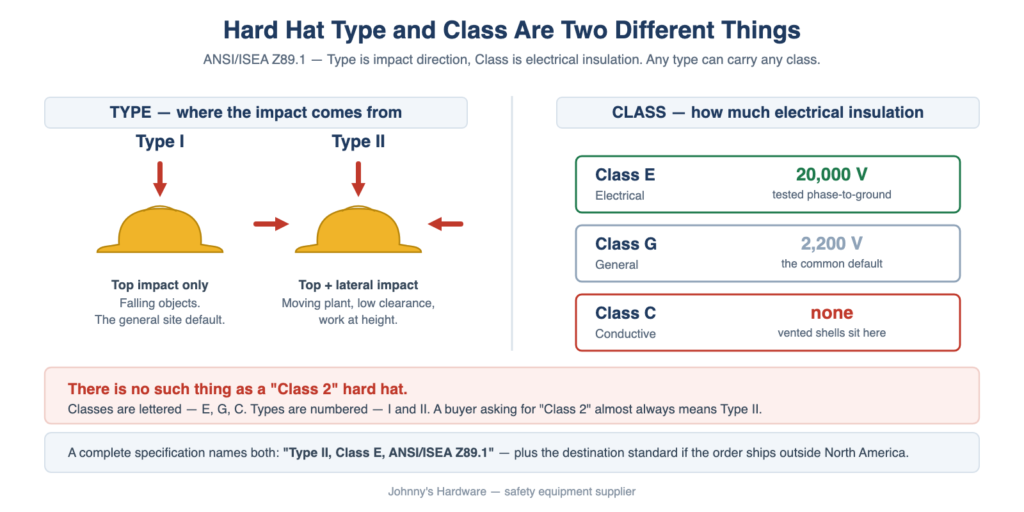
Hard hats are classified on two independent axes, and mixing them up is the most common error on a safety order. Type describes where the impact comes from — top only, or top and sides. Class describes electrical insulation. A hat can be any type in any class, so a complete specification always names both.
Everything below is ANSI/ISEA Z89.1, the North American standard. If the order ships to Europe, the UK or Australia it will be judged against a different standard entirely, and the two are not interchangeable — covered further down.
Type and class are not the same thing
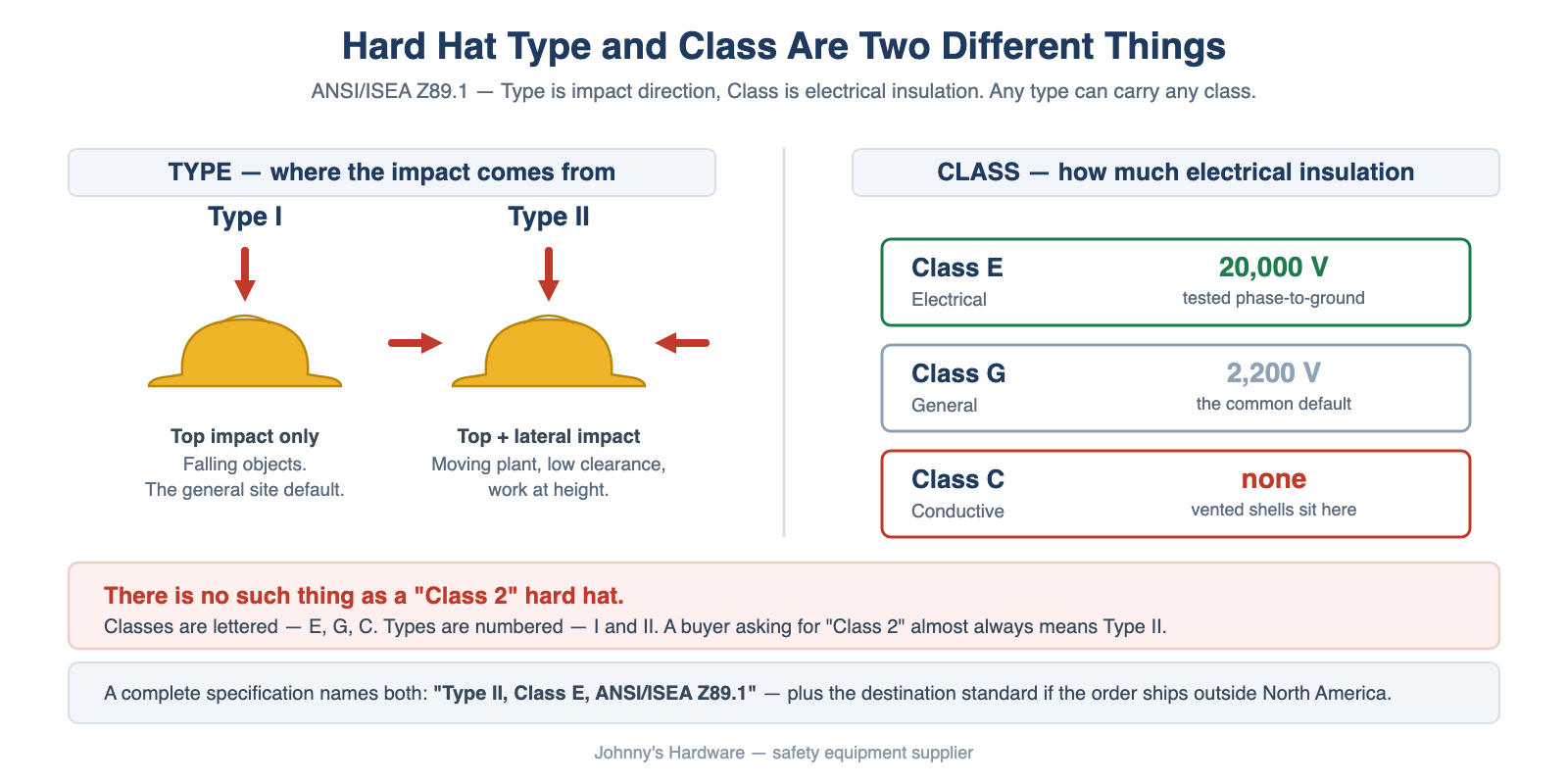
The naming convention itself is the trap: types are numbered, classes are lettered. There is no Class 1 or Class 2 hard hat. A buyer asking for a “Class 2” almost always means Type II, and a supplier who takes the request literally will ship the wrong thing or come back with questions.
The two types
| Type | Tested for | Where it belongs |
|---|---|---|
| Type I | Impact to the top of the head only | General construction, where falling objects are the main hazard |
| Type II | Top impact plus off-centre lateral impact | Moving plant, low clearances, work at height, anywhere a side blow is credible |
Type II adds an off-centre impact test that Type I is not subjected to, and it is achieved with an internal foam liner rather than suspension alone. That construction difference is why Type II costs more and why the two cannot be substituted for each other on price.
The three classes
| Class | Name | Proof tested at | Notes |
|---|---|---|---|
| Class E | Electrical | 20,000 V phase-to-ground | Utilities, live electrical work. Leakage limited to 9 mA |
| Class G | General | 2,200 V phase-to-ground | The common default on general sites |
| Class C | Conductive | Not tested | No electrical protection at all |
Class G and Class E were previously called Class A and Class B. Older drawings and specifications still use the old letters, so if a document says “Class A” it means what is now Class G.
Vented shells are always Class C. Ventilation holes are exactly the thing electrical insulation cannot have. If a buyer asks for a vented hard hat for hot weather and also needs Class E, those two requirements are mutually exclusive and the conflict has to be resolved before production, not after.
ANSI is not the only standard
This is where an order shipping outside North America goes wrong. The ranking guides on this subject are written by US distributors and cover ANSI only, but a hard hat compliant in Ohio is not automatically compliant in Manchester or Melbourne.
| Standard | Market | How it classifies |
|---|---|---|
| ANSI/ISEA Z89.1 | United States, Canada | Type I / II, Class E / G / C |
| EN 397 | Europe, UK | Mandatory base requirements plus optional marks: −20°C, −30°C, +150°C, 440 V a.c., LD (lateral deformation), MM (molten metal) |
| EN 12492 | Europe — climbing / work at height | Retained chin strap, higher lateral requirements |
| AS/NZS 1801 | Australia, New Zealand | Type 1 / Type 2 with its own numbering, not the ANSI one |
Two differences matter more than the rest.
The chin strap works in opposite directions. Under EN 397 the strap must release between 150 and 250 N, so a snagged helmet comes off rather than strangling the wearer. Under EN 12492 the strap must retain, so the helmet stays on during a fall. Those are contradictory requirements serving different hazards, and a helmet certified to one is not suitable where the other is required.
The electrical ratings do not convert. ANSI Class E is proof-tested at 20,000 V. The EN 397 electrical option is 440 V a.c. They are different tests at different voltages, so a Class E marking does not make a helmet EN 397 electrically rated, and a 440 V EN 397 helmet is nowhere near Class E. State the destination standard on the order and let the factory certify to it.
Bump caps are not hard hats
A bump cap looks like a lightweight hard hat and is frequently confused with one, including by buyers writing the order.
| Hard hat | Bump cap | |
|---|---|---|
| Protects against | Falling and flying objects | Walking into fixed objects — scrapes and knocks |
| Standard | ANSI Z89.1 / EN 397 | EN 812 — a separate, lower standard |
| Suspension | Suspended shell with a gap that absorbs the blow | Thin insert in a cap, no suspension gap |
| Valid substitute? | — | No. Never where a falling-object hazard exists |
Bump caps are the right product for warehouses, low pipework, aircraft maintenance and food processing — places where people bang their heads on fixed structures but nothing falls. Supplying one where the site risk assessment calls for the other is a compliance failure, not a cost saving. The standards, the OSHA question and how to label the two products are covered in bump cap vs hard hat.
Hard hat colours are not a standard
Colour conventions exist on most sites — white for supervisors and engineers, yellow for general labour, blue for technical or electrical, green for safety officers, red for fire marshals, orange for banksmen or visitors. Buyers frequently ask which colour “means” what.
The honest answer is that no regulation assigns meaning to hard hat colour. ANSI Z89.1 does not mention it, nor does EN 397. The conventions are site or contractor policy and they differ between countries and even between projects. Useful to know when planning a colour mix for an order, but never treat a colour as a substitute for the type and class markings.
Service life and replacement
Two separate clocks run on every hard hat, and the shorter one is easy to miss:
- The shell — manufacturers typically recommend replacement within about 5 years of the date of manufacture, sooner in high UV or chemical exposure
- The suspension — typically replaced every 12 months, because the webbing degrades faster than the shell
- After any impact — immediately, regardless of age or visible damage. A shell that has absorbed a blow has already done its job
The date of manufacture is moulded into the underside of the brim, usually as a clock face with an arrow to the month and the year in the centre. For a distributor this matters at goods-in: stock that has sat in a warehouse is already consuming its service life.
What to put on the order
- Type — I or II
- Class — E, G or C
- Standard — ANSI/ISEA Z89.1, EN 397, AS/NZS 1801, per destination market
- Shell style — cap style or full brim
- Suspension — 4-point or 6-point, ratchet or pinlock
- Colours and quantities per colour
- Accessories — slots for ear muffs and face shields, chin strap, sweatband
Written out: Type II, Class E, ANSI/ISEA Z89.1, cap style, 6-point ratchet, white, with universal accessory slots. Nothing left to interpretation.
Final thoughts
Two numbers and one letter carry almost all the risk on a head protection order: the type, the class and the destination standard. Get those three onto the specification and the rest is preference. Leave any of them off and the shipment can arrive exactly as ordered and still be non-compliant for the site it was bought for.
FAQ
What is the difference between a Type I and Type II hard hat?
Type I is tested for impact to the top of the head only. Type II adds an off-centre lateral impact test, achieved with an internal foam liner rather than suspension alone. Type I suits general sites where falling objects dominate; Type II is specified where moving plant, low clearances or work at height make a side blow credible.
Is there such a thing as a Class 2 hard hat?
No. Classes under ANSI Z89.1 are lettered — E, G and C — while types are numbered I and II. A request for a “Class 2” hard hat almost always means Type II. Confirm which the buyer wants before quoting, because the two describe completely different properties — one is impact direction, the other is electrical insulation, and neither implies the other.
What does Class E mean on a hard hat?
Class E stands for Electrical. The shell is proof-tested at 20,000 volts phase-to-ground with leakage current limited to 9 milliamps. It is specified for utility and live electrical work. Class G is tested at 2,200 volts, and Class C has no electrical protection and is not tested for it at all.
Can a hard hat be both vented and Class E?
No, and it is a common request. Ventilation holes are openings in the shell, which is precisely what electrical insulation cannot have. Any vented hard hat is Class C by definition. If a job needs both cooling and electrical protection, the answer is a non-vented Class E shell with a sweatband, not a compromise.
Does an ANSI hard hat meet EN 397?
Not automatically. They are separate standards with different tests. EN 397 has its own mandatory requirements plus optional marks such as 440 V a.c., low temperature and molten metal, and its chin strap must release under load. An ANSI Class E marking does not satisfy the EN 397 electrical option. State the destination standard when ordering.
How long is a hard hat good for?
Manufacturers typically recommend replacing the shell within about five years of the date of manufacture and the suspension every twelve months, with immediate replacement after any impact regardless of age. The manufacture date is moulded under the brim, so warehouse stock is already using up its service life before it ships.
What do hard hat colours mean?
Nothing that is written into a standard. Colour conventions — white for supervisors, yellow for general labour, blue for technical, green for safety, red for fire marshals — are site or contractor policy and vary by country and project. Plan a colour mix for the order by all means, but never let colour stand in for the type and class markings.
Can a bump cap replace a hard hat?
No. A bump cap is certified to EN 812, a lower standard covering knocks against fixed objects. It has no suspension gap and is not tested for falling objects. It is the right product for warehouses and low pipework, and the wrong one anywhere a risk assessment identifies falling or flying object hazards. See bump cap vs hard hat for the two compared side by side.
Sourcing head protection
Johnny’s Hardware supplies hard hats in Type I and Type II, Classes E, G and C, in cap and full brim styles with 4-point and 6-point ratchet or pinlock suspensions, certified to ANSI/ISEA Z89.1, EN 397 or AS/NZS 1801 depending on the destination market. Bump caps to EN 812 are supplied alongside for the applications that call for them.
Colours, printing and private label packaging are handled through our OEM hardware supplier service, and head protection consolidates with the rest of the safety equipment range, and with tools and the fastener supplier range, in one shipment.
Send the type, class, destination standard, style, suspension and colour split, and we will come back with specifications, certification, carton data and lead times within 12 working hours.
– Johnny’s Hardware Team, QC Engineer