ANSI Z87.1 is the American standard for occupational eye protection, and OSHA enforces it by reference. A pair of safety glasses either carries the marks the standard requires or it does not — there is no partial compliance, and no amount of assurance on a specification sheet substitutes for the marking itself.
The current revision is ANSI/ISEA Z87.1–2025, published in 2025. Most of what you will read online still describes the 2020 edition. The marking system below is what actually applies to eyewear bought today.
What ANSI Z87.1 means on a pair of safety glasses
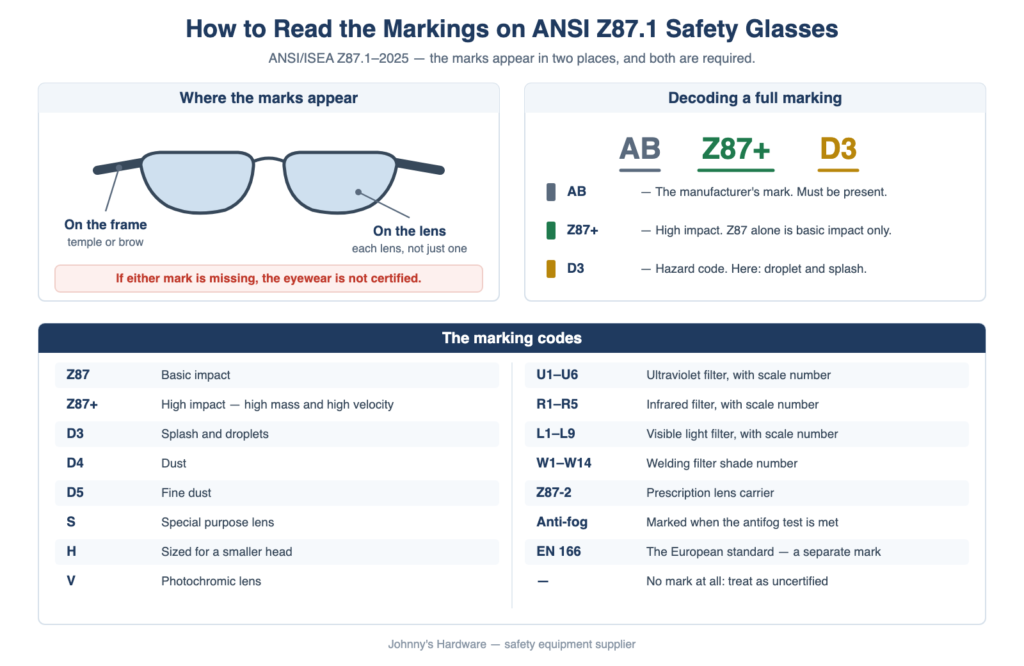
Z87.1 sets the impact, optical and hazard performance requirements for eye and face protectors sold in the United States, and it sets how those results must be permanently marked on the product. Two marks are mandatory: the manufacturer’s identifying mark and the Z87 designation, and both must appear on the frame and on the lens. A plus sign after Z87 means the protector passed the high impact tests rather than the basic one.
OSHA does not write its own eyewear specification. Under 29 CFR 1910.133 it requires eye protection that conforms to a consensus standard, and Z87.1 is the one it names. So “OSHA approved safety glasses” is not a real category — OSHA approves nothing. What an inspector looks for is the Z87 marking.
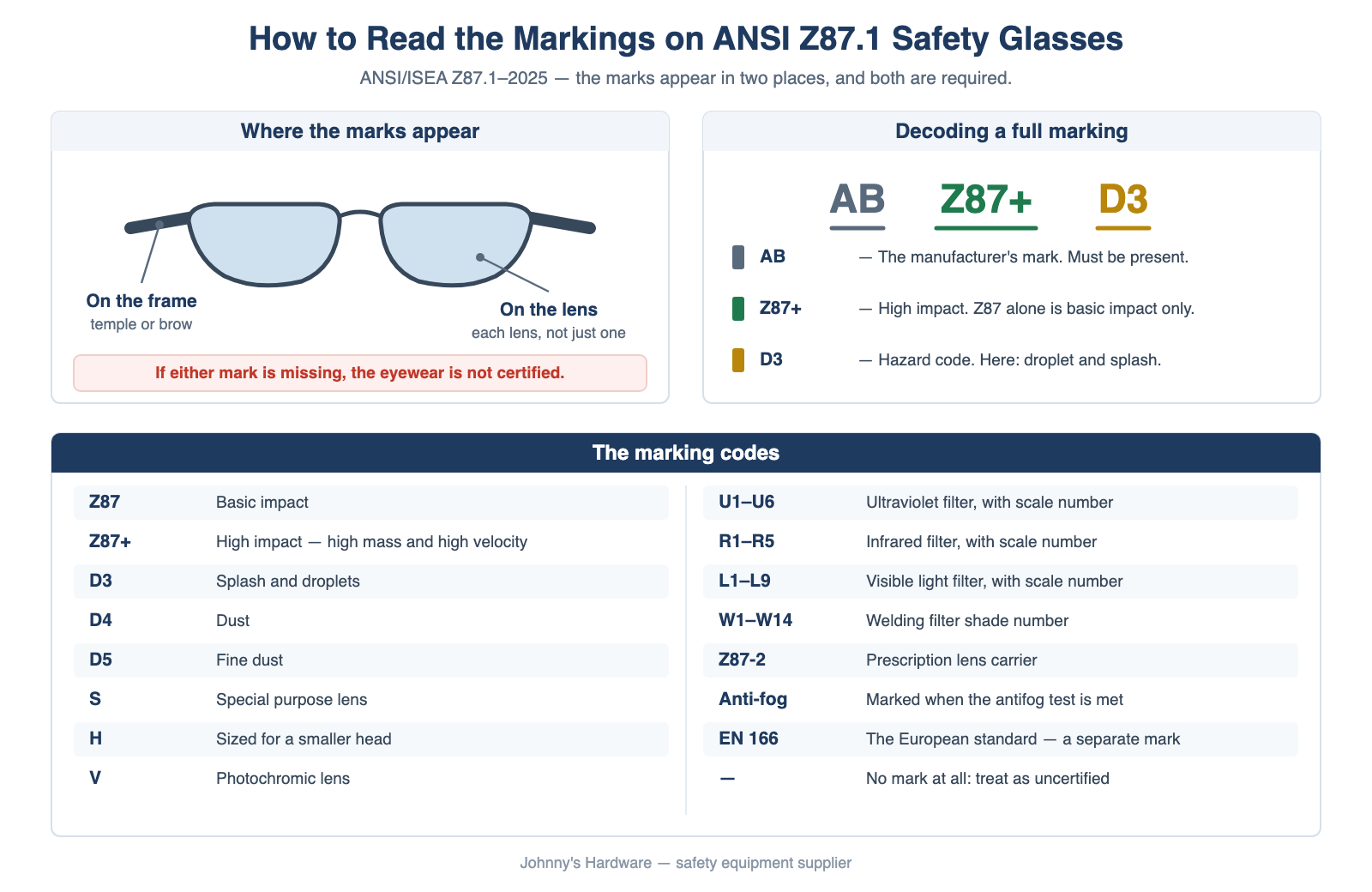
Z87 vs Z87+: the distinction that matters most
This is the single most consequential mark on the product, and the one buyers most often overlook.
| Mark | Rating | Test | Where it belongs |
|---|---|---|---|
| Z87 | Basic impact | A 25.4 mm steel ball dropped onto the lens from 127 cm | General handling, light assembly, visitor eyewear |
| Z87+ | High impact | High mass and high velocity — a 6.35 mm ball fired at the lens and frame | Grinding, cutting, chipping, powered fastening, machining |
The high velocity test is the meaningful one. Basic impact tells you the lens survives something dropped on it; high impact tells you it survives something thrown at it, which is what an angle grinder or a nail gun actually produces. If your programme covers powered tools, specify Z87+ and treat plain Z87 as a different product, not a cheaper version of the same one.
One point worth knowing before you quote: under Z87.1 the high impact test is applied to the complete protector, frame included, not to the lens alone. A high impact lens fitted into a frame that has not been tested as an assembly does not yield a Z87+ product.
The hazard codes
Beyond impact, Z87.1 marks what else the protector was tested against. These codes appear after the Z87 designation.
| Code | Meaning | Typical application |
|---|---|---|
| D3 | Splash and droplet | Chemical handling, cleaning, laboratory work. Needs a sealed goggle, not open glasses |
| D4 | Dust | Demolition, sweeping, bulk material handling |
| D5 | Fine dust | Cement, plaster, silica-bearing work |
| U1–U6 | Ultraviolet filter, by scale number | Outdoor work, UV curing |
| R1–R5 | Infrared filter, by scale number | Furnace and hot metal work |
| L1–L9 | Visible light filter, by scale number | Glare reduction |
| W1–W14 | Welding filter shade | Welding, brazing, cutting. Shade chosen by process and amperage |
| H | Designed for a smaller head | Worth stocking. Poor fit is the most common reason eyewear is not worn |
| V | Photochromic lens | Crews moving repeatedly between indoors and outdoors |
| S | Special purpose lens | Tints outside the standard scale numbers |
Note what is not in that list. Anti-scratch coating is not a Z87.1 marked property at all, and anti-fog is marked only when the protector has been tested against the standard’s antifog criteria. A supplier can legitimately offer both as features; neither is evidence of certification, and neither belongs in the same sentence as the Z87 mark on a datasheet.
Z87.1 and EN 166 are not interchangeable
If your programme ships to more than one market, this is where orders go wrong. EN 166 is the European standard, and it is a separate certification with its own tests, its own scale and its own marks. A protector marked Z87+ is not thereby compliant in the EU, and an EN 166 protector is not thereby compliant in the US.
| Property | ANSI/ISEA Z87.1 | EN 166 |
|---|---|---|
| Impact grades | Z87 basic, Z87+ high | S, F, B, A — four levels by projectile speed |
| Droplet / dust | D3, D4, D5 | 3, 4, 5 — similar concepts, different tests |
| Conformity route | Manufacturer’s declaration against the standard | EU type examination by a notified body, then CE marking |
| Marked on | Frame and lens | Frame and lens, plus the CE mark |
The conformity route is the practical difference. EN 166 requires a notified body to type-examine the product before it may be CE marked, which means a test certificate from a named body with a four-digit number. Z87.1 does not require third-party certification — which is exactly why the evidence you ask for matters more on the US side, not less.
What to actually require from a supplier
You cannot verify a standard by reading a specification sheet, because the sheet is written by the party making the claim. Five things settle it:
- A test report from an accredited laboratory, naming the model number you are buying — not a sister model, not a range.
- Photographs of the actual markings on both the frame and the lens of a production sample, legible enough to read.
- Confirmation the protector was tested as an assembly if you are buying Z87+, since the frame is part of that test.
- The revision year the report was issued against. A report against Z87.1–2015 is not evidence of conformity to the current edition.
- For EU-bound stock, the EU type examination certificate and the notified body number. Ask for the number and check it.
The phrase to watch for is “Z87.1 compliant” or “meets ANSI standards” with no marking, no model number and no report behind it. Treat that as a claim awaiting evidence. A supplier who has genuinely tested the product finds these five items easy to produce, and one who has not will offer reassurance instead of documents.
Specifying eye protection for a purchase order
A complete line on a PO names six things. Leave any of them out and you have delegated the decision to whoever picks the stock.
| State | Example | Why it matters |
|---|---|---|
| Standard and revision | ANSI/ISEA Z87.1–2025 | Older revisions are still circulating in test reports |
| Impact rating | Z87+ | The difference between basic and high impact is a different test regime |
| Hazard codes | D4 D5 | Dust ratings are not implied by impact ratings |
| Lens and coating | Clear polycarbonate, anti-fog, anti-scratch | Drives unit cost and whether the eyewear gets worn |
| Style and coverage | Wraparound with integral side protection | Side protection is required where flying objects are present |
| Destination market | US, or EU to EN 166 with CE marking | Determines which certification the shipment is judged against |
For a distributor building a general PPE programme, the defensible default is Z87+ clear polycarbonate, wraparound with integral side shields, anti-fog and anti-scratch coated, with D4 D5 where dust is a real exposure. That single specification covers most of what a mixed industrial and construction customer base actually needs, and adding tinted and photochromic versions of the same frame keeps one certification file behind several SKUs. Reserve goggles for the D3 splash work rather than trying to make glasses do it — open-sided glasses cannot achieve a D3 rating no matter what the lens is made of.
Final thoughts
Almost everything that goes wrong with an eye protection order traces back to one of three omissions: the plus sign, the revision year, or the destination standard. Get those onto the specification and the remaining choices are preference and price. Leave them off and stock can arrive exactly as ordered, and still fail the first inspection it meets.
FAQ
What does ANSI Z87.1 mean on safety glasses?
It means the protector has been tested against the American national standard for occupational eye and face protection and is marked accordingly. The standard covers impact, optical quality and specific hazards such as dust and splash, and it also dictates the marking itself. Both the manufacturer’s mark and the Z87 designation must be permanently marked on the frame and on the lens.
What is the difference between Z87 and Z87+?
Z87 alone indicates basic impact, verified by dropping a 25.4 mm steel ball onto the lens from 127 cm. Z87+ indicates high impact, verified by high mass and high velocity tests in which a 6.35 mm ball is fired at the protector. Any work involving grinding, cutting, chipping or powered fastening should specify Z87+. The two are different products, not two grades of the same one.
Are OSHA approved safety glasses a real thing?
No. OSHA does not approve, certify or list eyewear. Under 29 CFR 1910.133 it requires eye protection conforming to a recognised consensus standard and names ANSI Z87.1 as that standard. When a listing advertises “OSHA approved” it means, at best, Z87.1 marked. Look for the Z87 marking on the product rather than for a claim in the description.
Where are the ANSI markings located on safety glasses?
On the frame, usually on the inside of a temple arm or across the brow, and separately on each lens, typically etched or printed near the outer edge. Both locations must carry the manufacturer’s mark and the Z87 designation. Eyewear marked in only one place, or carrying a Z87 mark with no manufacturer’s mark alongside it, does not meet the standard’s marking requirements.
What do D3, D4 and D5 mean on safety eyewear?
They are hazard codes. D3 covers splash and droplets, D4 covers dust and D5 covers fine dust. They are independent of the impact rating, so a Z87+ protector is not automatically dust rated. D3 in practice requires a sealed goggle, since open-sided glasses cannot exclude a liquid splash regardless of lens material. The glasses and goggles comparison, by hazard, is in safety glasses vs goggles.
Does an ANSI Z87.1 marking satisfy EN 166?
No. EN 166 is a separate European standard with different tests, a different impact scale (S, F, B, A) and a different conformity route requiring EU type examination by a notified body before CE marking. A Z87+ protector cannot be sold into the EU as compliant on the strength of its ANSI marking. State the destination market when ordering so the correct certification is supplied.
Which revision of ANSI Z87.1 is current?
ANSI/ISEA Z87.1–2025, published in 2025, superseding the 2020 edition. It clarifies marking requirements, adds a cross-reference to Z87.62 for splash and spurt protection, and refines impact test and lens haze language. When reviewing a test report, check which revision it was issued against — reports against 2015 and 2020 editions are still in circulation.
Do anti-fog and anti-scratch coatings affect the ANSI rating?
Anti-scratch is not a marked property under Z87.1 at all. Anti-fog is marked only where the protector has been tested against the standard’s antifog criteria. Both are worth specifying because fogged or scratched eyewear gets pushed up onto a forehead, which is a real compliance failure. Neither is evidence of certification, and neither substitutes for the Z87 mark.
Can safety glasses be used without side protection?
Not where flying objects are a hazard. Side protection is required for that exposure, achieved either with a wraparound lens geometry or with detachable side shields. Wraparound designs are generally the better commercial choice, as they cannot be removed by the wearer and there is no separate component to lose or forget to fit.
Sourcing safety eyewear
Johnny’s Hardware supplies safety glasses and protective eyewear to ANSI Z87.1 and EN 166, in Z87 and Z87+ impact ratings, with clear, tinted, anti-fog, anti-scratch and UV-filter lens options and wraparound or side-shielded frame styles. Sealed goggles are supplied alongside for the splash and fine dust applications that open glasses cannot cover.
Lens tints, frame colours, logo printing and retail packaging are handled through our OEM hardware supplier service, and eye protection consolidates with the rest of the safety equipment range — including hard hats, gloves and respiratory products — and with the fastener supplier range in a single shipment.
Send the impact rating, hazard codes, lens and coating, frame style and destination market, and we will come back with specifications, test reports, carton data and lead times within 12 working hours.
– Johnny’s Hardware Team, QC Engineer