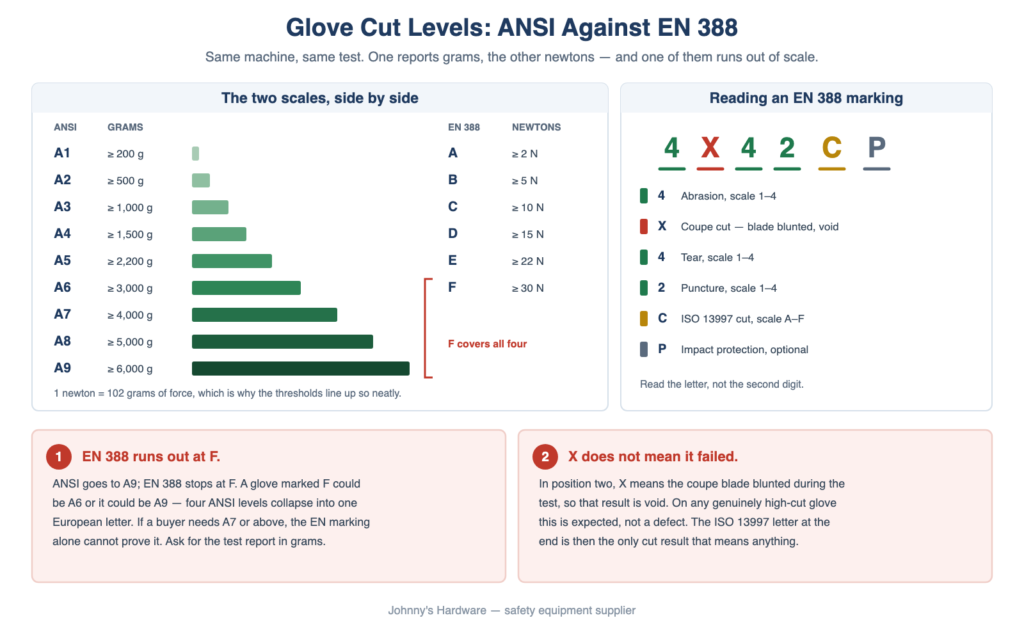
Cut level 3 gloves are rated A3 under ANSI/ISEA 105, meaning it takes at least 1,000 grams of force to cut through the material on a standard test. The same glove marked to the European standard would carry EN 388 level C, which is the same result reported in newtons rather than grams.
Both standards use the same machine and the same test. They differ in units, in how far the scale runs, and in what the marking looks like — and those differences are where sourcing errors happen, because one of the two scales runs out before the other does.
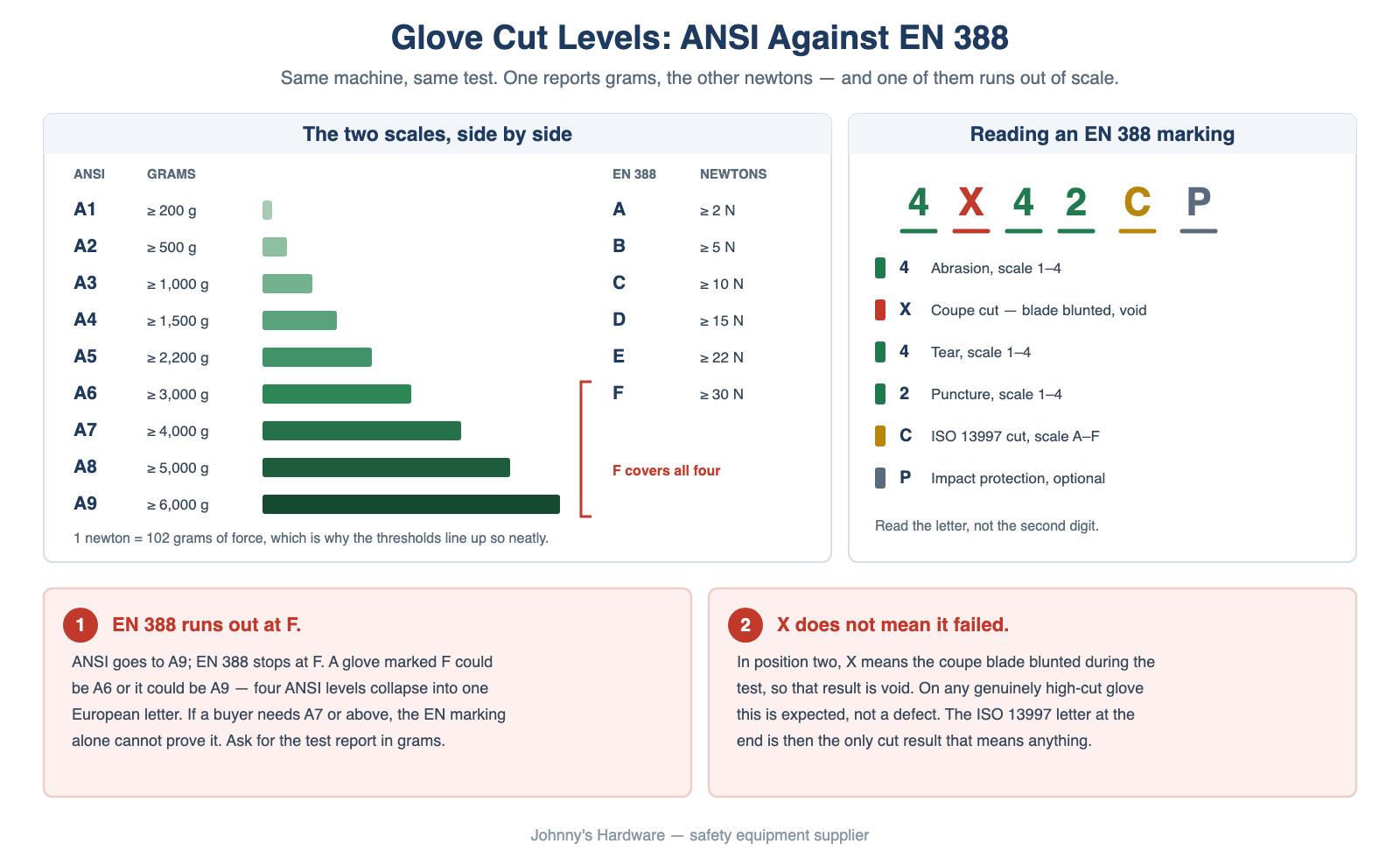
The two scales, side by side
| ANSI/ISEA 105 | Force to cut | EN 388 | Equivalent |
|---|---|---|---|
| A1 | ≥ 200 g | A | ≥ 2 N |
| A2 | ≥ 500 g | B | ≥ 5 N |
| A3 | ≥ 1,000 g | C | ≥ 10 N |
| A4 | ≥ 1,500 g | D | ≥ 15 N |
| A5 | ≥ 2,200 g | E | ≥ 22 N |
| A6 | ≥ 3,000 g | F covers all four | ≥ 30 N |
| A7 | ≥ 4,000 g | — | |
| A8 | ≥ 5,000 g | — | |
| A9 | ≥ 6,000 g | — |
This is the fact worth carrying into a negotiation: EN 388 has no letter above F. A glove marked F has passed 30 newtons, which is about 3,060 grams — ANSI A6. It might also be A7, A8 or A9, and the European marking cannot tell you which. If a customer specifies A7 or above, the CE marking alone is not evidence. Ask for the ISO 13997 test report with the figure in grams or newtons, not just the letter.
Which level for which job
| Level | Typical work |
|---|---|
| A1–A2 EN A–B | General handling, packing, light assembly, material handling with no sharp edges. Most general-purpose work gloves land here |
| A3 EN C | Warehouse work with box cutters, light glass handling, general construction, parts assembly with some stamped edges |
| A4 EN D | Metal fabrication, sheet metal, HVAC ductwork, glass handling. The general industrial default where cut risk is real but routine |
| A5 EN E | Heavy metal stamping, sharp sheet edges, glass manufacturing, demolition and salvage |
| A6–A9 EN F | Blade handling, meat and food processing, recycling sortation, pulp and paper. Specialist rather than general supply |
These are typical placements, not code requirements. A workplace risk assessment governs, and a customer with a documented incident history may specify a level above what the task appears to need.
Higher is not automatically better. Cut resistance is bought with thicker, stiffer material, and dexterity falls as the level rises. A worker in A6 gloves doing fine assembly will take them off, and a glove in a pocket protects nobody. The right level is the lowest one that covers the actual hazard — the same logic that governs eye protection in ANSI Z87.1 safety glasses.
Reading an EN 388 marking
An EN 388 glove carries four digits and up to two letters, in a fixed order. A typical marking reads 4X42C:
| Position | Property | Scale |
|---|---|---|
| 1 | Abrasion resistance | 1–4 |
| 2 | Coupe cut resistance | 1–5, or X |
| 3 | Tear resistance | 1–4 |
| 4 | Puncture resistance | 1–4 |
| 5 | ISO 13997 cut resistance | A–F |
| 6 | Impact protection | P, or absent |
The X in position two is the one that causes arguments, because it looks like a failure and is not. The coupe test drags a circular blade across the fabric, and on a genuinely cut-resistant material the blade blunts before it cuts through. When that happens the coupe result is void and marked X, and the ISO 13997 letter at the end becomes the only meaningful cut figure. A glove marked 4X42C is not a glove that failed the cut test — it is a glove good enough to wreck the old one.
This is also why the letter matters more than the digit on any modern glove. If a supplier quotes only a coupe number for a high-cut product, they are quoting the weaker and less reliable of the two tests.
What a cut level does not tell you
- Puncture is a separate test. EN 388 position four covers puncture with a fixed probe, and ANSI has its own puncture scale. A high cut level says nothing about it — A5 material can be pushed through by a spike.
- Needlestick is different again. The standard puncture probe is far blunter than a hypodermic needle. Gloves for waste handling and recycling need a specific needlestick rating; a cut level will not substitute.
- Heat, chemical and impact are all separate. Cut-resistant liners are frequently coated for grip, and the coating decides chemical and heat performance, not the liner. Impact protection appears only if a P is marked.
- Cut level says nothing about fit or grip, which are what actually determine whether a glove gets worn all shift.
What to put on the order
| Field | Example | Why |
|---|---|---|
| Standard and level | ANSI/ISEA 105 A4, or EN 388 4X42D | Name the standard, not just the number. “Level 4” means different things in each |
| Destination market | US, or EU with CE marking | EN 388 requires EU type examination by a notified body; ANSI does not require third-party testing |
| Liner and coating | HPPE liner, nitrile foam palm coating | The liner gives cut resistance; the coating gives grip, and decides oil and chemical behaviour |
| Gauge | 13 or 18 gauge knit | Higher knit gauge is thinner and more dexterous at the same cut level |
| Test report | ISO 13997 result in grams, naming the model | The only way to distinguish A6 from A9 on an EN-marked glove |
| Size split | S / M / L / XL / XXL ratio | Poor fit is the commonest reason gloves are not worn |
For a distributor building a general hand protection range, the defensible core is A2 for general handling and A4 for cut work, both on an HPPE liner with a nitrile foam palm coating, in 13 gauge. That covers the great majority of industrial and construction demand on two SKUs per size, and leaves A5 and above as deliberate additions for customers who can name the hazard.
Final thoughts
Cut levels are one of the more honest ratings in personal protective equipment: a single measured number, from a repeatable test, on a scale that means the same thing everywhere it is used. The traps are structural rather than technical — two scales in different units, one of which stops four levels early, and a void marking that reads like a failure. Name the standard alongside the level, ask for the report in grams when the level is high, and the rest is a fit and coating decision.
FAQ
What does cut level 3 mean on gloves?
Under ANSI/ISEA 105 it means A3: at least 1,000 grams of force is needed to cut through the material on the standard TDM test. The European equivalent is EN 388 level C, at 10 newtons, which is the same result in different units. A3 suits warehouse work with box cutters, light glass handling and general construction.
What is the difference between ANSI and EN 388 cut levels?
Units and range. ANSI/ISEA 105 reports in grams on a scale of A1 to A9; EN 388 reports the same test in newtons on a scale of A to F. One newton is about 102 grams, so the thresholds align — A1 with A, A3 with C, A4 with D. The important difference is that EN 388 stops at F, which corresponds to ANSI A6, so it cannot distinguish A6 from A9.
What is the highest cut level for gloves?
A9 under ANSI/ISEA 105, requiring at least 6,000 grams of cutting force. Under EN 388 the highest mark is F, at 30 newtons or roughly 3,060 grams, which is only equivalent to ANSI A6. A glove sold as the highest European rating may therefore be four ANSI levels below the highest American one, which is why the test report matters above A6.
What does X mean in an EN 388 rating?
That the test was not performed or the result is void. In position two it almost always means the coupe blade blunted before cutting through, which happens on genuinely cut-resistant materials and invalidates that test. It is not a failure. When you see an X there, read the ISO 13997 letter at the end of the marking, which is the reliable cut result.
Is a higher cut level always better?
No. Cut resistance comes from thicker and stiffer material, so dexterity, breathability and comfort all fall as the level rises. A glove that is too bulky for the task gets removed, which leaves the hand entirely unprotected. Specify the lowest level that genuinely covers the hazard, and prioritise fit and grip within that level.
Do cut resistant gloves protect against needles?
Not reliably. Cut resistance and puncture resistance are separate tests, and the standard puncture probe is much blunter than a hypodermic needle. Waste handling, recycling sortation and any work with sharps needs a glove specifically rated for needlestick resistance. A high cut level provides no assurance against it.
What is an A4 cut resistant glove used for?
Metal fabrication, sheet metal work, HVAC ductwork and glass handling — work where sharp edges are routine rather than exceptional. A4 requires at least 1,500 grams of cutting force and maps to EN 388 level D. It is the most common industrial specification, sitting above general handling gloves and below the specialist blade-handling grades.
What is the glove liner made of?
Most cut-resistant liners use HPPE, a high-performance polyethylene, often blended with glass or steel fibre to raise the level. Para-aramid such as Kevlar is the other common choice and brings heat resistance with it. The liner determines the cut level; the palm coating — usually nitrile, polyurethane or latex — determines grip and chemical behaviour.
Does a CE mark prove the cut level?
It proves the glove passed EU type examination by a notified body against the marked levels, so the letter is verified. What it cannot do is distinguish between ANSI A6 and A9, because both are marked F. For any specification above A6, ask for the ISO 13997 test report naming the model and giving the figure, rather than relying on the marking alone.
What knit gauge should I specify?
Thirteen gauge is the general-purpose choice and balances cut level against cost. Eighteen gauge is a finer knit that gives noticeably better dexterity at the same cut level, which suits assembly and inspection work, and costs more. Ten gauge is heavier and used where abrasion matters more than fine handling.
Sourcing cut resistant gloves
Johnny’s Hardware supplies cut resistant work gloves in ANSI/ISEA 105 levels A2 to A6 and EN 388 levels B to F, on HPPE and para-aramid liners in 10, 13 and 18 gauge, with nitrile foam, sandy nitrile, polyurethane and latex palm coatings, in sizes S to XXL.
ISO 13997 test reports are provided in grams as well as the marked letter, so an A6-and-above specification can be evidenced rather than assumed, and EU-bound orders are quoted with the notified body certificate. Gloves consolidate with the rest of the safety equipment range — including safety glasses and bump caps — and with the fastener supplier range in one shipment, with private label and retail packaging through our OEM hardware supplier service.
Send the cut level and standard, liner, coating, gauge, size split and destination market, and we will come back with specifications, test reports, carton data and lead times within 12 working hours.
– Johnny’s Hardware Team, QC Engineer