There is no published shear strength for a bolt. Tensile strength is written into the standard for every grade, but the shear figure that people quote is calculated, from the tensile strength and the area that carries the load. Any table of “bolt shear strength” is therefore only as good as the method behind it.
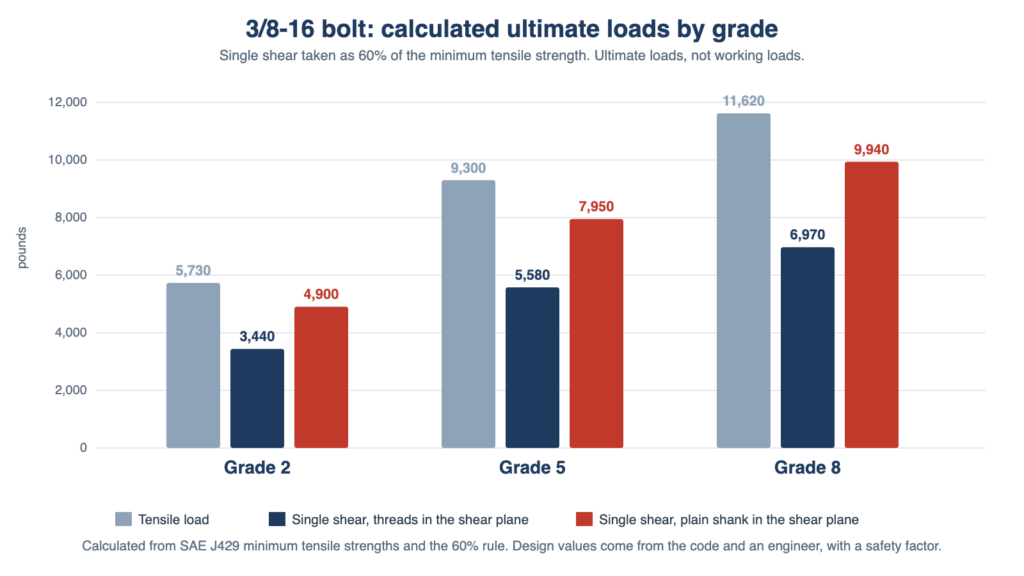
A 3/8-16 Grade 5 bolt has a calculated ultimate single-shear strength of about 5,580 lb with its threads in the shear plane, about 6,970 lb for Grade 8 and about 3,440 lb for Grade 2. These are ultimate failure loads, not safe working loads.
3/8 bolt shear strength by grade
The table gives the calculated single-shear strength of a 3/8-16 UNC bolt for the three common SAE grades, with the shear plane through the threads and through the plain shank. The thread figure is the lower one, and it is the safer one to use when the position of the thread is not controlled.
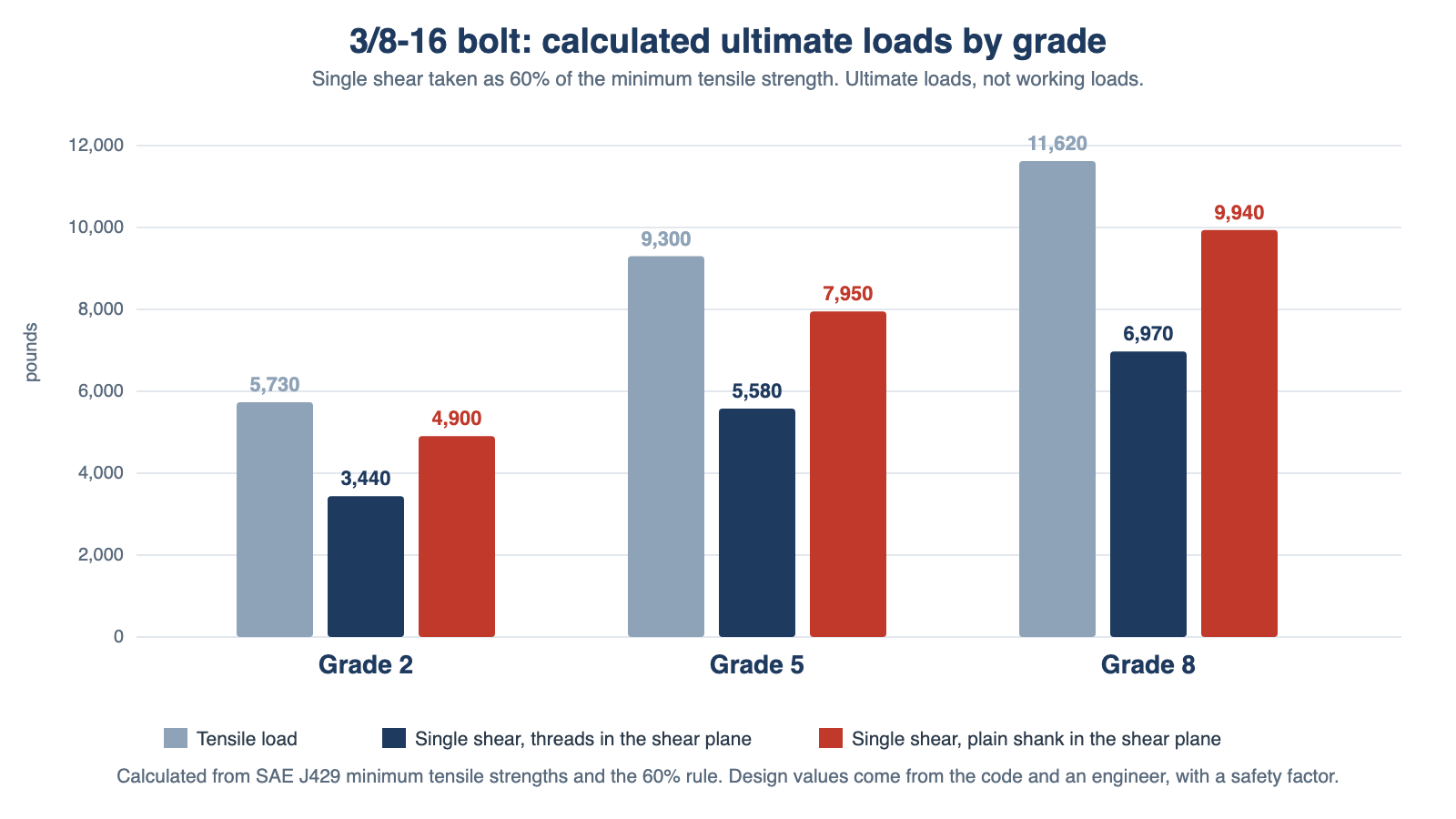
| SAE grade | Minimum tensile strength | Tensile load | Single shear, threads in plane | Double shear, threads in plane | Single shear, shank in plane |
|---|---|---|---|---|---|
| Grade 2 | 74,000 psi | 5,730 lb | 3,440 lb | 6,880 lb | 4,900 lb |
| Grade 5 | 120,000 psi | 9,300 lb | 5,580 lb | 11,160 lb | 7,950 lb |
| Grade 8 | 150,000 psi | 11,620 lb | 6,970 lb | 13,950 lb | 9,940 lb |
Every figure is calculated, not tested, and the next section shows how to reproduce it. The thread-plane values use the tensile stress area of 0.0775 in² for a 3/8-16 thread. Using the smaller minor-diameter area of 0.0742 in² lowers the Grade 5 figure to about 5,340 lb. The plain shank has a nominal area of 0.1104 in².
How bolt shear strength is calculated
Shear strength is taken as about 60% of the minimum tensile strength, multiplied by the area in the shear plane. The 60% rule is an empirical estimate and not a code requirement.
The source of the rule is the Industrial Fastener Institute’s Inch Fastener Standards, as quoted by Portland Bolt, which states that there are no published ASTM shear values and that the shear strength of carbon steel fasteners can be assumed to be approximately 60 percent of their specified minimum tensile strength. The same source works through a Grade 5 cap screw at 120,000 psi and rounds its shear strength down to 70,000 psi, slightly below the strict 60 percent figure of 72,000 psi.
- Find the minimum tensile strength for the grade and size from SAE J429. Grade 2 is 74,000 psi up to 3/4 in. and 60,000 psi above that, Grade 5 is 120,000 psi and Grade 8 is 150,000 psi.
- Multiply by 0.6 to get the shear strength in psi.
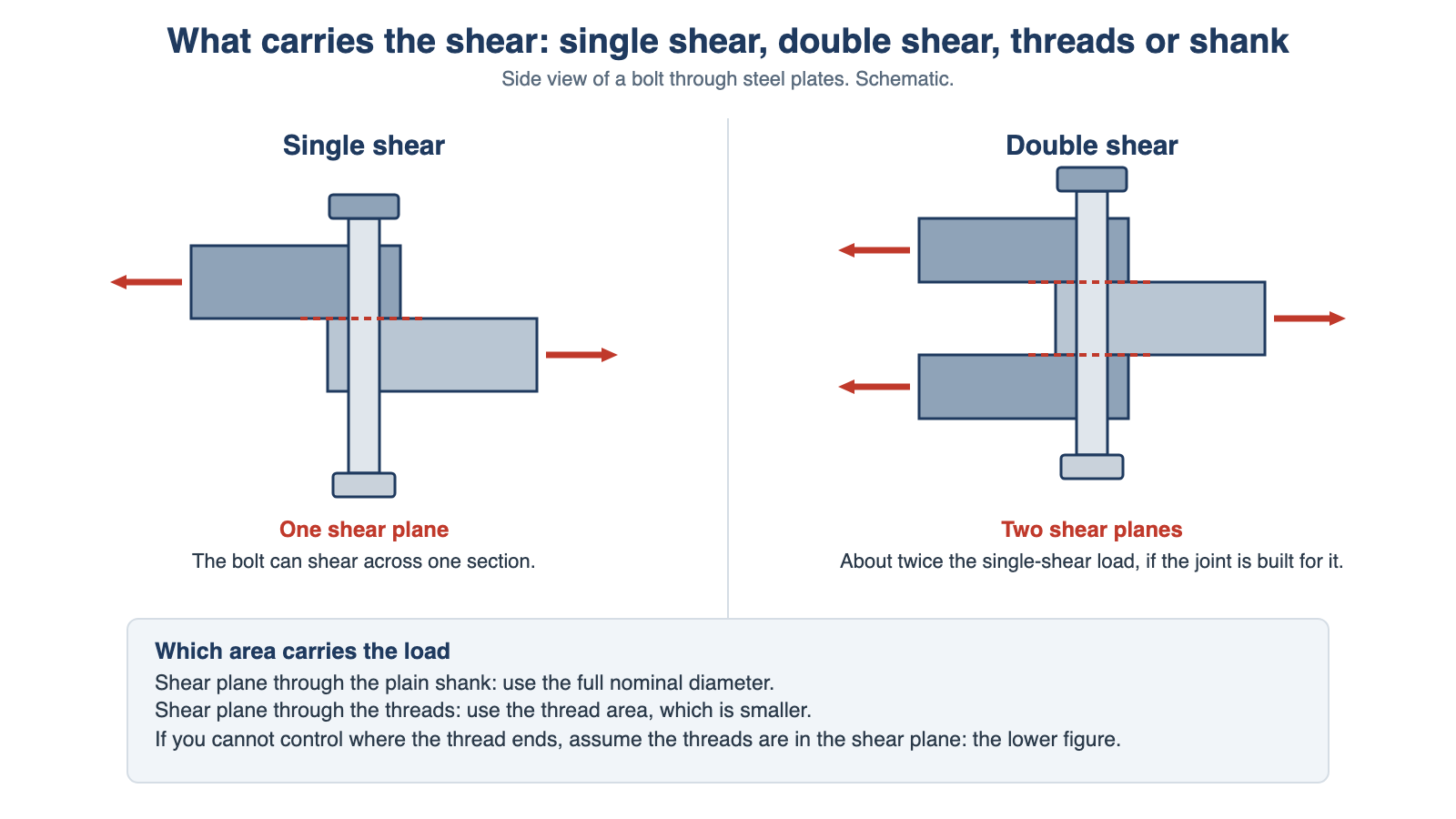
- Multiply by the area in the shear plane. Use the full nominal diameter if the plane is through the plain shank, and the thread area if it is through the threads.
- Multiply by the number of shear planes. A bolt in double shear has two.
For a Grade 5 3/8-16 bolt with threads in the plane: 0.6 × 120,000 psi × 0.0775 in² = 5,580 lb. This gives the same figure as the table. A bolt in double shear carries about twice that, if the joint is made for it.
Bolt shear strength chart, 1/4 to 1 inch
The chart repeats the calculation for every common size, with the shear plane through the threads. It is the lowest ultimate single-shear figure for each size and grade.
| Bolt size | Stress area, in² | Grade 2, lb | Grade 5, lb | Grade 8, lb |
|---|---|---|---|---|
| 1/4 | 0.0318 | 1,410 | 2,290 | 2,860 |
| 5/16 | 0.0524 | 2,330 | 3,770 | 4,720 |
| 3/8 | 0.0775 | 3,440 | 5,580 | 6,970 |
| 7/16 | 0.1063 | 4,720 | 7,650 | 9,570 |
| 1/2 | 0.1419 | 6,300 | 10,220 | 12,770 |
| 5/8 | 0.2260 | 10,030 | 16,270 | 20,340 |
| 3/4 | 0.3345 | 14,850 | 24,080 | 30,100 |
| 7/8 | 0.4617 | 16,620 | 33,240 | 41,560 |
| 1 | 0.6057 | 21,810 | 43,610 | 54,520 |
Calculated ultimate single-shear loads in pounds, with the threads in the shear plane. Grade 2 uses 74,000 psi up to 3/4 in. and 60,000 psi for 7/8 in. and 1 in. Stress areas are from the unified thread formula for coarse threads.
Why these are not safe working loads
These numbers are the loads at which a bolt is calculated to fail. They are not loads a bolt can carry in service, and nothing in this article is a design value.
- Ultimate is not working. A design applies a safety factor, set by the code and the consequence of failure, to a value like these.
- The code has its own values. Steel structures use the design strengths in the AISC specification, and timber connections use the National Design Specification for Wood Construction. Both set their own values and safety factors.
- Shear is rarely the only load. Bolts in tension and shear together carry less than either alone.
- The joint often fails first. Bearing on the plate hole, tear-out at an edge, or crushing of timber can set the limit well below the steel’s shear strength.
- The grade must be real. A figure for Grade 5 applies only to a bolt that is Grade 5, which the head marking and the certificate prove.
For anything that carries a person, a structure or a machine, the numbers come from an engineer and the applicable code.
Tensile, proof and shear strength
A bolt’s tensile strength is the load at which it breaks when pulled, proof load is the load it must carry without permanent stretch, and shear strength is the calculated load at which it cuts across. Shear is lower than tensile for the same bolt.
| 3/8-16 bolt | Proof load | Tensile load | Single shear, threads |
|---|---|---|---|
| Grade 5 | 85,000 psi: about 6,590 lb | 9,300 lb | 5,580 lb |
| Grade 8 | 120,000 psi: about 9,300 lb | 11,620 lb | 6,970 lb |
The tightening torque used for a bolt is set from the proof load, not from the shear strength, and is covered in the bolt torque chart.
Shear strength of screws and anchors
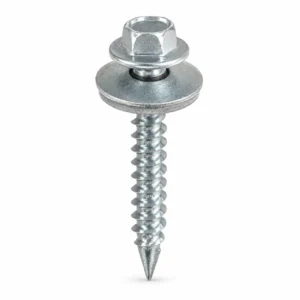
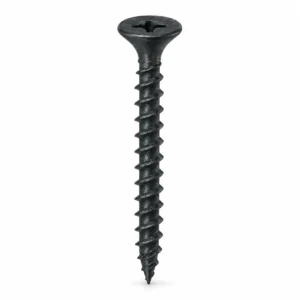
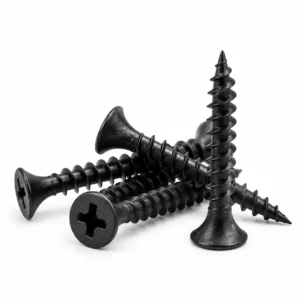
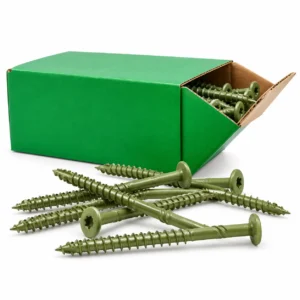
Screws do not have a general shear strength either, and in wood the screw is usually not what limits the joint. A wood screw loaded sideways bends and crushes the wood around it, so the allowable load comes from the timber design rules, not from the steel.
For deck screws and other wood screws, the lateral design values depend on the diameter, the species of wood and the thickness of the pieces, and the maker’s evaluation report states them for that product. Brands differ, and a figure for one deck screw does not apply to another. For concrete anchors, the shear capacity is in the evaluation report for the product, and the way those reports differ is explained in types of concrete anchors. The difference between a bolt and a screw is set out in bolt vs screw.
What to specify and ask for
For a buyer or distributor, the shear strength of a bolt is only meaningful for a bolt that is what it claims to be. The order has to carry the grade, and the supplier has to be able to prove it.
- Specify the grade on the order line, with size, length, thread and finish. The sizes and wrench dimensions are in the bolt and nut size chart.
- Check the head marking. A Grade 5 bolt carries three radial lines on the head and a Grade 8 bolt six, with the manufacturer’s mark.
- Ask for the certificate or mill test report for structural or safety-critical use.
- Match the nut grade to the bolt. The four properties that must match are covered in nut vs bolt.
- Do not quote a shear figure to a customer as a safe load. Refer them to the code and an engineer.
Final thoughts
The shear strength of a 3/8 bolt is a calculated number, about 60% of the tensile strength times the area, and it depends on the grade, on whether the threads are in the shear plane and on how many planes there are. For Grade 5 it is about 5,580 lb at its lowest and 7,950 lb with the plain shank in the plane, as an ultimate load. It is not a working load, and design belongs to an engineer.
Frequently asked questions
What is the shear strength of a 3/8 bolt?
It depends on the grade. A 3/8-16 bolt has a calculated ultimate single-shear strength of about 3,440 lb in Grade 2, 5,580 lb in Grade 5 and 6,970 lb in Grade 8, with the threads in the shear plane. These are failure loads, not safe working loads, and design values come from the applicable code.
What is the shear strength of a Grade 5 3/8 bolt?
About 5,580 lb in single shear with the threads in the shear plane, and about 7,950 lb with the plain shank in the plane. That is 0.6 times the 120,000 psi minimum tensile strength times the area. A bolt in double shear carries about twice that, if the joint is made for it. It is an ultimate load.
What is the shear strength of a Grade 8 3/8 bolt?
About 6,970 lb in single shear with the threads in the shear plane, and about 9,940 lb with the plain shank in the plane, based on the 150,000 psi minimum tensile strength. These are calculated ultimate loads. A design would apply a safety factor and the code’s own method, so do not use them as a rating.
How do you calculate the shear strength of a bolt?
Multiply the minimum tensile strength by 0.6, then by the area in the shear plane, and then by the number of shear planes. Use the full nominal area if the plane is through the plain shank and the thread area if it is through the threads. The 60% rule is an empirical estimate, because there are no published standard shear values.
Is shear strength the same as tensile strength?
No. Tensile strength is the load at which a bolt breaks when pulled, and the standard publishes it for every grade. Shear strength is the load at which it cuts across, which is lower and is normally taken as about 60% of the tensile strength. A bolt can be strong in tension and weaker in shear.
What is double shear?
Double shear is a joint in which the bolt passes through three plates, so it can fail across two sections instead of one. It carries about twice the single-shear load, because two areas resist the force. The joint has to be built that way, with the middle plate loaded from one side and the outer plates from the other.
What is the shear strength of a 5/16 bolt?
A 5/16-18 bolt has a calculated ultimate single-shear strength of about 2,330 lb in Grade 2, 3,770 lb in Grade 5 and 4,720 lb in Grade 8, with the threads in the shear plane. These are failure loads. The same method and the same limits apply as for a 3/8 bolt.
What is the shear strength of a 5/8 bolt?
A 5/8-11 bolt has a calculated ultimate single-shear strength of about 10,030 lb in Grade 2, 16,270 lb in Grade 5 and 20,340 lb in Grade 8, with the threads in the shear plane. They are failure loads and not design values, and joint failure modes often set a lower limit.
What is the shear strength of a screw?
There is no general value. The steel shear strength of a small screw is low, but in wood the screw usually bends and crushes the timber before it shears. The allowable load comes from the wood design rules and the maker’s evaluation report for that screw. A deck screw figure from one brand does not apply to another.
Can I use these numbers for design?
No. They are calculated ultimate loads to show how grade, size and shear plane compare. Structural and safety-critical connections must be designed to the applicable code by an engineer, using the code’s design strengths and safety factors. Do not use this article as a load rating for a bolt, or quote it as one.
Sourcing bolts by grade
Johnny’s Hardware supplies hex bolts and nuts in SAE grades 2, 5 and 8, and in metric property classes, with matching nuts and washers, in one consolidated order with the rest of the nuts and bolts range and our fastener supplier lines. We supply mill certificates where the order requires them, and we do not give a shear figure as a safe load.
Send the size, length, grade or class, thread, finish and quantity, and tell us whether you need a certificate, and we will come back with specifications and carton data within 12 working hours.
– Johnny’s Hardware Team, QC Engineer