For 1/2 inch drywall on wood studs, use a 1-1/4 inch coarse-thread drywall screw. For 5/8 inch drywall on wood, use 1-5/8 inch. On light steel studs the screws are shorter and fine-threaded: 1 inch for 1/2 inch board and 1-1/4 inch for 5/8 inch.
Those numbers are not rules of thumb. They come from one requirement in the building code, and once you know it you can work out the right length for any board thickness, any number of layers and either kind of stud — which is exactly where most drywall screw charts stop being useful.
The rule behind every drywall screw length
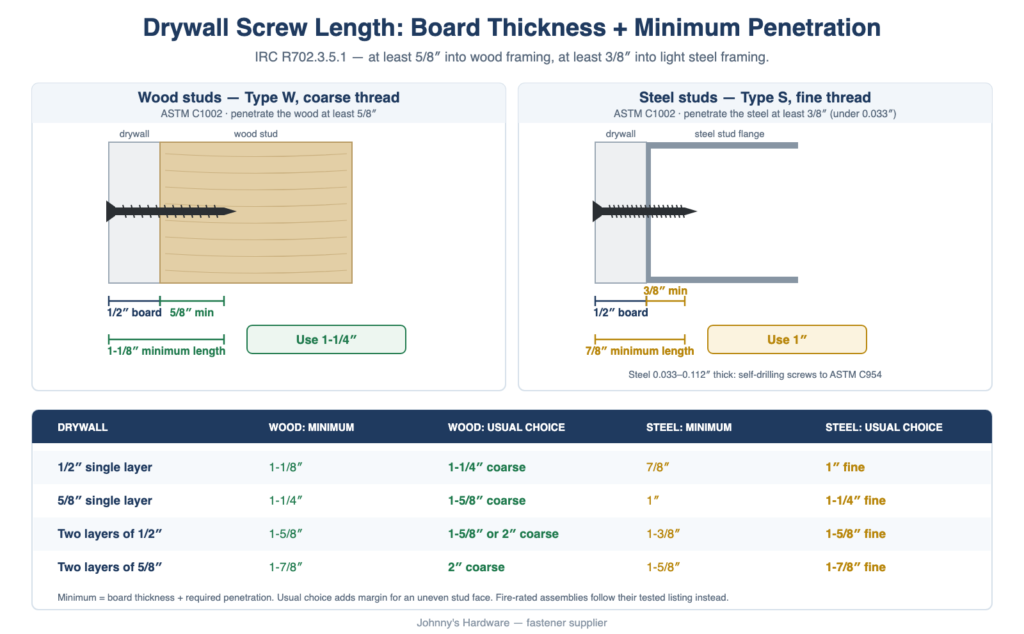
The International Residential Code, section R702.3.5.1, sets a minimum penetration into the framing, not a screw length:
- Wood framing: Type W or Type S screws to ASTM C1002, penetrating the wood at least 5/8 inch.
- Steel framing thinner than 0.033 inch: Type S screws to ASTM C1002, or bugle head screws to ASTM C1513, penetrating the steel at least 3/8 inch.
- Steel framing from 0.033 to 0.112 inch: screws to ASTM C954, or bugle head screws to ASTM C1513.
So the minimum screw length is simply the thickness of everything the screw passes through, plus the required penetration. For 1/2 inch drywall on wood, that is 1/2 + 5/8 = 1-1/8 inches, and the next common length up is 1-1/4 inches.
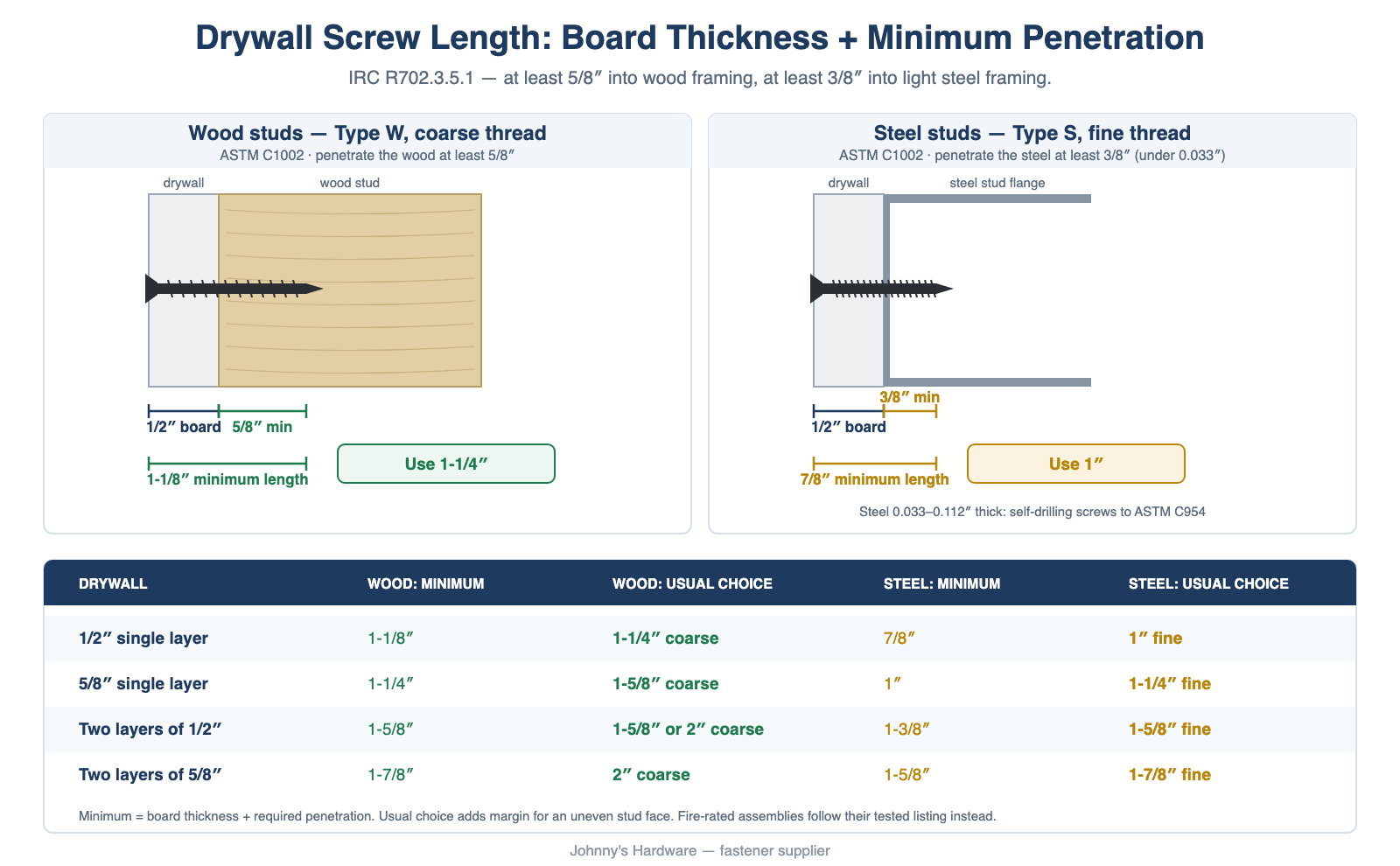
Drywall screw length chart
| Drywall | Wood: minimum | Wood: usual choice | Light steel: minimum | Light steel: usual choice |
|---|---|---|---|---|
| 3/8″ | 1″ | 1-1/4″ coarse | 3/4″ | 1″ fine |
| 1/2″ | 1-1/8″ | 1-1/4″ coarse | 7/8″ | 1″ fine |
| 5/8″ | 1-1/4″ | 1-5/8″ coarse | 1″ | 1-1/4″ fine |
| Two layers of 1/2″ | 1-5/8″ | 1-5/8″ or 2″ coarse | 1-3/8″ | 1-5/8″ fine |
| Two layers of 5/8″ | 1-7/8″ | 2″ coarse | 1-5/8″ | 1-7/8″ fine |
The minimum column is pure arithmetic from the code. The usual-choice column adds a little margin, because stud faces are rarely perfectly flat and a screw set slightly deep still has to reach its penetration. Two cautions apply. Fire-rated walls and ceilings follow their tested assembly listing, which may call for a specific screw length, type and spacing; the listing overrides a general chart. And where the code in force locally differs from the IRC, the local requirement applies. How far apart the screws go is set out in drywall screw spacing.
Going longer than the usual choice gains nothing once penetration is met. A longer screw costs more, drives more slowly, and puts more steel into the stud cavity, which is where cables and pipes run.
Wood studs or steel studs: Type W or Type S
| Framing | Screw | Thread | Why |
|---|---|---|---|
| Wood studs and joists | Type W, ASTM C1002 | Coarse | Deep, widely spaced threads bite into soft timber and hold hardest in it |
| Light steel studs, under 0.033″ | Type S, ASTM C1002 | Fine | Thin steel is narrower than the gap between two coarse threads; closely spaced threads grip it |
| Heavier steel, 0.033–0.112″ | ASTM C954 | Fine, drill point | A self-piercing point stalls on heavier steel; a drill point cuts its own hole |
The code allows Type S screws into wood, but not coarse Type W screws into steel. A coarse thread spins in a thin steel flange and never pulls the board tight, which is the most common reason a drywall screw “won’t bite” on a steel-framed job. The practical rule on site is simple: coarse for wood, fine for steel. Drywall screws are self-piercing tapping screws, the same family covered in what is a self tapping screw.
#6 or #8 drywall screws
A #6 screw has a nominal diameter of 0.138 inch and a #8 of 0.164 inch. The standard drywall screw is #6, and the common 1-1/4 inch bugle head screw is almost always a #6. Heavier gauges appear on the longer lengths used for multiple layers, where the extra stiffness helps the screw drive straight.
On ordinary single-layer work a #8 adds cost and driving effort without holding the board any better. The board fails around the head long before a #6 shank does, so the head and the setting depth matter more than the gauge. How screw gauges are numbered is covered in the screw size chart.
Head and finish
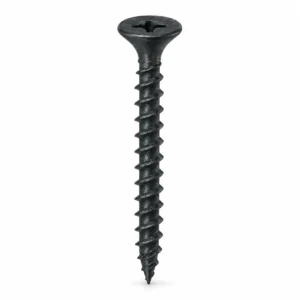
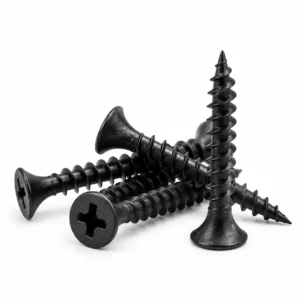
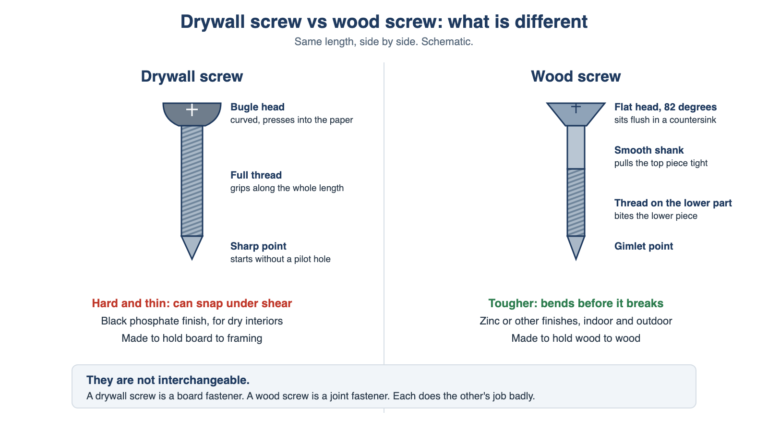
Every drywall screw has a bugle head: a smoothly curved underside rather than the sharp 82-degree cone of a flat head wood screw. The curve lets the head press into the face paper and seat just below the surface without tearing through it. A screw driven through the face paper leaves the board held only by its gypsum core, which crumbles under load, so the fastener stops holding the board tight.
Standard drywall screws are finished in black phosphate, which is an interior finish. It resists light rust during storage and gives joint compound a surface to key to, but it is not corrosion protection. In damp rooms, unheated spaces and exterior soffits, specify a zinc-plated or otherwise coated screw; coating life by environment is covered in do zinc screws rust. Heads and drives across screw types are compared in screw head types.
What a drywall screw range should include
Because the length follows from board thickness and stud type, a small range covers almost all demand. For a distributor or a hardware retail programme, the core is:
| Line | Covers | Priority |
|---|---|---|
| #6 × 1-1/4″ coarse | 1/2″ board on wood — the bulk of residential work | Highest turnover |
| #6 × 1-5/8″ coarse | 5/8″ board on wood, ceilings, two layers of 1/2″ | Core |
| #6 × 1″ fine | 1/2″ board on light steel | Core for commercial fit-out |
| #6 × 1-1/4″ fine | 5/8″ board on light steel | Core for commercial fit-out |
| 2″ coarse | Two layers of 5/8″ on wood | Secondary |
A residential-leaning programme weights the coarse lines; a commercial fit-out customer weights the fine lines, because commercial interiors are mostly framed in steel. Collated screws for autofeed screw guns are a separate format of the same sizes and belong on the order as their own lines.
Final thoughts
Drywall screw length is arithmetic, not memory: add up what the screw passes through, add 5/8 inch for wood or 3/8 inch for light steel, and round up to a stock length. That gives 1-1/4 inch for 1/2 inch board on wood and 1-5/8 inch for 5/8 inch, with the fine-thread lengths a step shorter on steel. Match the thread to the stud, keep to #6 for ordinary work, and let a fire-rated listing override the chart where one applies. How drywall screws differ from wood screws is covered in drywall screws vs wood screws.
FAQ
What length screw for 1/2 drywall?
Use a 1-1/4 inch coarse-thread screw for 1/2 inch drywall on wood studs. The code requires at least 5/8 inch of penetration into the wood, so the minimum is 1/2 + 5/8 = 1-1/8 inches, and 1-1/4 inches is the next common length. On light steel studs, use a 1 inch fine-thread screw, which gives the required 3/8 inch penetration into the steel.
What size screws for 5/8 drywall?
Use a 1-5/8 inch coarse-thread screw on wood studs. The arithmetic minimum is 5/8 + 5/8 = 1-1/4 inches, and 1-5/8 inches adds margin for an uneven stud face. On light steel studs, a 1-1/4 inch fine-thread screw is the usual choice, against a minimum of 1 inch.
Can drywall screws be too long?
They can be longer than they need to be. Once the screw reaches its required penetration, extra length adds no holding power, costs more, drives more slowly and pushes more steel into the stud cavity, where cables and pipes run. There is no benefit in using a 2 inch screw for single-layer 1/2 inch board.
Should I use coarse or fine drywall screws?
Coarse thread for wood studs and fine thread for steel studs. Coarse threads bite deeply into timber; fine threads are spaced closely enough to grip thin steel, where a coarse thread would spin without pulling the board tight. The code permits fine-thread Type S screws in wood but does not permit coarse Type W screws in steel.
Are drywall screws #6 or #8?
Standard drywall screws are #6, with a nominal diameter of 0.138 inch. Heavier gauges such as #8, at 0.164 inch, are generally found on longer screws for multiple layers. For ordinary single-layer drywall, a #8 adds cost and effort without holding the board better, because the board fails around the head before a #6 shank would.
What is the difference between Type W and Type S drywall screws?
Both are defined in ASTM C1002. Type W has a coarse thread for wood framing. Type S has a fine thread and a sharper point for light steel framing, and it is also permitted in wood. For steel framing between 0.033 and 0.112 inch thick, the code moves to drill-point screws to ASTM C954, because a self-piercing point cannot get through heavier steel.
What screws do I need for two layers of drywall?
Add both board thicknesses to the required penetration. Two layers of 1/2 inch on wood need at least 1 + 5/8 = 1-5/8 inches, and two layers of 5/8 inch need 1-7/8 inches, so 2 inch screws are the usual choice. On light steel, two layers of 5/8 inch need at least 1-5/8 inches. Fire-rated multi-layer assemblies follow their listing.
Why are drywall screws black?
The black colour is a phosphate conversion coating. It gives light protection against rust in storage and a surface that joint compound adheres to. It is an interior finish, not real corrosion protection, so screws for damp rooms, unheated spaces or exterior soffits should be zinc plated or otherwise coated.
Can I use drywall screws for wood projects?
They drive easily into wood, but they are hardened and relatively brittle, with a head designed to seat in paper rather than clamp timber. For framing, shelving, decking or anything that carries load, use a wood screw or a structural screw rated for the job. Drywall screws are made to hold board flat against framing, not to carry weight.
Sourcing drywall screws
Johnny’s Hardware supplies drywall screws from 3.5 to 4.8 mm, roughly #6 to #10, with bugle heads and Phillips drives, in coarse thread for timber studs and fine thread for metal studs, finished in black phosphate or zinc plate. Lengths, packing and collation for autofeed screw guns are quoted against the order.
Drywall screws consolidate with the rest of the screw supplier range — wood, chipboard, deck, concrete and self-tapping screws — and with the wider fastener supplier catalogue in one shipment. Private label boxes and printed packaging are handled through our OEM hardware supplier service. For the full picture of screw families, see types of screws.
Send the thread, gauge, lengths, finish, packing and quantities, and we will come back with specifications, carton data and lead times within 12 working hours.
– Johnny’s Hardware Team, QC Engineer