There are perhaps a dozen bolt types and a dozen nut types in general commercial use, and most catalogues present them as a picture gallery. That is the wrong way round. Every one of them exists because of a job the plain hex bolt and plain hex nut cannot do — a head that must not rotate, a joint that vibrates, a surface too soft to bear a nut face.
Sort them by the job and the choice makes itself. A carriage bolt exists because timber cannot hold a hex head still. A flange nut exists so nobody has to remember the washer. A nylon insert nut exists because plain nuts back off under vibration. This guide groups both families that way.
Bolt types and what each one is for
All of these are externally threaded fasteners intended to be tightened by a nut. Where a name says “screw” but the part is used with a nut, that is a naming convention rather than a contradiction — covered in bolt vs screw.
| Type | Standard | The problem it solves |
|---|---|---|
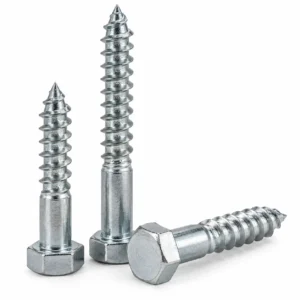
| Hex bolt | ISO 4014 part thread ISO 4017 full thread | The general case. Six flats give a wrench good purchase in a confined space |
| Carriage bolt | DIN 603 | A square neck under a domed head bites into timber so the bolt cannot spin while the nut is turned. Also leaves no snag on the visible face |
| Flange bolt | DIN 6921 | Integral washer face spreads the load and removes a separate part from the line |
| Socket head cap screw | ISO 4762 / DIN 912 | Driven by an internal hex, so it fits a counterbore where no wrench could reach the outside of a head |
| Countersunk socket bolt | ISO 10642 / DIN 7991 | Sits flush with the surface where anything proud would foul a moving part |
| Eye bolt | DIN 580 (lifting) | Provides an attachment point for a rope, chain or sling. Lifting grades are load rated and must not be substituted with a formed eye bolt |
| U-bolt | Various | Clamps around a pipe or bar rather than through it. Sized by the tube it must fit, not by grip length |
| Anchor bolt | ASTM F1554 | Cast into or fixed into concrete to hold structural steel down. Specified by yield grade, not property class |
| Stud | DIN 975 / DIN 976 | No head at all. Takes a nut at each end, or screws into a tapped hole and takes one nut. Used where a bolt could not be withdrawn |
Two of those carry a risk worth flagging. Eye bolts sold as general hardware are formed from bent rod and are not rated for overhead lifting; only a forged, load-rated eye bolt with a stated working load limit belongs on a lifting point. And anchor bolts to ASTM F1554 come in grades 36, 55 and 105, which are yield strengths in ksi rather than property classes — asking for “grade 8 anchor bolts” mixes two systems and will produce a query rather than a quotation.
Nut types, grouped by the job they do
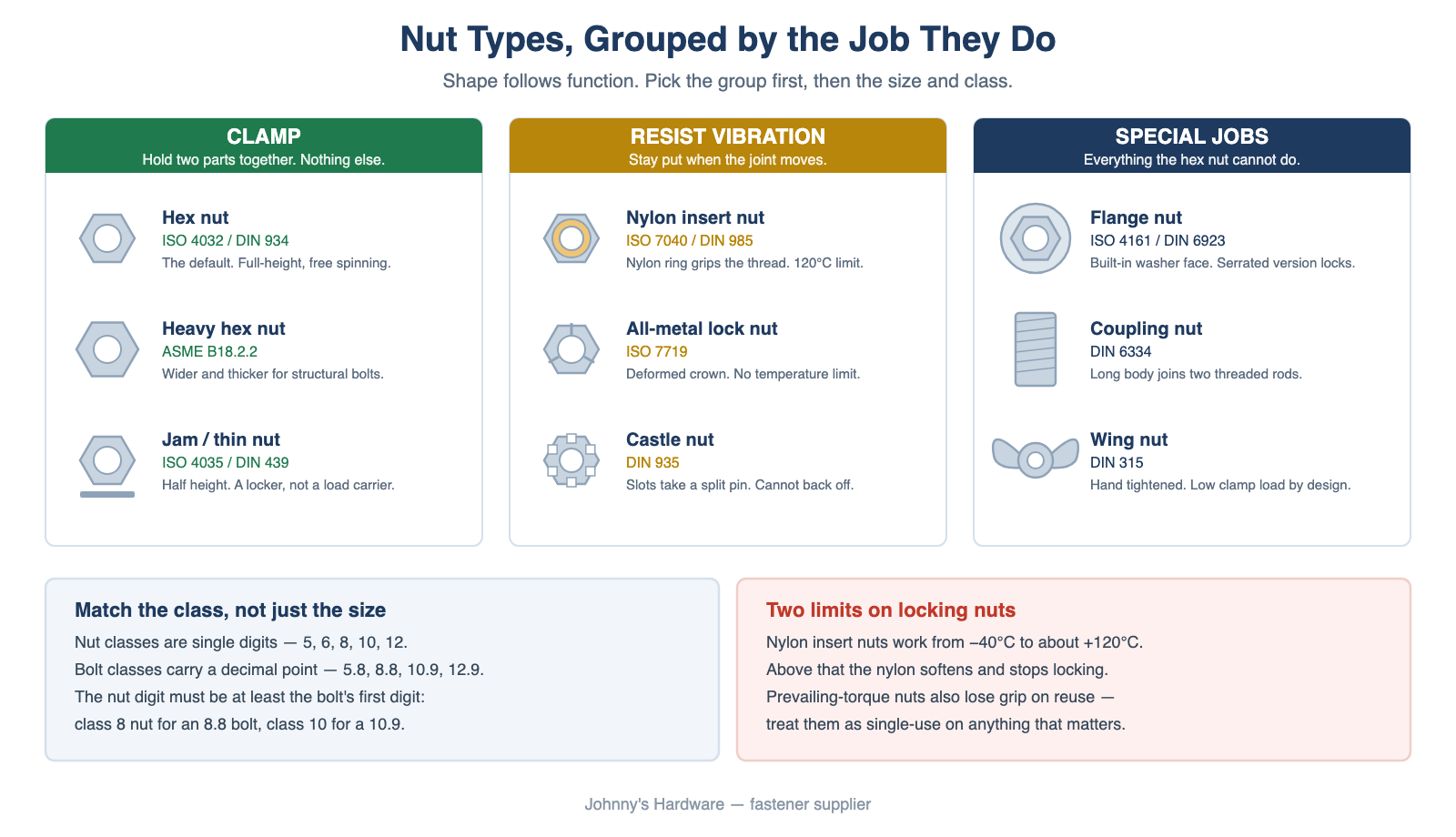
Nuts that clamp
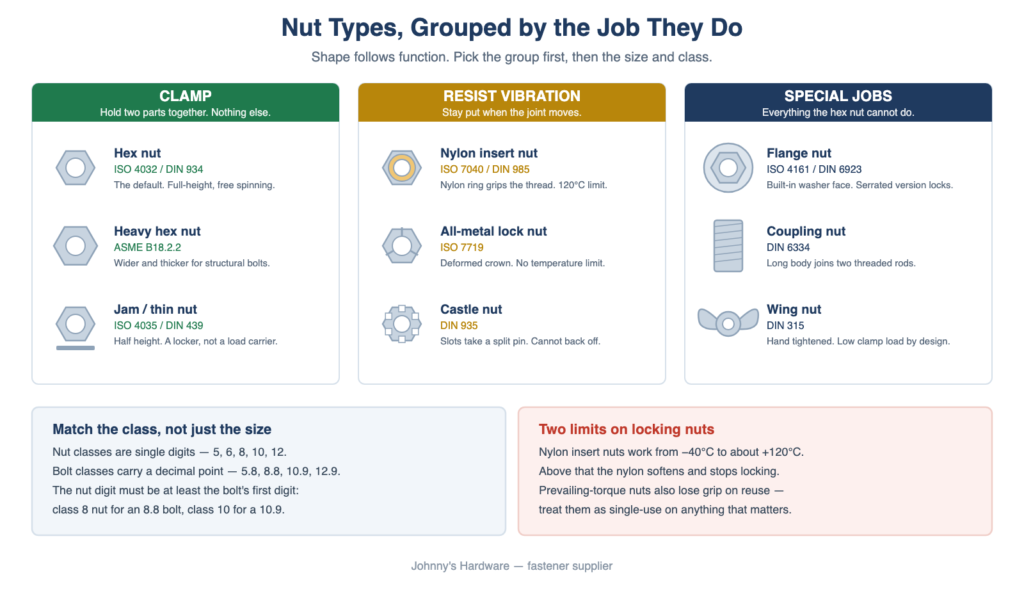
The hex nut to ISO 4032 or DIN 934 is the default and covers most of what any programme sells. The heavy hex nut to ASME B18.2.2 is wider across the flats and taller, and pairs with structural bolts where the bearing area under the nut matters.
The jam nut or thin nut to ISO 4035 is the one most often misused. At roughly half the height of a standard nut it carries far less thread engagement, so it is not a lighter version of a hex nut — it is a locking device, tightened against a full nut already carrying the load. Using one alone on a loaded joint is a genuine failure mode, not a shortcut.
Nuts that resist vibration
A plain nut on a joint that moves will eventually loosen. Four answers, in rough order of how often they are specified:
- Nylon insert nut (ISO 7040, DIN 985 thin type, DIN 982 high type). A nylon collar above the thread deforms around the bolt and grips it. Cheap, effective and by far the most common. Two limits: it works from about −40 °C to +120 °C, above which the nylon softens and stops locking, and the insert loses grip each time it is undone.
- All-metal prevailing torque nut (ISO 7719). The crown is deliberately deformed so the threads bind. No temperature ceiling, which is why it replaces nyloc near engines, exhausts and furnaces. Also degrades with reuse.
- Serrated flange nut (DIN 6923). Teeth on the underside of the flange bite into the joint face. Excellent on steel, and unsuitable where the surface finish must survive or the mating part is soft.
- Castle nut (DIN 935) with a split pin through a cross-drilled bolt. The only one on this list that cannot loosen at all, because it is mechanically captured rather than relying on friction. Standard on axles, steering and anywhere failure is not an option.
Treat prevailing-torque nuts as single-use on anything that matters. Both the nylon and the deformed-metal types lose locking torque with each cycle, and a nut that spins on freely by hand has stopped being a locking nut whatever is printed on the box.
Nuts for special jobs
| Type | Standard | What it is for |
|---|---|---|
| Flange nut | ISO 4161 / DIN 6923 | Integral washer face. Removes a part from the assembly and spreads load on softer material |
| Coupling nut | DIN 6334 | A long body that joins two lengths of threaded rod end to end |
| Wing nut | DIN 315 | Hand tightening without a tool. By design it cannot reach a meaningful clamp load, so it belongs on covers and guards, not structure |
| Acorn / cap nut | DIN 1587 | Domed closed end covers the thread. Appearance, and protection against snagging or corrosion |
| Square nut | DIN 557 | Sits in a channel or slot that stops it rotating. Common in framing systems and older timber work |
| T-nut | Various | Prongs pull into the back of timber or board to create a machine thread in a material that has none |
| Rivet nut | Various | Set into sheet metal from one side to give a threaded hole where the panel is too thin to tap |
| Weld nut | DIN 928 / DIN 929 | Welded to a panel in advance so assembly needs access from one side only |
The last three deserve grouping in the mind: T-nut, rivet nut and weld nut all solve the same underlying problem, which is getting a machine thread into a material that cannot hold one — timber, thin sheet and fabricated panel respectively.
Matching the nut to the bolt
Choosing the shape is the easy half. A nut also has to match the bolt in strength, thread and coating, and the strength system is where the mistakes happen.
Nut property classes are single digits: 5, 6, 8, 10, 12. Bolt property classes carry a decimal point: 5.8, 8.8, 10.9, 12.9. They are deliberately different notations for a reason, and the rule is that the nut’s digit must be at least the first digit of the bolt’s class. A class 8 nut for an 8.8 bolt, class 10 for a 10.9, class 12 for a 12.9.
Get this backwards and the joint is designed to fail in the wrong place. The intent behind the system is that the bolt yields before the nut threads strip, because a stretched bolt is visible and a stripped nut thread is not. Fitting a class 8 nut to a 10.9 bolt inverts that.
| Bolt class | Minimum nut class | Imperial equivalent, roughly |
|---|---|---|
| 4.6 / 4.8 | Class 4 or 5 | SAE grade 2 |
| 8.8 | Class 8 | SAE grade 5 |
| 10.9 | Class 10 | SAE grade 8 |
| 12.9 | Class 12 | — |
Thread and coating have to match as well, and the coating trap is the one that produces returns: a hot-dip galvanised nut is tapped oversize to leave room for the coating on the bolt, so it will spin loosely on a zinc-plated bolt and will not develop clamp load. The four properties that must agree, and how to write them on an order, are covered in nut vs bolt.
What a distributor should actually stock
For a general hardware or industrial programme, the defensible core is narrow:
- Hex bolts to ISO 4017, class 8.8, zinc plated, M6 to M16 — the bulk of demand
- Hex nuts to ISO 4032 in class 8, matched to those sizes
- Nylon insert nuts to DIN 985 in the same sizes — the one locking type that earns its shelf space everywhere
- Flange nuts in the mid sizes, which quietly remove washers from the picking list
- Carriage bolts where the customer base does any timber work
Everything else — castle, coupling, wing, acorn, square, T-nut — sells in genuine but much smaller volume and is better handled by quoting against demand than by holding depth. Wing and acorn nuts in particular are appearance and convenience items whose demand is driven by the end product, not by fastener volume, so they are worth carrying only where a specific customer pulls them.
Final thoughts
Nut and bolt types look like a memory exercise and are not. Each shape answers one question — how the head is held, how the load is spread, how the joint resists vibration, how a thread gets into a material that has none. Work out which question the joint is asking and the shortlist is usually two items. Then match the class, the thread and the coating, because those decide whether the joint works at all.
FAQ
What are the main types of nuts and bolts?
On the bolt side: hex, carriage, flange, socket head cap, countersunk, eye, U-bolt, anchor bolt and stud. On the nut side: hex, heavy hex, jam, nylon insert, all-metal lock, castle, flange, coupling, wing, acorn, square, T-nut, rivet nut and weld nut. Each exists to solve a specific problem the plain hex bolt and hex nut cannot, so grouping them by function is more useful than memorising shapes.
What is the difference between a hex nut and a jam nut?
Height. A jam nut, also called a thin nut and standardised as ISO 4035, is roughly half the height of a standard hex nut, so it has much less thread engagement and carries far less load. It is a locking device intended to be tightened against a full nut that is already carrying the joint. Using a jam nut alone on a loaded joint is a misuse, not a cost saving.
What temperature can a nylon insert lock nut withstand?
Nylon insert nuts hold their properties from roughly −40 °C to about +120 °C. Above that the nylon softens and loses its grip on the thread flanks, so the nut is no longer locked even though it looks unchanged. This limit applies to stainless versions too, since the insert is still nylon. Where temperatures exceed it, specify an all-metal prevailing torque nut to ISO 7719.
Can you reuse a lock nut?
Not reliably. Both nylon insert and all-metal prevailing torque nuts lose locking torque each time they are undone and refitted, because the locking action depends on deformation that does not fully recover. Treat them as single-use on any joint that matters. A quick field test: if the nut spins on by hand for its full length, the locking feature is gone.
What class of nut goes with an 8.8 bolt?
A class 8 nut. Nut property classes are single digits — 5, 6, 8, 10, 12 — while bolt classes carry a decimal point, and the nut digit must be at least the first digit of the bolt class. So class 8 pairs with 8.8, class 10 with 10.9 and class 12 with 12.9. The system exists so the bolt stretches before the nut threads strip, because a stretched bolt is visible and stripped threads are not.
Why is a carriage bolt shaped that way?
The square neck under the domed head is the whole point. Pulled into timber it stops the bolt rotating, so the joint can be tightened from the nut side alone with no tool on the head. The domed head also leaves nothing to snag or catch on the visible face, which is why the design persists on furniture, playground equipment and agricultural machinery.
What is the difference between a flange nut and a nut with a washer?
A flange nut has the bearing surface built in, so it is one part instead of two. That removes a picking line, an assembly step and the chance of the washer being left off. A separate washer is still preferable where the washer needs to be a different material to the nut, where a hardened washer is required, or where a serrated flange would damage the finish of the joint face.
Are eye bolts safe for lifting?
Only if they are specifically rated for it. General hardware eye bolts formed from bent rod have no working load limit and are intended for tensioning and light restraint. Overhead lifting requires a forged, load-rated eye bolt such as DIN 580, marked with its rating, and the rating falls sharply once the pull is at an angle rather than straight along the axis. Never substitute one for the other.
What is a T-nut used for?
Creating a machine thread in timber or board. The prongs on its flange are pulled into the back face of the material as the bolt is tightened, anchoring the nut so a standard metric or imperial bolt can be used and removed repeatedly. It solves the same problem as a rivet nut in thin sheet or a weld nut in fabricated panel — putting a durable thread where the material cannot hold one.
Do I need a different nut for a stainless bolt?
Yes, match the material. A stainless bolt should take a stainless nut of the same family, A2 with A2 and A4 with A4, both to keep corrosion performance and to avoid a galvanic pair. Be aware that stainless against stainless is prone to galling — the threads cold-weld under load and seize. A lubricant or anti-seize on assembly, and moderate tightening speed, largely prevent it.
Sourcing nuts and bolts
Johnny’s Hardware supplies hex, carriage, flange, socket and eye bolts, studs and threaded rod, with hex, heavy hex, jam, nylon insert, all-metal lock, castle, flange, coupling, wing, acorn, square, T- and weld nuts to match, in ISO, DIN, ASME and ASTM standards, metric and imperial, property classes 4.8 through 12.9, plus A2 and A4 stainless.
Nuts are supplied class-matched to the bolts on the same order as standard, and hot-dip galvanised sets are tapped and quoted as sets rather than as separate lines, so the oversize-tapping problem does not reach your warehouse. Orders consolidate across the bolts and nuts range, the screw supplier range and the wider fastener supplier catalogue, with private label and retail packaging through our OEM hardware supplier service.
If you are still fixing sizes, the metric bolt designation guide covers how M8 × 1.25 × 40 is read, and the bolt torque chart covers what each class should be tightened to. For inch sizes and the wrench that fits each, see the bolt and nut size chart.
Send the types, sizes, classes, finish and quantities, and we will come back with specifications, mill certificates, carton data and lead times within 12 working hours.
– Johnny’s Hardware Team, QC Engineer