An inch bolt is named for its diameter and its thread, not for the wrench that fits it. A 1/2 inch bolt takes a 3/4 inch wrench, and a 7/16 inch bolt and its nut take two different wrenches. Most buying errors in this category come from one of those two facts.
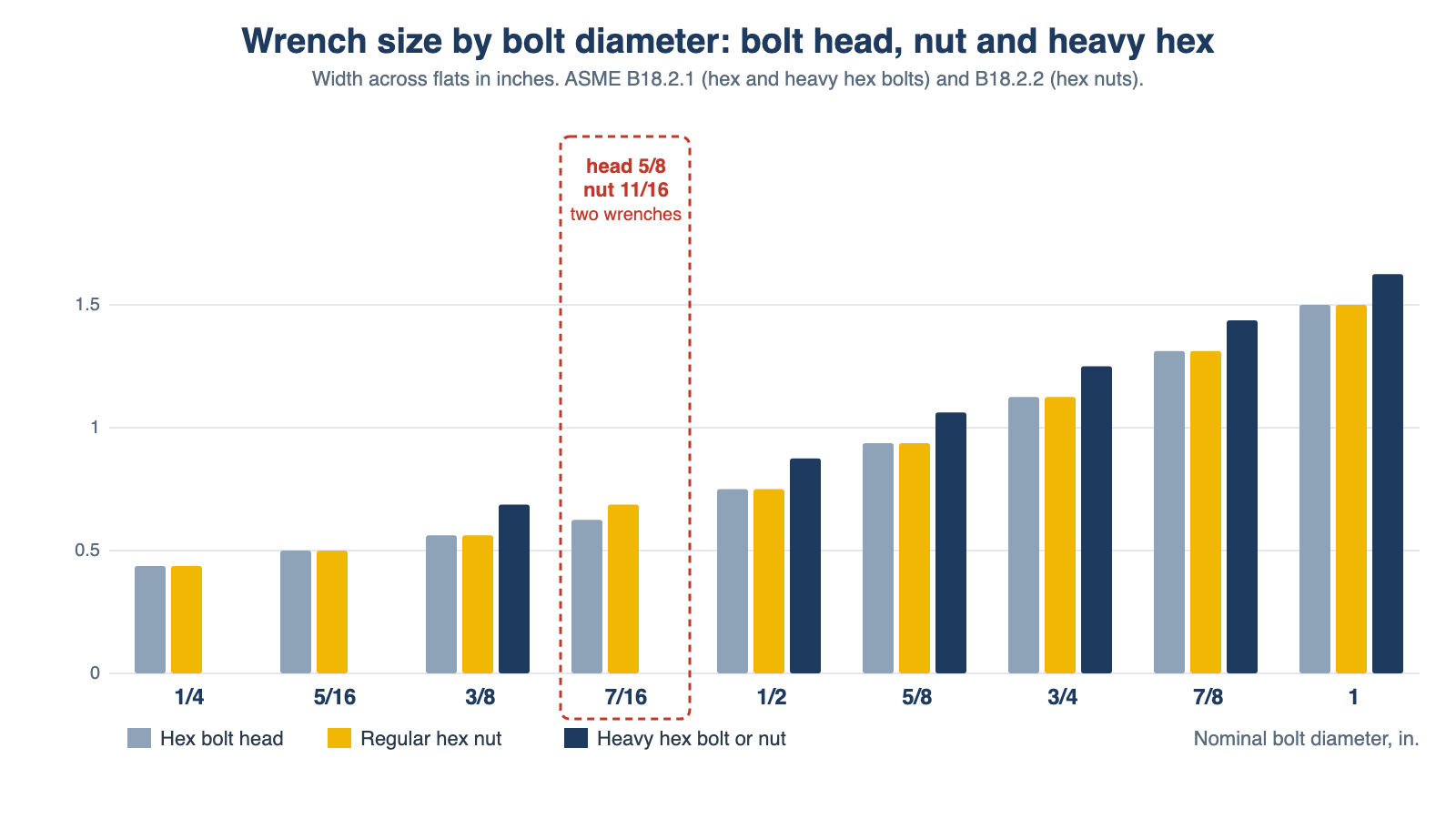
The size of an inch bolt is its diameter, threads per inch and length, and the wrench size is the width across flats of the head or nut: 7/16 in. for a 1/4 in. bolt, 1/2 in. for 5/16, 9/16 in. for 3/8, 3/4 in. for 1/2, 15/16 in. for 5/8 and 1-1/8 in. for 3/4.
Bolt and nut size chart: thread and length
Every inch bolt size has a coarse (UNC) and a fine (UNF) thread. The coarse series is the default, and the bolt length that is threaded depends on the diameter.
| Nominal size | Diameter, in. | Coarse thread, UNC | Fine thread, UNF | Thread length, bolt 6 in. or shorter | Thread length, bolt over 6 in. |
|---|---|---|---|---|---|
| 1/4 | 0.250 | 20 | 28 | 0.750 in. | 1.000 in. |
| 5/16 | 0.3125 | 18 | 24 | 0.875 in. | 1.125 in. |
| 3/8 | 0.375 | 16 | 24 | 1.000 in. | 1.250 in. |
| 7/16 | 0.4375 | 14 | 20 | 1.125 in. | 1.375 in. |
| 1/2 | 0.500 | 13 | 20 | 1.250 in. | 1.500 in. |
| 9/16 | 0.5625 | 12 | 18 | Not in the hex bolt table | Not in the hex bolt table |
| 5/8 | 0.625 | 11 | 18 | 1.500 in. | 1.750 in. |
| 3/4 | 0.750 | 10 | 16 | 1.750 in. | 2.000 in. |
| 7/8 | 0.875 | 9 | 14 | 2.000 in. | 2.250 in. |
| 1 | 1.000 | 8 | 12 | 2.250 in. | 2.500 in. |
Thread length is the nominal minimum from ASME B18.2.1, Table 2. It follows a simple rule: twice the diameter plus 1/4 in. for bolts up to 6 in. long, and twice the diameter plus 1/2 in. beyond that. Threads per inch are from the unified thread series, ASME B1.1. A 9/16 in. hex bolt is not listed in the standard’s hex bolt table, although the nut size exists.
Bolt head and nut wrench sizes
The wrench size is the width across flats of the hex. For most sizes the bolt head and the nut take the same wrench, but 7/16 in. is the exception: a 7/16 in. bolt head is 5/8 in. across flats, and its nut is 11/16 in.
| Nominal size | Bolt head across flats | Same in mm | Head height | Hex nut across flats | Hex nut thickness |
|---|---|---|---|---|---|
| 1/4 | 7/16 in. | 11.1 | 11/64 in. | 7/16 in. | 7/32 in. |
| 5/16 | 1/2 in. | 12.7 | 7/32 in. | 1/2 in. | 17/64 in. |
| 3/8 | 9/16 in. | 14.3 | 1/4 in. | 9/16 in. | 21/64 in. |
| 7/16 | 5/8 in. | 15.9 | 19/64 in. | 11/16 in. | 3/8 in. |
| 1/2 | 3/4 in. | 19.1 | 11/32 in. | 3/4 in. | 7/16 in. |
| 9/16 | Not listed | Not listed | Not listed | 7/8 in. | 31/64 in. |
| 5/8 | 15/16 in. | 23.8 | 27/64 in. | 15/16 in. | 35/64 in. |
| 3/4 | 1-1/8 in. | 28.6 | 1/2 in. | 1-1/8 in. | 41/64 in. |
| 7/8 | 1-5/16 in. | 33.3 | 37/64 in. | 1-5/16 in. | 3/4 in. |
| 1 | 1-1/2 in. | 38.1 | 43/64 in. | 1-1/2 in. | 55/64 in. |
Bolt values are from ASME B18.2.1-2010, Table 2, for hex bolts. Nut values are the basic dimensions of finished hex nuts from ASME B18.2.2, cross-checked against two published tables. Check the current edition of each standard before using them on a drawing.
Heavy hex bolts and nuts need a bigger wrench
A heavy hex bolt has a larger head than a regular hex bolt of the same diameter, so the wrench is one size up. Heavy hex nuts follow the same width across flats as heavy hex bolts, and they are thicker than regular nuts.
| Nominal size | Regular hex, across flats | Heavy hex, across flats | Regular nut thickness | Heavy hex nut thickness |
|---|---|---|---|---|
| 3/8 | 9/16 in. | 11/16 in. | 21/64 in. | 23/64 in. |
| 1/2 | 3/4 in. | 7/8 in. | 7/16 in. | 31/64 in. |
| 5/8 | 15/16 in. | 1-1/16 in. | 35/64 in. | 39/64 in. |
| 3/4 | 1-1/8 in. | 1-1/4 in. | 41/64 in. | 47/64 in. |
| 7/8 | 1-5/16 in. | 1-7/16 in. | 3/4 in. | 55/64 in. |
| 1 | 1-1/2 in. | 1-5/8 in. | 55/64 in. | 63/64 in. |
Heavy hex across-flats figures are from ASME B18.2.1, Table 3. Heavy hex nut thickness is calculated from the B18.2.2 formula, diameter minus 0.016 in., and rounded to the nearest 1/64 in., so treat it as a guide, not as a drawing dimension.
How to read an inch bolt size
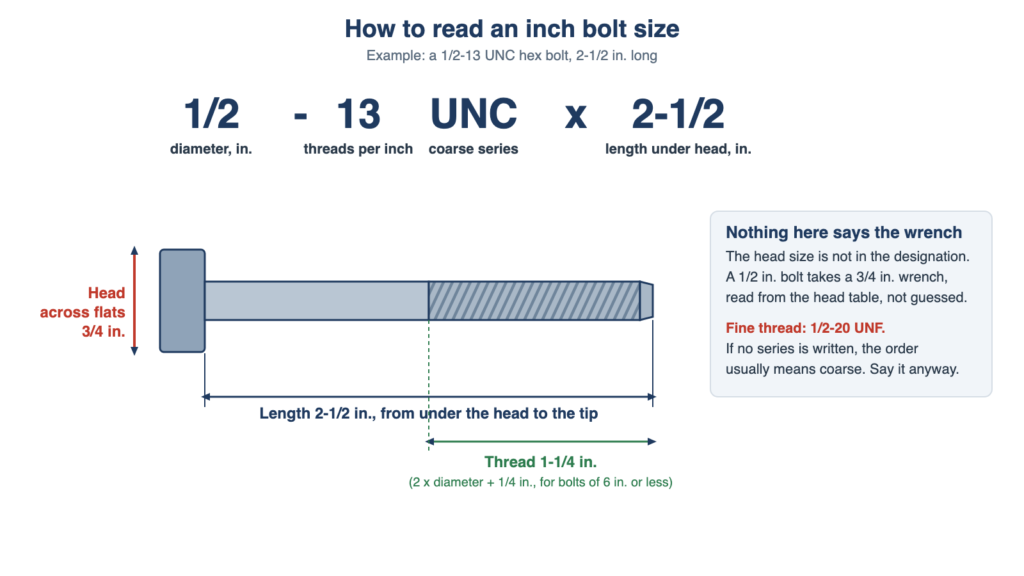
An inch bolt is written as diameter, threads per inch, thread series and length. The head size is not part of it.
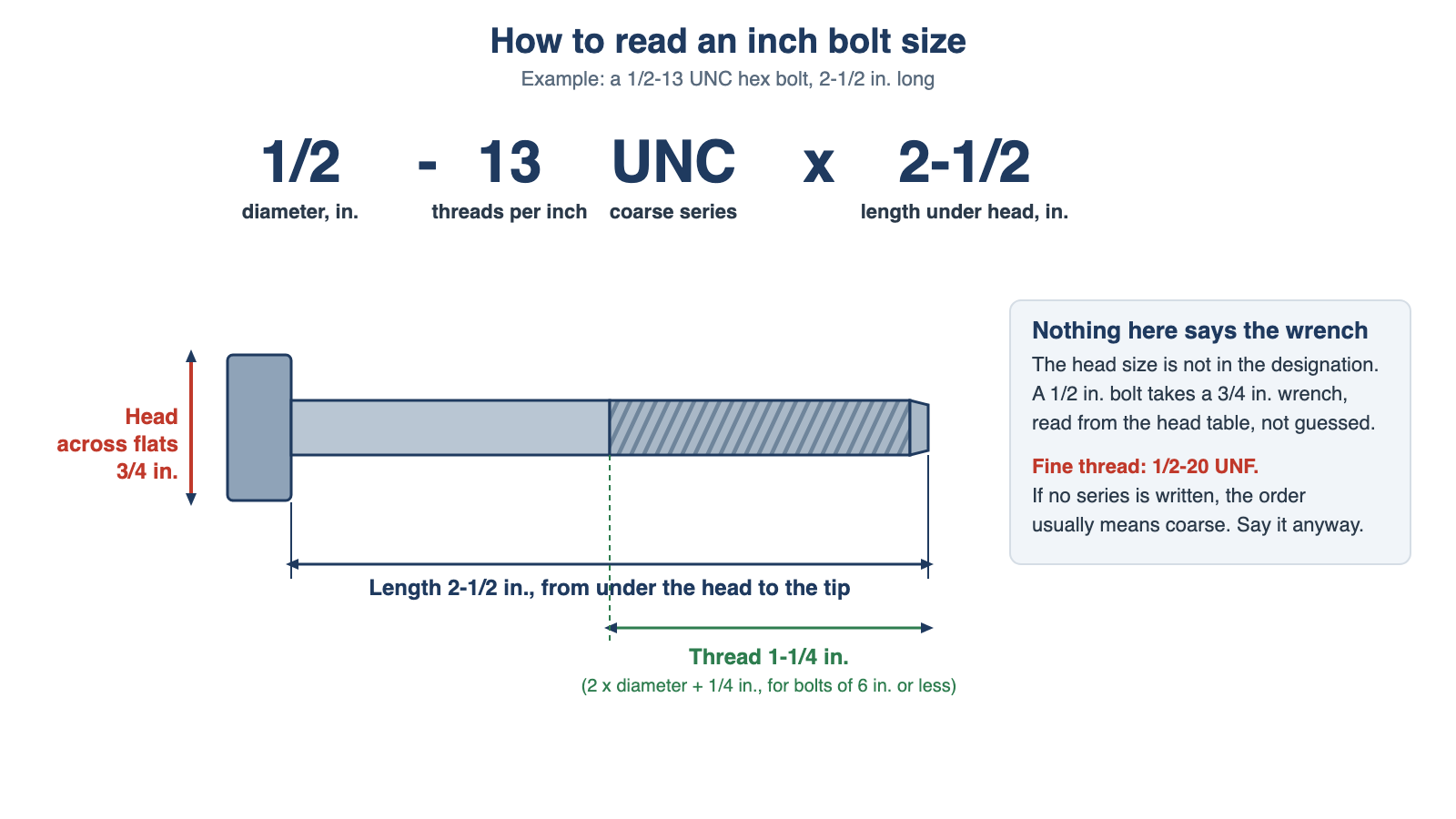
- 1/2 is the nominal diameter in inches.
- 13 is the number of threads per inch. A higher number means a finer thread.
- UNC marks the coarse series and UNF the fine series. If neither is written, an order usually means coarse. Write it anyway.
- 2-1/2 is the length in inches, measured from under the head to the tip for a hex bolt.
The metric equivalent, where the number is the diameter in millimetres and the pitch is a distance, is worked through in M8 bolt size. The screw version of this chart, with gauge numbers, is in screw size chart.
How nut sizes work
A nut is sized by the bolt it fits: its nominal diameter and its thread. A 1/2-13 UNC nut goes on a 1/2-13 UNC bolt, and the same nut will not start on a 1/2-20 UNF bolt.
The thickness depends on the type of nut. A regular hex nut is about 7/8 of its diameter thick. A heavy hex nut is about equal to its diameter, and a jam nut is roughly half. That is why the same 1/2 in. nominal size appears as three different nut thicknesses on a price list. The nut size on an order must name the type, not only the diameter and the thread. The way nut types differ in function is set out in types of nuts and bolts.
Inch and metric bolts are not interchangeable
Several inch and metric sizes have diameters within about one millimetre of each other, but their pitches differ, so they do not mate. Never substitute one for the other.
| Inch size | Diameter, mm | Close metric size | Diameter, mm | Why they do not mix |
|---|---|---|---|---|
| 1/4 | 6.35 | M6 | 6.00 | Pitch 20 TPI against 1.0 mm |
| 5/16 | 7.94 | M8 | 8.00 | Pitch 18 TPI against 1.25 mm |
| 3/8 | 9.53 | M10 | 10.00 | Pitch 16 TPI against 1.5 mm |
| 1/2 | 12.70 | M12 | 12.00 | Pitch 13 TPI against 1.75 mm |
| 3/4 | 19.05 | M20 | 20.00 | Pitch 10 TPI against 2.5 mm |
The metric pitches are the standard coarse values for each size.
How to measure a bolt and a nut
- Diameter: measure across the crests of the thread with calipers. A bolt reads a little under its nominal size because of the thread tolerance.
- Threads per inch: lay a thread pitch gauge against the thread until it meshes, or count the crests along one inch.
- Length: measure from under the head to the tip. Do not include the head.
- Head or nut size: measure across opposite flats, not across the corners. The corner-to-corner figure is about 15% larger.
- Nut thickness: measure with the nut flat, and compare with the type: regular, heavy or jam.
What to put on a bolt and nut order
A bolt line and its nut line should name the same diameter and thread, and the type, the grade and the finish. Written out: Hex bolt, ASME B18.2.1, 1/2-13 UNC x 2-1/2, grade 5, zinc plated. Hex nut, ASME B18.2.2, 1/2-13 UNC, grade 5, zinc plated.
A bolt and a nut must match on four properties, not only on size. That is covered in nut vs bolt, and the torque that a given size and grade can take is in the bolt torque chart.
What a distributor should stock
For a distributor, inch bolts and nuts are a size-led range. A starter range usually covers the small and middle diameters, with the large ones bought by project.
- Core line: 1/4, 5/16, 3/8 and 1/2 in. in coarse thread, in zinc plated, in a spread of lengths.
- Second line: 5/8 and 3/4 in., and 7/16 in. in small quantities. Stock the 7/16 in. nut separately and label both wrench sizes.
- Nuts to match: a regular hex nut and a matching washer for each bolt diameter.
- Print the wrench size on the pack. It is the question customers ask first.
- Keep inch and metric on separate shelves and mark each, because the sizes in the table above look alike.
The full nuts and bolts range, with private label packs through an OEM hardware supplier, is set up in one consolidated order.
Final thoughts
Read an inch bolt as diameter, thread and length, and look up the wrench from the head table. Match the nut by diameter, thread and type. Watch the 7/16 in. size, the heavy hex series and the inch-metric look-alikes, because those are where wrong parts reach the order.
Frequently asked questions
What size wrench fits a 1/2 inch bolt?
A 3/4 inch wrench. The hex head of a 1/2 inch hex bolt is 3/4 inch across flats under ASME B18.2.1, and a regular hex nut of the same size is also 3/4 inch. A heavy hex bolt or nut of 1/2 inch takes a 7/8 inch wrench, so check which type is on the job before choosing the socket.
What size is a 5/8 inch bolt head?
15/16 inch across flats for a regular hex bolt, which is also the size of a regular 5/8 inch nut. A heavy hex bolt head of the same diameter is 1-1/16 inch. The wrench size has no connection to the bolt diameter, so it has to be read from the table, not estimated from the 5/8.
What is the head size of a 1/4 inch bolt?
7/16 inch across flats, about 11.1 mm, for a hex bolt. The regular hex nut for a 1/4 inch bolt is also 7/16 inch. A 5/16 inch bolt takes a 1/2 inch wrench, and a 3/8 inch bolt a 9/16 inch wrench, so the three smallest sizes step up by 1/16 inch each.
What is the difference between UNC and UNF threads?
UNC is the coarse series with fewer threads per inch, such as 13 on a 1/2 inch bolt. UNF is the fine series with more, such as 20 on the same bolt. Coarse threads are the default, faster to assemble and more tolerant of damage. A coarse nut will not fit a fine bolt of the same diameter.
Why does a 7/16 inch bolt need two wrenches?
Because the hex bolt head is 5/8 inch across flats, while the regular hex nut for the same size is 11/16 inch. At every other regular size the head and nut take the same wrench. When fitting a 7/16 inch bolt, hold the head with a 5/8 inch wrench and turn the nut with an 11/16 inch one.
Is heavy hex bigger than regular hex?
Yes, at the same diameter a heavy hex bolt head and nut are larger across flats, and the nut is thicker. A 3/4 inch regular hex bolt is 1-1/8 inch across flats, and a heavy hex one is 1-1/4 inch. Heavy hex parts need a larger wrench and are not interchangeable with regular hex in a drawing.
How do you measure the size of a bolt?
Measure the diameter across the thread crests with calipers, count the threads per inch with a pitch gauge, and measure the length from under the head to the tip. The head size is measured across opposite flats, not corners. Together these give the designation, such as 1/2-13 UNC x 2-1/2, and the wrench size.
What size socket fits a 3/8 inch bolt?
A 9/16 inch socket fits the head of a regular 3/8 inch hex bolt, and it fits the regular hex nut as well. A heavy hex bolt of the same diameter is 11/16 inch across flats. In metric terms 9/16 inch is about 14.3 mm, which is not a standard metric wrench size, so use an inch socket.
Can I use an inch nut on a metric bolt?
No. Some sizes look alike, such as 5/16 inch and M8, but the pitches differ, so the nut will not thread properly or will cross-thread and damage the bolt. Always match inch with inch and metric with metric, keep them on separate shelves, and put the thread on the pack so the mix-up is caught before the bolt is forced.
What does grade mean on a bolt and nut order?
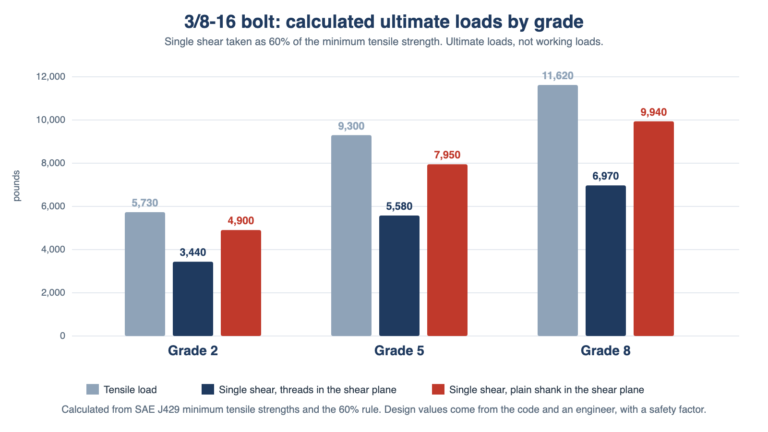
Grade is the strength marking, for inch bolts the SAE grade shown by lines on the head. A bolt and nut should be specified together at a matching grade, as the nut has to carry the same load as the bolt. The size chart sets the dimensions, but the grade and the finish still have to be written on the order. What a grade means for load is worked through in 3/8 bolt shear strength.
Sourcing bolts and nuts
Johnny’s Hardware supplies hex bolts, nuts, washers, studs and threaded rod to ISO, DIN, ASME and ASTM standards, in metric and inch sizes, with SAE grades 2, 5 and 8 and property classes 8.8, 10.9 and 12.9, plus A2 and A4 stainless, in one consolidated order with the rest of our fastener supplier range.
Send the diameter, thread series, length, standard, grade, finish, head or nut type, pack size and quantity, and we will come back with specifications and carton data within 12 working hours.
– Johnny’s Hardware Team, QC Engineer