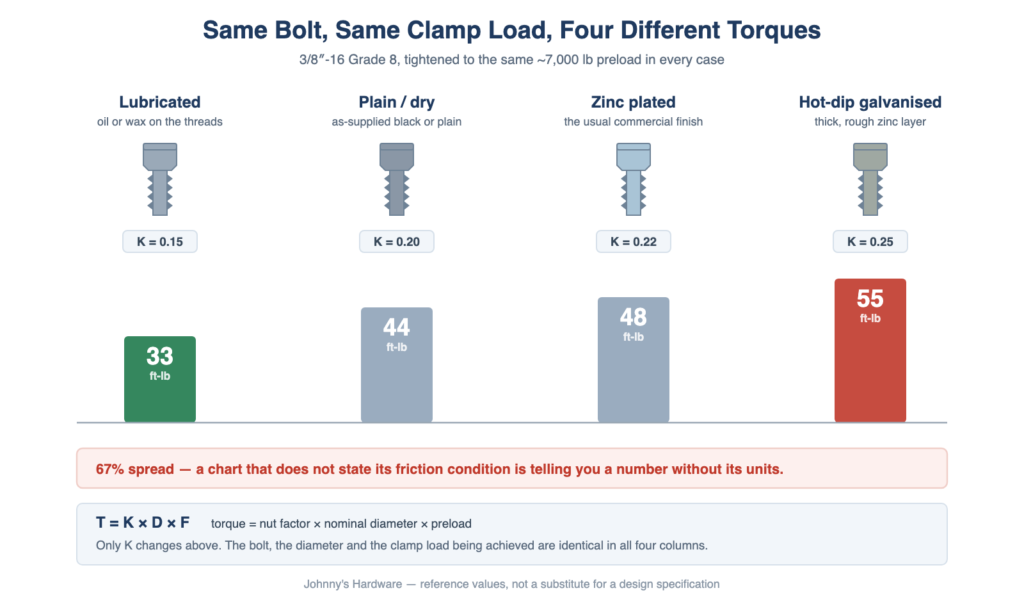
A torque figure is only meaningful alongside the condition it assumes. The same 3/8″ Grade 8 bolt needs roughly 33 ft-lb lubricated and 55 ft-lb hot-dip galvanised to reach the same clamp load. That is why published charts disagree with each other: they are not wrong, they are quoting different friction conditions and most of them never say which.
The tables below give reference torques by size, grade and condition, in both imperial and metric. They are guidance figures for general assembly. Where an engineer, a code or a manufacturer has issued a specification, that specification wins.
Why published torque charts contradict each other
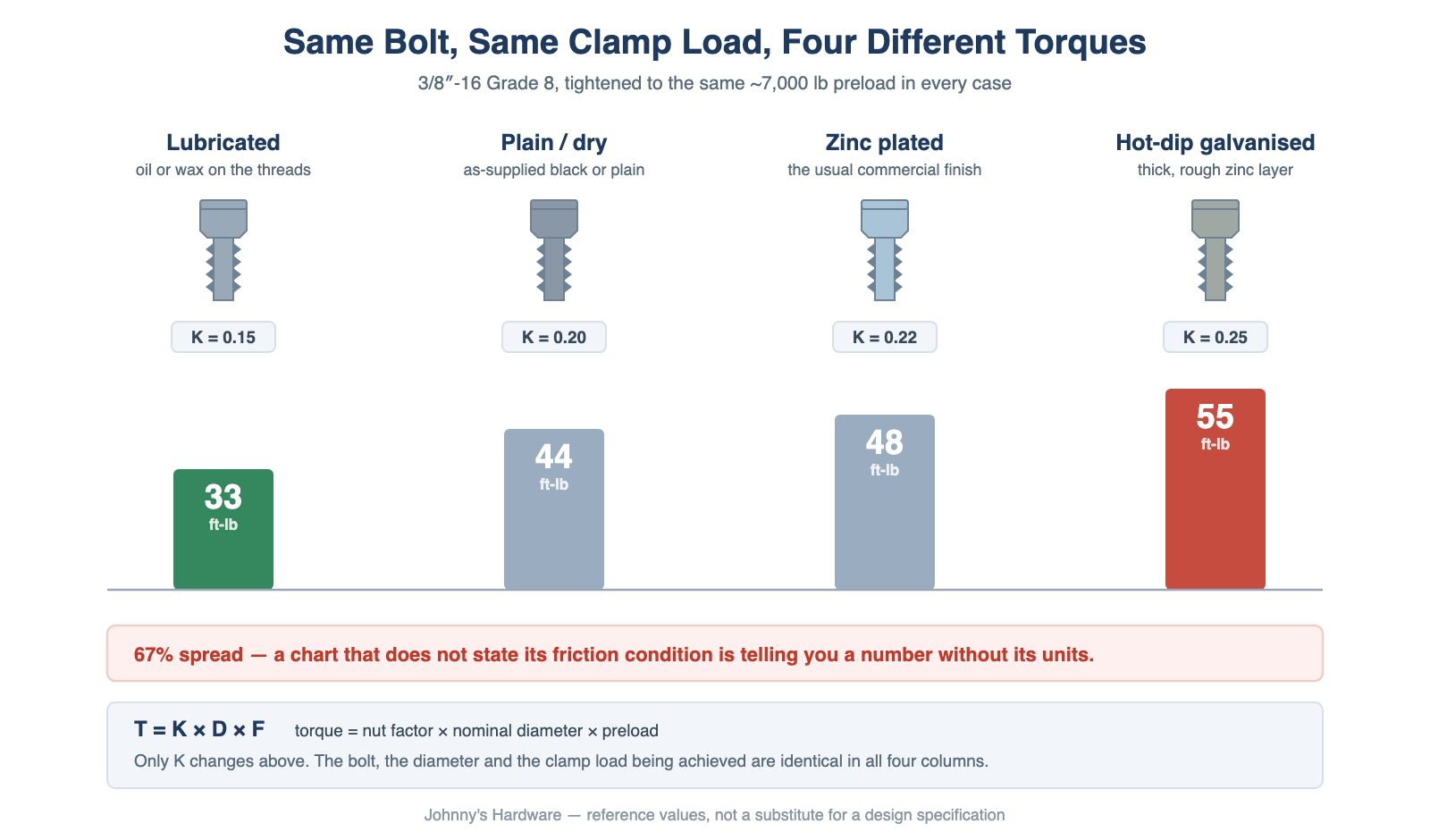
Tightening torque is not a property of the bolt. It is a calculation, and the standard form of it is:
T = K × D × F
Where T is torque, D is nominal diameter, F is the preload you are trying to achieve, and K is the nut factor — a coefficient that stands in for all the friction in the joint. Diameter is fixed and preload is what the designer wants. K is the only term that moves, and it moves a lot.
| Condition | Typical K | Effect on required torque |
|---|---|---|
| Lubricated (oil, wax, anti-seize) | 0.15 | Roughly 25% below plain dry |
| Plain / black, dry | 0.20 | The baseline most charts quote |
| Zinc plated, dry | 0.22 | Slightly above plain |
| Hot-dip galvanised, dry | 0.25 | Roughly 25% above plain; often waxed to bring it back down |
The practical consequence: if a chart says 45 ft-lb and you tighten a lubricated bolt to that figure, you are not at the intended preload — you are roughly a third above it, and closer to yield than the designer intended. Applying a dry figure to an oiled bolt is the most common way to snap fasteners during assembly.
What torque is actually controlling
Torque is a proxy. The thing that holds a joint together is preload — the tension stretched into the bolt, which clamps the parts. Nobody can measure that directly with a wrench, so torque is used as a stand-in.
It is a poor stand-in. Most of the applied torque is spent overcoming friction rather than stretching the bolt:
- Roughly half is lost to friction under the head or nut bearing face
- Roughly a third is lost to friction in the threads
- Only the remainder, typically 10-15%, actually becomes preload
Because friction dominates, torque-based tightening carries a scatter of roughly ±25 to 35% on the achieved preload even when the torque wrench is accurate. That scatter is why safety-critical joints move to angle-controlled tightening or direct tension measurement rather than a torque figure alone.
Imperial bolt torque chart
Coarse thread (UNC), reference values in ft-lb, for the two conditions that cover most work.
| Size | Grade 2 dry | Grade 5 dry | Grade 5 lubed | Grade 8 dry | Grade 8 lubed |
|---|---|---|---|---|---|
| 1/4″-20 | 5.5 | 8 | 6 | 12 | 9 |
| 5/16″-18 | 11 | 17 | 13 | 25 | 18 |
| 3/8″-16 | 20 | 30 | 23 | 45 | 33 |
| 7/16″-14 | 32 | 50 | 37 | 70 | 52 |
| 1/2″-13 | 49 | 75 | 56 | 105 | 79 |
| 9/16″-12 | 70 | 110 | 82 | 150 | 112 |
| 5/8″-11 | 97 | 150 | 112 | 210 | 157 |
| 3/4″-10 | 172 | 265 | 199 | 375 | 281 |
Grade markings. Grade 2 has no lines on the head, Grade 5 has three radial lines, Grade 8 has six. If the head is unmarked and the joint matters, do not assume Grade 5 — an unmarked bolt is a Grade 2 until proven otherwise, and the torque figure drops by more than half.
Metric bolt torque chart
Coarse pitch, reference values in Nm, dry condition.
| Size | Pitch | Class 8.8 | Class 10.9 | Class 12.9 | A2-70 stainless |
|---|---|---|---|---|---|
| M6 | 1.00 | 10 | 14 | 17 | 7 |
| M8 | 1.25 | 25 | 35 | 41 | 17 |
| M10 | 1.50 | 49 | 69 | 83 | 33 |
| M12 | 1.75 | 85 | 120 | 145 | 56 |
| M14 | 2.00 | 135 | 190 | 230 | 89 |
| M16 | 2.00 | 210 | 295 | 355 | 136 |
A 10 mm bolt is not the same thing as an M10 in every catalogue — the thread pitch has to be confirmed, because fine pitch changes the figure. Sizes and pitches are set out in our screw size chart.
Why stainless needs its own column
Stainless is not a stronger material with a different colour. A2-70 has 700 MPa tensile strength against class 8.8’s 800 MPa, so stainless torque figures are lower, not higher. Using a class 8.8 figure on an A2 bolt over-tightens it.
Stainless also galls. The threads cold-weld under friction and seize before the joint is properly tight, which the wrench reads as correct torque when the bolt is barely loaded. It happens most above M10 and when driving fast. Anti-seize compound is close to mandatory on A4 assemblies, and it moves K down to roughly 0.15, so the torque figure must come down with it.
How coatings change the number
| Finish | Behaviour | What to do |
|---|---|---|
| Zinc plated | Close to plain steel, slightly higher friction | Dry chart figures are usable |
| Hot-dip galvanised | Thick, rough zinc; high and inconsistent friction | Nuts are usually waxed by the supplier — confirm, and use the lubricated figure if so |
| Dacromet / zinc flake | Engineered low, consistent friction | Follow the coating supplier’s K value, not a generic chart |
| Plain, lightly oiled from production | Often mistaken for dry | If the threads feel oily, treat as lubricated |
Hot-dip galvanised assemblies are the ones that catch people out. The nut is tapped oversize to clear the zinc and is frequently waxed at the factory to control friction. A waxed hot-dip nut behaves closer to the lubricated column than the dry one — a difference of about 40% on the same joint.
When torque is the wrong method
- Structural steel connections — ASTM A325 and A490 joints are commonly tightened by turn-of-nut, direct tension indicators or tension-control bolts, precisely because torque scatter is too wide.
- Anything the designer has specified differently — an angle spec, a stretch measurement or a torque-plus-angle sequence overrides any chart.
- Reused fasteners — thread condition has changed, so the assumed K no longer holds. High-grade bolts taken to yield are single-use.
- Soft or thin joint materials — the limit is what the material takes before crushing, not what the bolt can carry.
Final thoughts
Every torque figure carries a hidden assumption about friction, and the gap between lubricated and hot-dip on the same bolt is wide enough to either snap it or leave it loose. Before using any chart, including this one, settle two questions: what grade is the bolt, and what condition are the threads in. Torque without those two answers is a number without its units.
FAQ
What is the torque spec for a 3/8 Grade 8 bolt?
Around 45 ft-lb dry and 33 ft-lb lubricated, for coarse thread 3/8″-16. The gap between those two figures is the reason published charts disagree. If the threads carry oil, wax or anti-seize, use the lubricated figure — applying the dry number to a lubricated bolt over-tightens it by roughly a third.
Why do bolt torque charts give different numbers?
Because they assume different friction conditions and rarely say so. Torque equals nut factor times diameter times preload, and the nut factor ranges from about 0.15 lubricated to 0.25 hot-dip galvanised. Same bolt, same clamp load, a 67% spread in the torque required to get there. A chart quoting one number without naming its condition is incomplete rather than wrong.
Should bolts be torqued dry or lubricated?
Follow whatever the design specification assumes. If none exists, be consistent: pick a condition, use the matching column, and apply it across the joint. Mixing lubricated and dry fasteners in one connection produces uneven preload even when every bolt reads the same on the wrench, which is how a joint ends up with some bolts near yield and others barely loaded.
What is the torque for an M10 class 8.8 bolt?
Approximately 49 Nm dry for coarse pitch. Class 10.9 in the same size takes around 69 Nm and 12.9 around 83 Nm. Confirm the pitch before using any figure, because a fine-pitch M10 has a different stress area and therefore a different target preload. These are dry values; subtract roughly a quarter if the threads are lubricated.
Do stainless bolts use the same torque as steel?
No, and using steel figures over-tightens them. A2-70 stainless has 700 MPa tensile against class 8.8’s 800 MPa, so the torque values are lower. Stainless also galls under friction, so anti-seize is usually needed, which lowers the required torque again. Applying a carbon steel figure to a lubricated stainless bolt can take it past yield on the first pull.
How accurate is torque as a way of setting preload?
Not very. Most of the applied torque is consumed by friction under the head and in the threads, leaving only 10-15% to stretch the bolt. Even with an accurate wrench, the achieved preload scatters by roughly 25 to 35%, which is why critical joints use angle control or direct tension measurement instead.
Does hot-dip galvanising change the torque figure?
Yes, substantially. Dry hot-dip has high and inconsistent friction, pushing required torque about 25% above plain steel. Most suppliers wax hot-dip nuts to control this, and a waxed nut behaves closer to the lubricated column. Confirm with the supplier which one you have before setting the wrench, because the difference between a waxed and an unwaxed hot-dip nut is around 40% on the same joint.
Can a bolt be re-torqued or reused?
Low-grade bolts in non-critical joints are often reused. High-grade bolts tightened close to yield should not be, because the thread condition and the material have both changed, so the assumed nut factor no longer applies. Structural bolts tightened by turn-of-nut are single-use by specification. If there is any doubt about a fastener’s history on a joint that carries load, replace it rather than re-torque it.
Sourcing bolts to a stated grade
Every torque figure on this page assumes the bolt actually is the grade it is sold as. Johnny’s Hardware supplies hex, carriage, eye, U-bolts, anchor bolts and threaded rod in classes 4.8 through 12.9 and stainless A2 and A4, with head markings to the ordered class and mill certificates available on request.
Nuts and washers are quoted as matched sets, because a class 8.8 bolt in a class 4 nut fails at the nut regardless of how carefully it is torqued. Full range, standards and order terms are on our bolts and nuts suppliers page, and bolts consolidate with screws and the rest of the fastener supplier range in one shipment.
– Johnny’s Hardware Team, QC Engineer