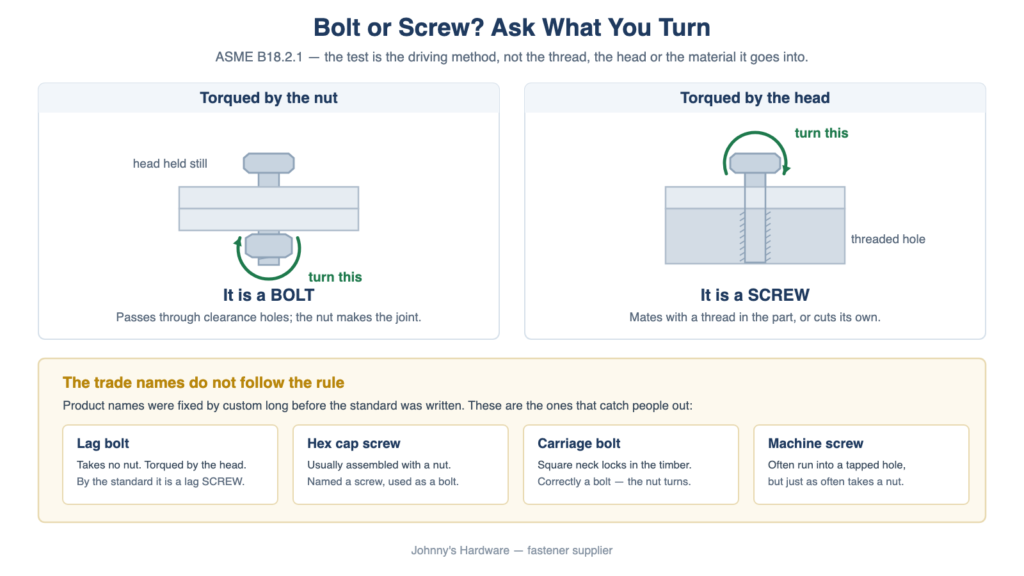
The difference between a bolt and a screw is not the thread, the head, or whether it goes into metal or timber. It is the driving method. A fastener designed to be tightened by turning a nut is a bolt. One designed to be tightened by turning its own head is a screw.
That is the test in ASME B18.2.1, and it is the test a United States federal appeals court applied when the question was worth money. Every other rule of thumb you have heard — bolts have plain shanks, screws are fully threaded, bolts are bigger — falls apart on common products in every catalogue.
The definition that actually governs
ASME B18.2.1 describes a bolt as an externally threaded fastener meant to pass through holes in the parts being joined, and normally tightened or released by torquing a nut. It describes a screw as an externally threaded fastener that goes into a hole in the assembled parts, mates with a pre-formed internal thread or forms its own, and is tightened or released by torquing the head.
Read those side by side and the whole distinction reduces to one question: which end do you put the wrench on?
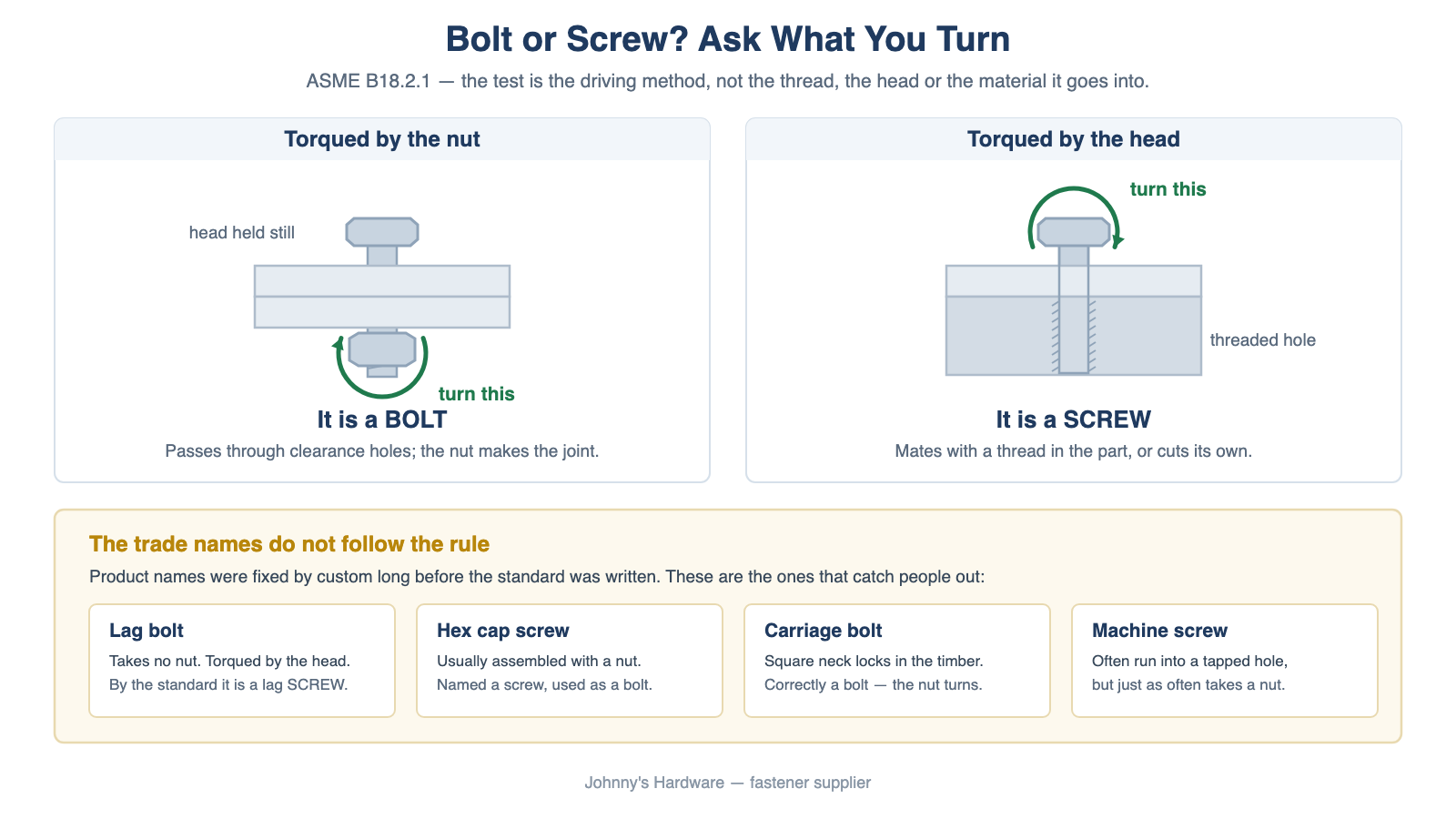
The consequence follows directly. A bolt needs a clearance hole, because nothing about the joint depends on the fastener gripping the material — the nut does the work. A screw needs a threaded hole, or a material soft enough that it can cut one, because the grip is the joint.
Why the usual rules of thumb fail
| The rule you have heard | Why it does not hold |
|---|---|
| “A bolt has an unthreaded shank; a screw is threaded to the head” | ISO 4017 and DIN 933 hex bolts are threaded their full length and are still bolts. Plenty of screws have plain shanks under the head |
| “A bolt always takes a nut” | Closest to right, and still not a definition — it describes the intent, not the part. The same part number can be sold with or without nuts |
| “Screws go into wood, bolts go into metal” | Machine screws go into tapped steel every day. Carriage bolts go through timber |
| “Bolts are bigger” | M3 bolts exist; 20 mm lag screws exist. Diameter says nothing about the category |
| “Screws are pointed, bolts are blunt” | Machine screws have blunt ends. This describes wood screws specifically, not screws generally |
The reason these keep circulating is that each one is a decent description of the typical case. None of them survives contact with the edges of a real catalogue, which is precisely where the arguments start.
The trade names that break the rule
Product names were fixed by custom decades before anyone wrote the standard, and nobody renamed the inventory afterwards. Four cause most of the confusion:
| Trade name | How it is used | What it is by the standard |
|---|---|---|
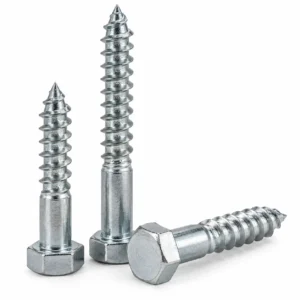
| Lag bolt | Driven into timber by the head, no nut anywhere | A screw. Its formal name is lag screw, and both names are in daily use for the same part |
| Hex cap screw | Usually through a clearance hole with a nut on the back | Used as a bolt, named a screw. The name reflects a tighter tolerance class, not the driving method |
| Carriage bolt | Square neck bites into timber so the head cannot rotate; the nut is turned | A bolt, correctly named. The head is deliberately undriveable |
| Machine screw | Into a tapped hole, or through a clearance hole with a nut | Genuinely either, depending on the assembly. The name describes the thread form and finish, not the use |
This is why the practical answer to “is it a bolt or a screw” in a commercial conversation is usually: say the product name and the standard instead. “ISO 4014 hex bolt, M12 × 60, class 8.8” is unambiguous to everyone. “A 12 mm bolt” is not, and neither is arguing about the category.
Where the distinction costs real money
For anyone importing into the United States, this stops being a terminology debate. US tariff classification puts bolts and screws in different subheadings of HTSUS heading 7318, at different duty rates:
| Subheading | Covers | General rate |
|---|---|---|
| 7318.15.20 | Bolts, and bolts with their nuts or washers in the same shipment | Free |
| 7318.15.40 | Machine screws 9.5 mm or longer and 3.2 mm or larger, excluding cap screws | Free |
| 7318.15.50 | Studs | Free |
| 7318.15.60 | Other, with shanks or threads under 6 mm diameter | 6.2% |
| 7318.15.80 | Other, with shanks or threads 6 mm diameter or larger | 8.5% |
An M8 fastener classified as a bolt enters free. The same part classified as a screw carries 8.5%. On a container of fasteners that is not a rounding error.
Here is the part that makes it genuinely difficult: the tariff schedule itself does not define either word. Where a tariff term is undefined, it takes its common and commercial meaning — which is exactly the ambiguity this article started with.
That question reached the Court of Appeals for the Federal Circuit in Rocknel Fastener v. United States in 2001. The importer had entered its fasteners as bolts under 7318.15.20; Customs reclassified them as screws under 7318.15.80. The court resolved it by adopting the ASME B18.2.1 definitions — the driving-method test above — together with the supplemental criteria the specification provides for borderline parts. The fasteners met most of the screw criteria. Rocknel lost.
Three practical consequences follow, and they matter more than the terminology:
- Classification is the importer’s legal responsibility, not the supplier’s. A commercial invoice that says “bolts” does not classify anything. The importer of record answers for the entry.
- The rates above are the general Column 1 rates only. Section 301 duties on Chinese-origin goods, and any antidumping or countervailing duty orders covering the specific product, apply on top and can dwarf the underlying rate. Check the current position for the exact article and origin.
- If a programme is large and the classification is genuinely borderline, get a binding ruling from US Customs and Border Protection before the first entry rather than arguing after liquidation. It is free to request and it settles the question in advance.
None of that is advice a supplier can give on your behalf, and any supplier who tells you a classification is guaranteed is overreaching. What a supplier can do is describe the goods accurately and consistently — product name, governing standard, dimensions, whether nuts ship in the same consignment — so that your broker has what they need to classify correctly.
What to put on the order
Because the words themselves carry so little, a fastener line should not lean on them. Five fields make the part unambiguous regardless of what anyone calls it:
| Field | Example |
|---|---|
| Product name and governing standard | Hex bolt to ISO 4014, or hex cap screw to ASME B18.2.1 |
| Thread, pitch and length | M12 × 1.75 × 60 |
| Property class or grade | Class 8.8 to ISO 898-1 |
| Material and finish | Carbon steel, zinc plated |
| Whether nuts and washers ship together | Supplied as matched sets in the same consignment |
That last line does double duty. It tells the factory to pack matched sets, and it is the fact that 7318.15.20 turns on — bolts entered together with their nuts or washers. For a distributor selling assemblies rather than loose parts, shipping them together is worth confirming explicitly with your broker.
Final thoughts
Bolt or screw comes down to what you turn. Everything else — thread length, head shape, point, material, size — is a description of the usual case rather than a rule. Because the trade names ignore the distinction anyway, the reliable move on any order is to name the product and the standard and let the category look after itself. The one place the word genuinely matters is a customs entry, and that is a question for a broker with the actual part in front of them.
FAQ
What is the difference between a bolt and a screw?
A bolt is designed to be tightened by turning a nut; a screw is designed to be tightened by turning its own head. That is the ASME B18.2.1 test. It follows that a bolt passes through clearance holes and relies on the nut to make the joint, while a screw mates with a threaded hole in the part or cuts its own thread as it goes in.
Is a lag bolt a bolt or a screw?
By the standard it is a screw, and its formal name is a lag screw. It has a coarse thread, a pointed end and is driven into timber by turning its hex head, with no nut involved. Both names refer to the same part and both are in everyday commercial use, so a supplier quoting “lag bolt” and one quoting “lag screw” are offering the same thing. Sizes, thread length and uses are set out in what is a lag bolt.
Is a hex cap screw the same as a hex bolt?
They are close but not identical. A hex cap screw is manufactured to tighter tolerances on the head, body and a chamfered washer face, which is why it is a separate designation. In use it is very often assembled with a nut, which by the strict definition makes it function as a bolt despite the name. Where a drawing calls for a cap screw, do not substitute a standard hex bolt.
Do bolts always need a nut?
By definition a bolt is intended to be tightened by a nut, so in normal use yes. In practice the same part can be run into a tapped hole, at which point it is functioning as a screw regardless of what the box says. The definition describes intended use, which is why edge cases exist and why arguing the category rarely settles anything on an order.
Is a machine screw a bolt?
It can function as either. A machine screw has a uniform diameter and a straight machine thread, and is used both in tapped holes, driven by the head, and through clearance holes with a nut. The name describes the thread form and finish rather than the assembly method, so machine screws sit genuinely on the boundary rather than being misnamed.
Does it matter whether I call something a bolt or a screw?
For ordering, rarely — name the product and the standard instead, and the ambiguity disappears. For a United States customs entry it matters a great deal, because bolts and screws fall under different HTSUS subheadings at different duty rates. That classification is the importer’s responsibility, and borderline cases are worth a binding ruling from CBP before the first shipment.
What is the duty difference between bolts and screws in the US?
Under HTSUS heading 7318, bolts under subheading 7318.15.20 carry a general rate of Free, as do qualifying machine screws under 7318.15.40 and studs under 7318.15.50. Other screws are dutiable at 6.2% below 6 mm diameter and 8.5% at 6 mm and above. These are general rates only; Section 301 and any antidumping duties apply separately on top.
Why is a carriage bolt called a bolt?
Because the name is accurate. A carriage bolt has a domed head with a square neck beneath it that bites into timber and stops the head rotating, which means it can only be tightened by turning the nut. It is one of the few common fasteners where the trade name and the standard definition agree exactly, and the geometry makes the alternative physically impossible.
Is a stud a bolt or a screw?
Neither. A stud is a rod threaded at both ends or along its whole length, with no head at all, so there is nothing to torque by the head. It is installed into a tapped hole at one end and takes a nut on the other. US tariff classification treats studs as their own subheading, 7318.15.50, separate from both bolts and screws.
Are the definitions the same outside the United States?
The functional distinction is broadly shared, but the formal wording is American. ASME B18.2.1 is a US standard, and ISO and DIN describe products individually — ISO 4014 hex bolt, ISO 4762 socket head cap screw — rather than defining the two categories in general. This is another reason to specify the product standard rather than the category word on international orders.
Sourcing bolts and screws
Johnny’s Hardware supplies hex bolts, cap screws, carriage bolts, machine screws, lag screws, studs and threaded rod to ISO, DIN, ASME and ASTM standards, in metric and imperial, from M3 to M24 and #6 to 1 inch, in property classes 8.8, 10.9 and 12.9 and SAE grades 2, 5 and 8, plus A2 and A4 stainless.
Bolts can be packed as matched sets with their nuts and washers in the same consignment where that suits your entry, and every line is quoted with the governing standard on the specification so your broker has what they need. Orders consolidate across the bolts and nuts range, the screw supplier range and the wider fastener supplier catalogue, with private label and packaging handled through our OEM hardware supplier service.
If you are still deciding which head style or size a job needs, the screw head types guide covers drive and head selection, and the bolt torque chart covers what each property class should be tightened to.
Send the product name, standard, thread and length, class, finish and whether nuts ship with the bolts, and we will come back with specifications, mill certificates, carton data and lead times within 12 working hours.
– Johnny’s Hardware Team, QC Engineer