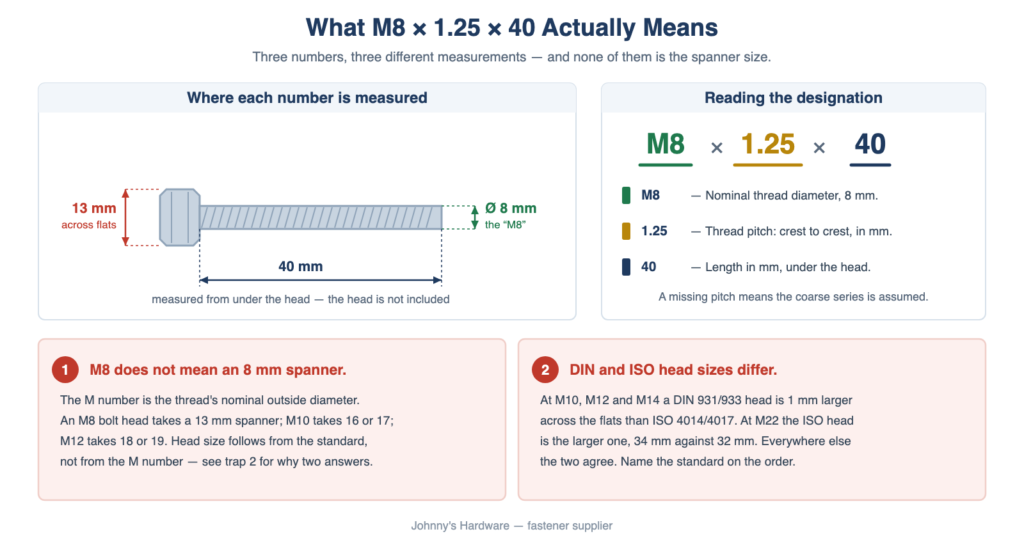
An M8 bolt has a thread 8 mm in diameter. It does not take an 8 mm spanner — it takes a 13 mm one. That single confusion accounts for more mis-ordered metric fasteners than any other, and it comes from reading the M number as a head size when it describes the thread.
A full metric designation looks like M8 × 1.25 × 40. Three numbers, three entirely different measurements: 8 mm nominal thread diameter, 1.25 mm thread pitch, 40 mm length measured under the head. The head size appears nowhere in it, because it follows from the standard the bolt is made to rather than from the designation.
What M8 x 1.25 x 40 means
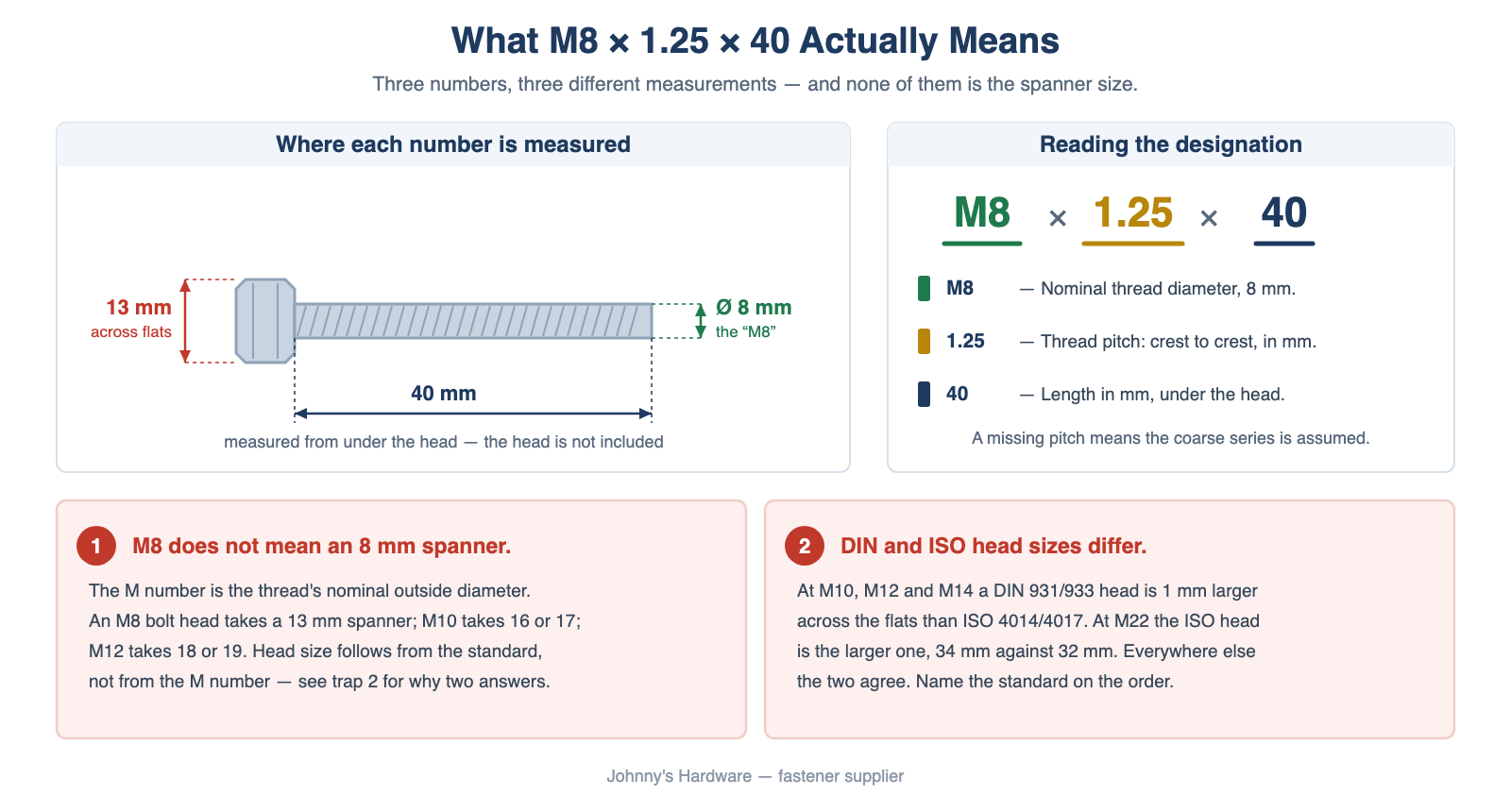
Taking each in turn:
- M8 — the ISO metric thread designation. The number is the nominal major diameter of the thread in millimetres, measured across the crests. Machine the bolt and put a caliper on the shank and you will read a shade under 8 mm, because the tolerance runs downward from nominal.
- 1.25 — the pitch, the distance from one thread crest to the next, in millimetres. This is the metric system’s genuine advantage: imperial fasteners state threads per inch, so the number rises as threads get finer, while metric states the distance, so the number falls. Coarser thread, bigger number.
- 40 — the length in millimetres, measured from under the head to the tip for any bolt with a protruding head. For countersunk heads the length is measured overall, head included, because the head sits inside the material.
You will often see the pitch omitted, written simply as M8 × 40. That is not an incomplete specification — it means the coarse series, which is the default. A fine pitch must always be stated explicitly.
Metric bolt size chart: pitch, wrench size and inch equivalent
Wrench sizes below are the width across flats for a standard hex head. Where DIN and ISO diverge, both are given — that divergence is covered in the next section.
| Size | Coarse pitch | Fine pitch | Across flats ISO 4014/4017 | Across flats DIN 931/933 | Diameter in inches |
|---|---|---|---|---|---|
| M3 | 0.5 | — | 5.5 | 5.5 | 0.118″ |
| M4 | 0.7 | — | 7 | 7 | 0.157″ |
| M5 | 0.8 | — | 8 | 8 | 0.197″ |
| M6 | 1.0 | — | 10 | 10 | 0.236″ |
| M8 | 1.25 | 1.0 | 13 | 13 | 0.315″ |
| M10 | 1.5 | 1.25 or 1.0 | 16 | 17 | 0.394″ |
| M12 | 1.75 | 1.5 or 1.25 | 18 | 19 | 0.472″ |
| M14 | 2.0 | 1.5 | 21 | 22 | 0.551″ |
| M16 | 2.0 | 1.5 | 24 | 24 | 0.630″ |
| M20 | 2.5 | 1.5 | 30 | 30 | 0.787″ |
| M22 | 2.5 | 1.5 | 34 | 32 | 0.866″ |
| M24 | 3.0 | 2.0 | 36 | 36 | 0.945″ |
The pattern in the wrench column is worth noticing: for most of the range the across-flats figure is roughly 1.5 times the thread diameter, but it is not a formula you can rely on. M10 breaks it, M22 breaks it, and socket head, flange and heavy hex variants have their own figures entirely. Read the size off the standard, never off a rule of thumb.
Where DIN 931 and ISO 4014 disagree
This is the one that costs money, and almost nothing written for a general audience mentions it.
DIN 931 and 933 are the older German hex bolt standards; ISO 4014 and 4017 are the international ones that replaced them. Dimensionally the two are identical except at four sizes, where the head is a millimetre different across the flats:
| Size | ISO 4014 / 4017 | DIN 931 / 933 | Which is larger |
|---|---|---|---|
| M10 | 16 mm | 17 mm | DIN |
| M12 | 18 mm | 19 mm | DIN |
| M14 | 21 mm | 22 mm | DIN |
| M22 | 34 mm | 32 mm | ISO |
The threads are the same, so both will fit the same hole. The head is what changes. Order M12 hex bolts against a drawing that says DIN 931 and receive ISO 4014 stock, and the fasteners will assemble correctly but the 19 mm sockets on the line will spin on an 18 mm head. On a maintenance or kit-assembly programme where tooling is fixed, that is a genuine rejection.
State the standard, not just the size. “M12 × 1.75 × 60, ISO 4014, class 8.8, zinc plated” is a specification. “M12 × 60 hex bolts” is a request that leaves four decisions to the factory.
Metric and imperial are not interchangeable
The inch column in the chart above converts diameters. It does not license substitution. Some pairs sit close enough to look swappable and are not:
| Metric | Nearest imperial | Difference | Interchangeable? |
|---|---|---|---|
| M6 (0.236″) | 1/4″ (0.250″) | M6 is 0.014″ undersize | No — loose in a 1/4″ hole, will not thread a 1/4″ nut |
| M8 (0.315″) | 5/16″ (0.3125″) | 0.002″ — nearly identical | No. Diameters match; the threads do not. It will start and then seize |
| M10 (0.394″) | 3/8″ (0.375″) | M10 is 0.019″ oversize | No — will not enter a 3/8″ hole |
| M12 (0.472″) | 1/2″ (0.500″) | M12 is 0.028″ undersize | No |
M8 and 5/16″ are the dangerous pair. Two thousandths of an inch apart on diameter, so an M8 bolt will start into a 5/16″-18 nut and turn a quarter of a turn before it locks. That is enough for it to be assembled by hand on a line and enough to strip both parts. Where a programme mixes markets, the practical defence is separating stock physically and marking cartons by thread system, not by diameter.
Specifying a metric bolt on a purchase order
Six fields make a metric bolt line unambiguous. Fewer than six and something is being decided for you.
| Field | Example | What goes wrong if it is left out |
|---|---|---|
| Thread and pitch | M12 × 1.75 | Omitting pitch means coarse. If you needed fine, you get the wrong thread |
| Length | 60 mm | Measured under the head, except on countersunk heads |
| Standard | ISO 4014 (part thread) or 4017 (full thread) | Head size at M10, M12, M14, M22; and whether the shank is threaded to the head |
| Property class | 8.8, 10.9 or 12.9 to ISO 898-1 | Strength, and therefore the torque figure the assembly is built to |
| Material and finish | Carbon steel, zinc plated / A2-70 stainless | Corrosion life, and whether class markings even apply |
| Head type | Hex, flange, socket cap | Changes the across-flats or drive size completely |
For a distributor stocking a general metric range, the defensible default is ISO 4017 full-thread hex bolts in class 8.8, zinc plated, coarse pitch, M6 to M16. That covers the overwhelming majority of general assembly demand on one standard and one class, keeps the wrench sizes consistent with modern tooling, and leaves fine pitch, 10.9 and stainless as deliberate additions rather than accidental mixtures. Once the property class is fixed, the bolt torque chart for that class becomes the reference the assembly is built against.
Final thoughts
Metric designation is a compact system that gives up nothing once you know which measurement each number carries. The M is the thread, the second number is the pitch, the third is the length under the head, and the head size is not in the designation at all — it comes from the standard. Name the standard and the class alongside the size, and a metric bolt line stops being ambiguous.
FAQ
What size is an M8 bolt?
An M8 bolt has a nominal thread diameter of 8 mm, which is 0.315 inches. Its standard coarse pitch is 1.25 mm and a fine pitch version at 1.0 mm also exists. The hex head takes a 13 mm spanner under both ISO 4014 and DIN 931. The length is stated separately and is measured from under the head, so an M8 × 40 bolt has 40 mm of shank below the head.
What does M8 mean on a bolt?
The M means an ISO metric thread and the 8 is the nominal major diameter of that thread in millimetres, measured across the thread crests. It is not the head size, not the spanner size and not the drill size. An actual M8 bolt measures slightly under 8 mm on the shank because manufacturing tolerance runs downward from the nominal figure.
What spanner does an M8 bolt take?
13 mm, for a standard hex head to either ISO 4017 or DIN 933. Flange head, socket cap and heavy hex variants of M8 use different figures, so the head type has to be known as well as the thread size. There is no reliable formula converting the M number to a wrench size — M10 and M22 both break the usual ratio, so read the value from the standard.
What is the difference between M8 x 1.25 and M8 x 1.0?
The pitch. M8 × 1.25 is the coarse series, the default assumed whenever a pitch is not stated. M8 × 1.0 is fine pitch, with threads spaced 1 mm apart instead of 1.25 mm. Fine threads give slightly higher tensile area and resist loosening under vibration, but they are more easily cross-threaded and are not interchangeable with coarse. A fine pitch must always be written out explicitly.
Is an M8 bolt the same as a 5/16 bolt?
No, though they are the closest metric-imperial pair in common use. M8 is 0.315 inches and 5/16 inch is 0.3125 inches, a difference of two thousandths. The diameters effectively match but the threads do not, so an M8 bolt will start into a 5/16-18 nut, turn part of a turn and then seize, damaging both parts. Never substitute one for the other.
How is metric bolt length measured?
From directly under the head to the tip, for any bolt with a head that sits on the surface — hex, flange, socket cap, button head. For countersunk and flat heads the length is measured overall, including the head, because the head is designed to sit inside the material. Getting this backwards on a countersunk order produces bolts that are consistently too short by the head height.
Do DIN 931 and ISO 4014 bolts have the same head size?
At most sizes yes, but not at four. At M10, M12 and M14 the DIN 931 and 933 head is 1 mm larger across the flats than ISO 4014 and 4017 — 17 against 16, 19 against 18, 22 against 21. At M22 the relationship reverses and the ISO head is larger, 34 mm against 32 mm. The threads are identical in every case, so the parts assemble but the tooling may not fit.
What does the pitch number mean on a metric bolt?
It is the distance between adjacent thread crests, in millimetres. This is the reverse of the imperial convention, which counts threads per inch, so the numbers move in opposite directions: a larger metric pitch number means a coarser thread, while a larger imperial TPI number means a finer one. M8 × 1.25 is coarse; M8 × 1.0 is fine.
What is the difference between ISO 4014 and ISO 4017?
Thread length. ISO 4014 is a partially threaded hex bolt with a plain shank under the head, and ISO 4017 is threaded along its full length. Partial thread suits shear joints where the plain shank bears against the hole; full thread suits thin sections and adjustable grip lengths. DIN 931 and DIN 933 are the corresponding older pair. Both must be specified, not assumed.
Are metric bolt property classes the same as grades?
They describe the same idea in different systems. Metric uses property classes to ISO 898-1, written as 8.8, 10.9 or 12.9, where the first number relates to tensile strength and the second to the yield-to-tensile ratio. Imperial uses SAE grades 2, 5 and 8 or ASTM designations. Class 8.8 is broadly comparable to grade 5 and 10.9 to grade 8, but they are not equivalents and should not be substituted on a specification.
Sourcing metric fasteners
Johnny’s Hardware supplies metric hex bolts, socket screws, studs and threaded rod from M3 to M24 to ISO 4014, ISO 4017, DIN 931 and DIN 933, in property classes 8.8, 10.9 and 12.9 to ISO 898-1, plus A2 and A4 stainless, with matching nuts to ISO 4032 and washers. Coarse and fine pitch are both standard, and imperial ranges run alongside for programmes serving both markets.
Metric and imperial stock is packed and labelled by thread system to keep the two apart in a warehouse, and orders consolidate across the bolts and nuts range, the wider fastener supplier catalogue and our OEM hardware supplier service in one shipment. If your programme is imperial rather than metric, the screw size chart covers gauge numbering on the screw side, and the bolt and nut size chart gives the inch bolt, nut and wrench sizes.
Send the thread and pitch, length, standard, property class, finish and head type, and we will come back with specifications, mill certificates, carton data and lead times within 12 working hours.
– Johnny’s Hardware Team, QC Engineer