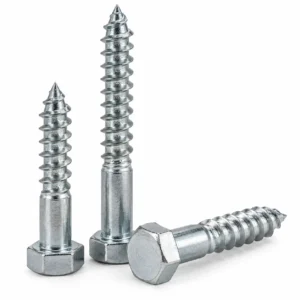
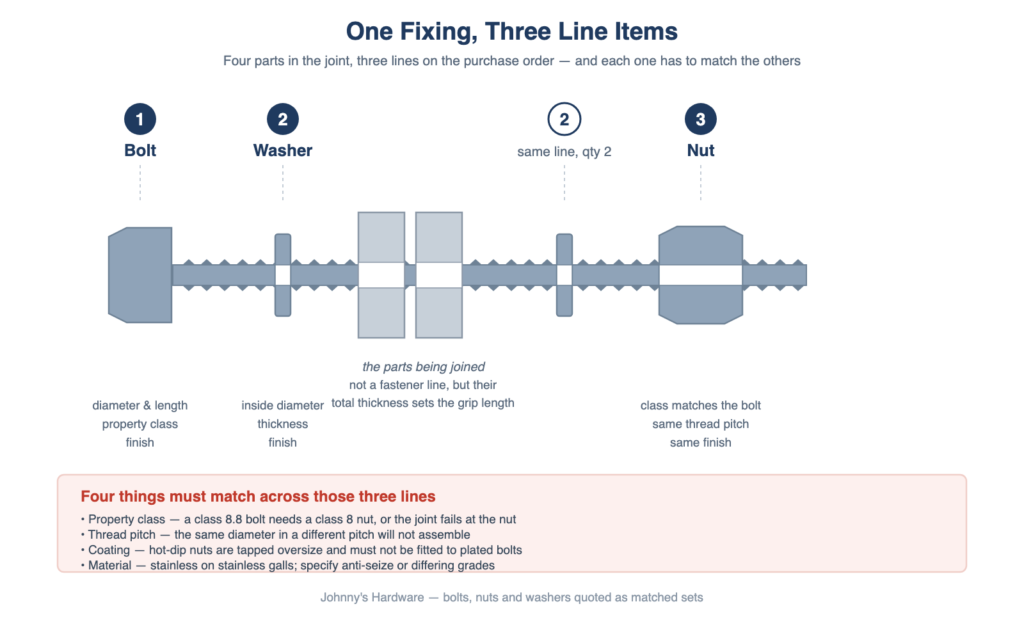
A bolt is externally threaded and carries the load. A nut is internally threaded and closes the joint from the far side. That is the whole definitional answer, and every article on the subject stops there. The part that costs money is different: on a purchase order a single bolted fixing is three lines, not one, and four separate things have to match across them.
This page covers the difference, then what it means when you are the one placing the order.
The difference in one section
| Bolt | Nut | |
|---|---|---|
| Thread | External, on the outside of the shank | Internal, inside the bore |
| Structure | Head plus a partly or fully threaded shank | No head; a threaded body, usually hexagonal |
| Job in the joint | Carries the tension that clamps the parts | Closes the joint and holds the tension |
| Can work alone | Yes, into a tapped hole | No, never |
| Sold by | Diameter, length, class, head, finish | Diameter, pitch, class, type, finish |
Note the last row. A bolt is specified by length and a nut is not, because a nut has no length to specify — but a nut does carry a pitch that has to be stated. The two products are described by different fields, which is exactly why they end up mismatched on an order.
One fixing, three line items
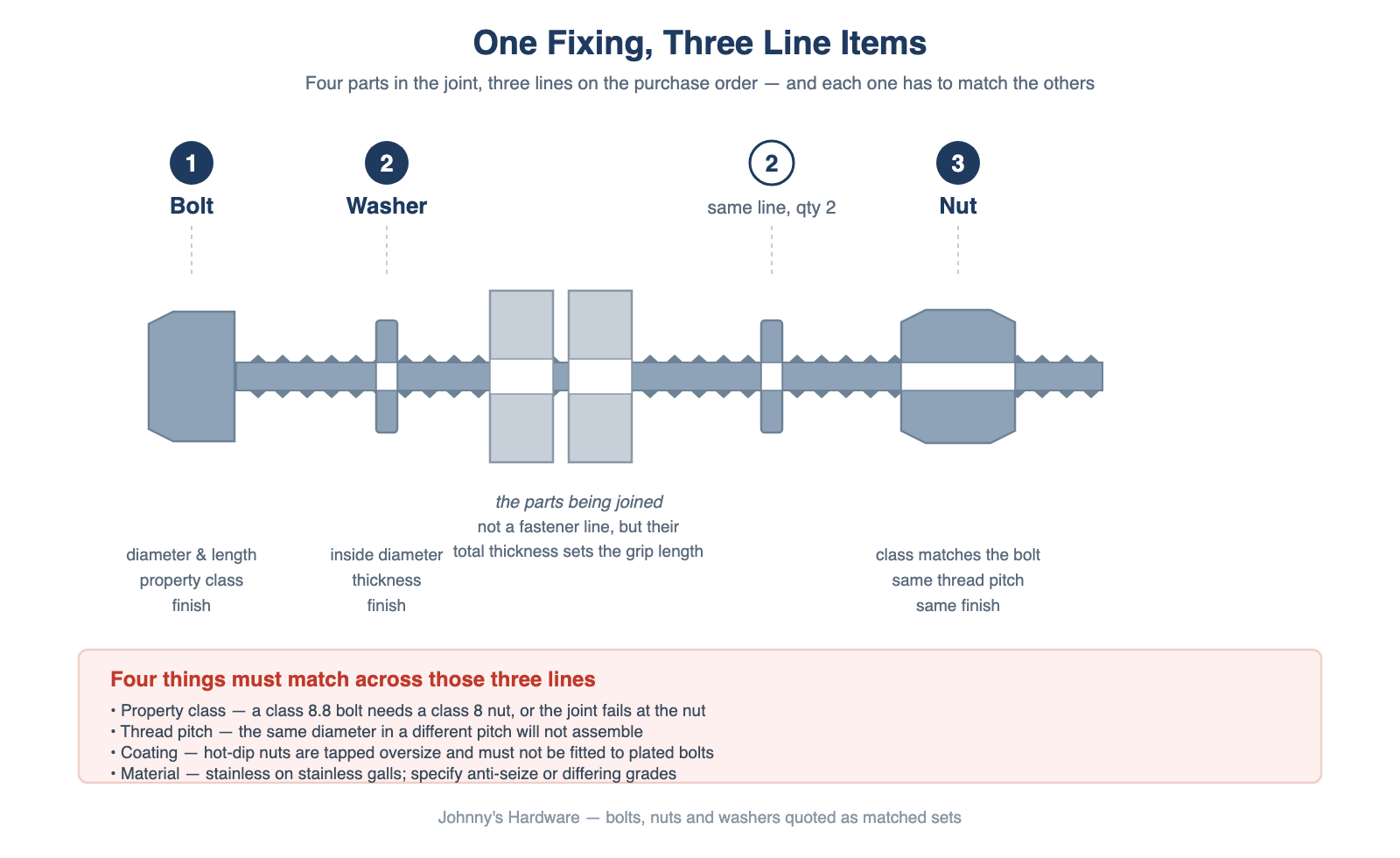
The practical difference between a bolt and a nut is that ordering one obliges you to order the other, in matching specification, in the right quantity. A screw is a single line. A bolted fixing is not.
- The bolt — diameter, length, property class, head type, drive if applicable, finish
- The washers — usually two per fixing, one under the head and one under the nut, on the same order line at double quantity
- The nut — diameter, pitch, class, type, finish
Buyers who plan a bolt range as a single line consistently end up short of nuts, or holding nuts that do not fit the bolts they arrived with. Quoting them as matched sets is the simplest way to avoid it, which is why our bolts and nuts range is priced that way by default.
The four things that have to match
1. Property class
A nut has a strength rating just as a bolt does, and it has to be at least equal. A class 8.8 bolt needs a class 8 nut; a 10.9 bolt needs a class 10. Pair a high-class bolt with a low-class nut and the joint fails at the nut threads, which strips before the bolt reaches the tension it was bought for. The bolt’s rating is wasted and the joint is weaker than either part suggests.
Imperial works the same way through a different naming system: a Grade 8 bolt takes a Grade 8 nut, not whatever hex nut is in the bin.
2. Thread pitch
Diameter alone does not define a thread. An M10 coarse has 1.50 mm pitch and an M10 fine has 1.25 mm, and the two will not assemble. In imperial the same trap appears as 1/2″-13 UNC against 1/2″-20 UNF. Both are “half inch”, and neither nut fits the other bolt.
Metric coarse is standardised against the diameter, so M10 implies 1.50 mm unless the order says otherwise. Imperial has no such default, which is one reason imperial orders need the thread count written out.
3. Coating
Hot-dip galvanising lays down a thick zinc layer, thick enough that the nut has to be tapped oversize to run onto the bolt at all. That is normal and it is specified in the standard. The consequence is a nut that must not be substituted onto a zinc plated bolt, where it will be loose, lose preload and back off in service.
It works in the other direction too: a standard nut will not run onto a hot-dip bolt. If the order mixes finishes, it produces a container of parts that individually pass inspection and together do not assemble.
4. Material
Stainless bolt with stainless nut is the combination that seizes. The threads gall — they cold-weld under sliding friction, because stainless cannot rebuild its oxide layer fast enough while moving. It happens most above M10 and when driving fast with a power tool, and once it has galled the fixing usually has to be cut off.
The fixes are anti-seize compound, slower assembly, or pairing grades that differ slightly. Whichever is chosen, it should be decided at the order stage rather than discovered on site.
When a bolt needs no nut at all
A bolt is the one of the pair that can work alone. Three cases come up regularly:
- Into a tapped hole — the female thread is machined into the part itself, so no nut is required. Strictly this is a cap screw application rather than a bolt one, though most markets use the terms interchangeably.
- Into a weld nut or rivet nut — the nut is already fixed in the assembly, so it is not on the fastener order at all.
- Anchor bolts into concrete — the embedded end is held by the concrete or by resin, and only the exposed end takes a nut.
This is the practical reason bolt and nut quantities are frequently not 1:1 on a real order. Ask what the female thread is before assuming a nut is needed.
When one bolt needs two nuts
The reverse also happens, and it is easy to under-order:
- Jam nut arrangements — a thin nut is tightened against a full nut to lock the assembly by friction between them.
- Adjustable assemblies — threaded rod suspension, turnbuckles and tie rods usually carry a nut on each side of a bracket.
- Coupling joints — where two lengths of threaded rod meet, a coupling nut joins them and standard nuts still secure each end.
What to put on the order
A complete bolted-fixing specification names all three lines and states the shared properties once:
- Bolt — M10 x 60, class 8.8, hex head, zinc plated
- Washer — M10 flat, zinc plated, quantity 2 per fixing
- Nut — M10 x 1.50, class 8, hex, zinc plated
Written that way, the class matches, the pitch is stated, the finish is consistent and the washer quantity is explicit. Everything the factory needs, and nothing left for either side to assume. The tightening figure that follows from that class is in our bolt torque chart.
Final thoughts
The definitional answer — external thread against internal thread — is the least useful thing about this comparison. What matters commercially is that a bolt and a nut are two products sold on different fields, bought together, and easy to mismatch. Get class, pitch, coating and material to agree across the lines and the rest of the order looks after itself.
FAQ
What is the difference between a nut and a bolt?
A bolt has an external thread on a shank with a head at one end, and it carries the tension that clamps a joint. A nut has an internal thread and no head, and it closes the joint from the opposite side. A bolt can work alone in a tapped hole; a nut can never work without a bolt or threaded rod to run onto.
Do nuts and bolts have to be the same grade?
Yes, and it is the most common mismatch on a bolt order. A class 8.8 bolt requires a class 8 nut, and a 10.9 bolt a class 10. If the nut is lower rated, its threads strip before the bolt reaches its intended tension, so the joint fails at the nut and the bolt’s rating is wasted entirely.
Can any nut fit any bolt of the same diameter?
No. Diameter is only half the thread specification — the pitch has to match as well. An M10 coarse at 1.50 mm pitch will not accept an M10 fine nut at 1.25 mm. The imperial equivalent is 1/2″-13 UNC against 1/2″-20 UNF. Both are nominally the same size and neither will assemble with the other.
How many washers does a bolted joint need?
Usually two, one under the head and one under the nut, so washers go on the order at double the bolt quantity. Some joints use one, and flange bolts or flange nuts build the bearing face into the part and need none. Confirm which arrangement applies before setting the quantity.
Why will a hot-dip galvanised nut not fit a zinc plated bolt?
It will fit, but too loosely. Hot-dip nuts are tapped oversize to clear the thick zinc on a hot-dip bolt, and that clearance is wrong on a thinly plated bolt. The assembly loses preload and can back off in service. Match the coating across the bolt and the nut rather than mixing what is in stock.
What is the difference between a bolt and a screw?
A bolt is tightened by turning a nut; a screw is tightened by turning its own head. For stocking, what matters is that bolts bring nuts and washers with them, so they are three lines rather than one. The full test, the trade names that break it and why the distinction changes a US duty rate are covered in bolt vs screw.
Do stainless nuts seize on stainless bolts?
They can, and it is called galling. The threads cold-weld under sliding friction because stainless cannot re-form its oxide layer fast enough while moving. It happens most on A4 above M10 and when driving quickly. Anti-seize compound, slower assembly or slightly differing grades all reduce it; once galled, the fixing usually has to be cut out.
Which is stronger, the nut or the bolt?
In a correctly specified pair, neither — the nut is chosen so its threads are at least as strong as the bolt, so the bolt shank is the limiting part. That is deliberate: a bolt failing in tension is predictable and inspectable, while stripped nut threads can hold apparent torque while carrying almost no clamp load.
Sourcing bolts and nuts as matched sets
Johnny’s Hardware supplies hex, carriage, eye, U-bolts and anchor bolts with the nuts and washers that pair with them, in carbon steel classes 4.8 through 12.9 and stainless A2 and A4, in DIN, ISO and ASTM standards. Class, pitch, coating and material are stated on every quotation rather than assumed.
Full range and order terms are on our bolts and nuts suppliers page. Bolts consolidate with screws and the rest of the fastener supplier range in one shipment, so a mixed order does not have to be split across factories.
– Johnny’s Hardware Team, Sourcing Advisor