There is no such thing as an OSHA approved shoe. OSHA does not test, certify or list footwear, and no box can truthfully carry that claim. What the regulation does is require protective footwear that meets a named consensus standard — ASTM F2413 — or is shown to be at least as effective. The evidence is the F2413 label stitched inside the shoe.
That label is one of two marking systems you will meet when sourcing safety footwear internationally. The other is the European EN ISO 20345 category — S1, S3 and the rest. The two test many of the same things, at different energies and in different units, and a shoe certified to one is not thereby certified to the other.
What OSHA actually requires
29 CFR 1910.136 requires employers to provide protective footwear wherever feet are at risk from falling or rolling objects, objects piercing the sole, or electrical hazards. Paragraph (b) sets the test: footwear must meet ASTM F2412 and ASTM F2413 — the 2005 editions are the ones written into the regulation — or the older ANSI Z41, or be demonstrated by the employer to be at least as effective.
F2412 is the test method; F2413 is the performance specification that says what the shoe must pass. In practice buyers specify the current edition, ASTM F2413-24. The regulation’s own “at least as effective” clause is what makes a later edition, or any other standard, acceptable — and that clause puts the burden of showing it on the employer, not on the supplier. The same structure governs eye protection under 1910.133, covered in ANSI Z87.1 safety glasses.
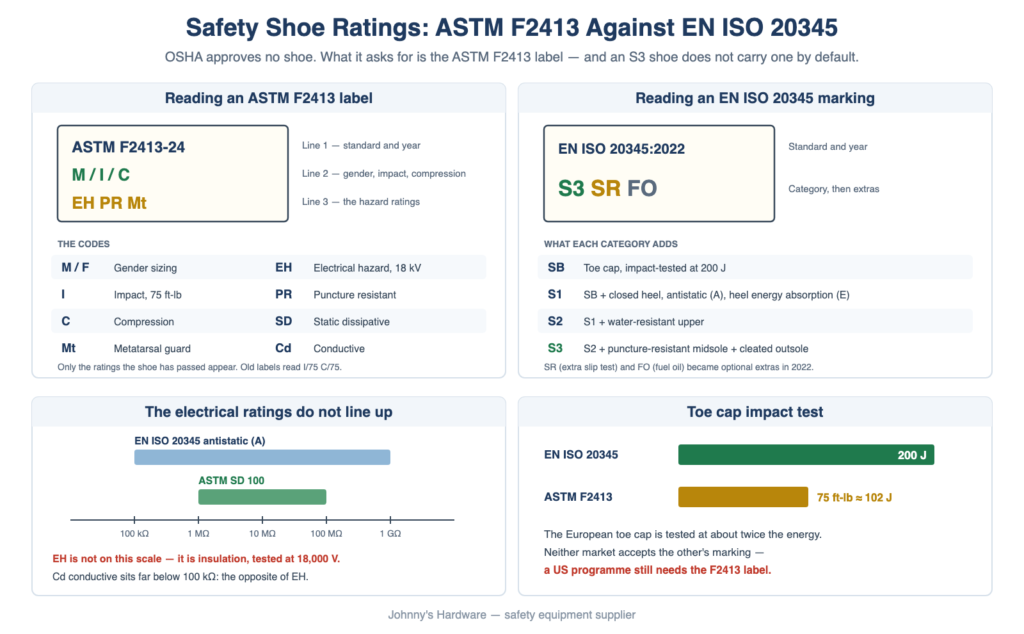
How to read an ASTM F2413 label
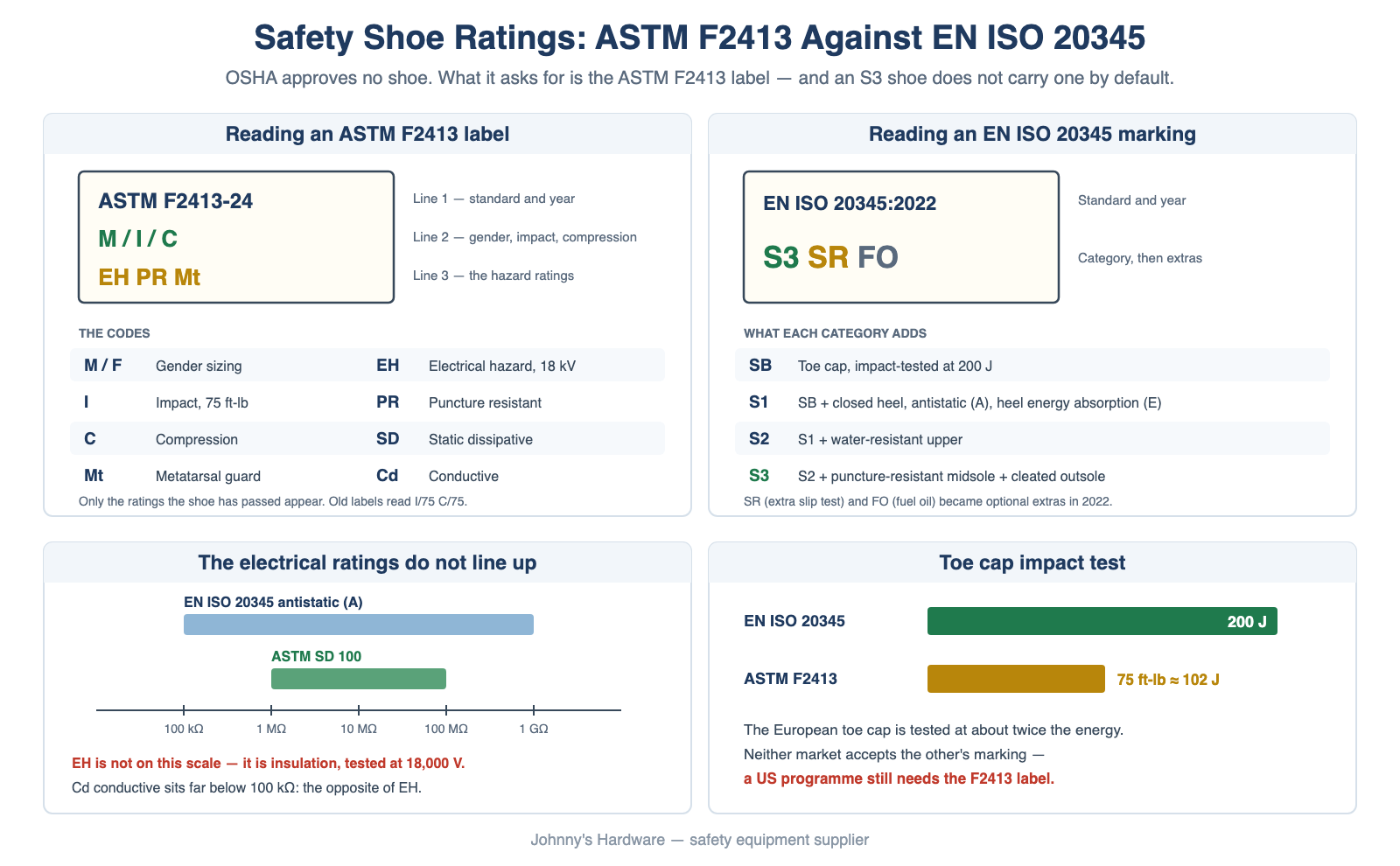
The label sits on the tongue, gusset or quarter lining of one shoe in the pair, in three or four lines:
| Line | Example | Means |
|---|---|---|
| 1 | ASTM F2413-24 | The standard and the edition year |
| 2 | M / I / C | Gender sizing, then impact and compression protection. Every F2413 shoe carries I and C |
| 3 and 4 | EH PR Mt | Additional hazard ratings — only the ones the shoe has actually passed |
| Code | Rating | What it covers |
|---|---|---|
| I | Impact | Toe cap tested at 75 ft-lb, about 102 joules |
| C | Compression | Toe cap tested under a crushing load |
| Mt | Metatarsal | A guard over the top of the foot, behind the toe cap |
| EH | Electrical hazard | Sole and heel withstand 18,000 V at 60 Hz for one minute with no more than 1.0 mA leakage |
| PR | Puncture resistance | A plate in the sole resists penetration from beneath |
| SD | Static dissipative | Controlled resistance to bleed off static. Marked SD 10, SD 35 or SD 100 |
| Cd | Conductive | Very low resistance, for explosive atmospheres — the opposite of EH |
Older labels read I/75 and C/75. Those class numbers belong to F2413-11 and earlier; current labels show I and C alone. A label in the old format tells you the edition behind it is old, which is worth knowing before accepting warehouse stock against a new specification.
How to read an EN ISO 20345 marking
European safety footwear is marked with the standard and a category, and each category bundles a set of properties that builds up from the base:
| Category | Adds | Typical use |
|---|---|---|
| SB | Toe cap impact-tested at 200 J, plus compression | Basic protection where only the toe is at risk |
| S1 | SB + closed heel, antistatic (A), heel energy absorption (E) | Dry indoor work: warehousing, logistics |
| S1P / S1PL / S1PS | S1 + puncture-resistant midsole | Dry work with nails and debris underfoot |
| S2 | S1 + water-resistant upper | Damp indoor or light outdoor work |
| S3 | S2 + puncture-resistant midsole + cleated outsole | Construction and general outdoor work — the most common site specification |
The 2022 revision changed three things a buyer will notice on the marking. Slip resistance became a basic requirement for every category, and SR now denotes an additional, more demanding slip test rather than the old SRA, SRB and SRC grades. Fuel oil resistance, FO, became an optional extra instead of being assumed. And non-metallic midsoles are now graded PL, tested with a 4.5 mm nail, or PS, tested with a finer 3 mm nail and the higher performance of the two, while P still denotes a steel plate.
A marking such as S3 SR FO therefore reads: the full S3 package, plus the harder slip test, plus fuel oil resistance.
Why an S3 shoe is not an ASTM F2413 shoe
The two standards overlap heavily in intent and differ in almost every number. The most striking is the toe cap: EN ISO 20345 impact-tests it at 200 joules; ASTM F2413 at 75 foot-pounds, roughly 102 joules. The European toe cap is tested at about twice the energy.
That does not make a European shoe compliant in the US. The test methods and pass criteria differ well beyond the toe cap, neither market accepts the other’s marking, and the F2413 label is what a US employer, safety manager or retailer will look for. An S3 shoe can be the better shoe and still be the wrong shoe for a US programme.
The reverse holds as well. A shoe tested only to F2413 has not been through EU type examination and carries no CE marking, so it cannot be placed on the European market as safety footwear on the strength of its ASTM label.
Three electrical ratings that are not the same thing
This is where cross-market footwear orders most often go wrong, because three different properties all get described as “electrical protection”:
| Rating | Standard | What it does | Resistance |
|---|---|---|---|
| EH | ASTM F2413 | Insulates — blocks current from accidental contact with a live circuit | Not a band: an 18,000 V withstand test |
| SD 100 | ASTM F2413 | Bleeds static to ground slowly, while still limiting current | 1 MΩ to 100 MΩ |
| Antistatic (A) | EN ISO 20345 | Prevents static build-up on the wearer | 100 kΩ to 1 GΩ |
| Cd | ASTM F2413 | Grounds the wearer as fast as possible | Very low — the opposite of EH |
Three consequences follow. An antistatic S3 shoe is not an EH shoe: antistatic drains charge, EH blocks current, and the S3 category contains no insulation test at all. Antistatic is not the same as SD: the European band is ten times wider at each end, so a shoe measuring 500 MΩ passes EN antistatic and fails SD 100. And footwear for electronics assembly is certified to a third standard again, IEC 61340-5-1, and should be specified separately.
EH itself is secondary protection for accidental contact, not permission to work live, and its performance drops once a sole is wet, worn through or punctured. Specify the property the hazard actually needs, by name and by standard.
Steel toe or composite toe
Both are tested to the same impact and compression requirements under either standard, so a certified composite toe is not a weaker toe. The differences are practical:
| Steel toe | Composite toe | |
|---|---|---|
| Protection | Same test, same pass | Same test, same pass |
| Bulk and weight | Thinner cap, heavier | Bulkier cap for the same rating, lighter |
| Temperature | Conducts cold and heat | Insulates — warmer in cold stores and winter work |
| Metal detectors | Sets them off | Passes through — preferred at airports and secure sites |
| Cost | Lower | Higher |
Steel remains the value default for general construction and warehousing. Composite earns its premium in cold environments, at security checkpoints and for workers on their feet all shift who notice the weight. Aluminium alloy toes sit between the two: thinner than composite, lighter than steel, and conductive like steel. Whether a boot is EH rated is decided by the sole, not the toe cap, so steel toe EH boots are common.
What to put on the order
| Field | Example | Why it matters |
|---|---|---|
| Market and standard | US: ASTM F2413-24. EU and UK: EN ISO 20345:2022 | Decides which certificate the shoe needs; one does not substitute for the other |
| Category or codes | S3 SR, or M / I / C / EH / PR | Name every property the hazard needs |
| Toe cap | Steel, composite or alloy | Weight, temperature, metal detectors |
| Midsole | Steel plate (P), or non-metallic PL or PS | PS resists finer points than PL; steel is the cheapest |
| Electrical property | EH, SD 100, antistatic or Cd — one of them | These are different properties, not grades of one |
| Sole | PU/PU, PU/rubber, heat-resistant rubber | Slip, oil and heat behaviour |
| Sizing | EU 36–48, or US sizes | Confirm the factory’s conversion chart before the first order |
| Evidence | EU type examination certificate, or F2413 test report naming the model | The marking is a claim; the report is the proof |
For a distributor serving more than one market, the defensible range is two lines, each certified for its own market: an S3 SR line to EN ISO 20345 for European and UK customers, and an ASTM F2413 M/F I/C EH line for US programmes, each with its own evidence file. Dual-certified shoes exist, but they cost more and still need both files; for most programmes it is simpler to hold the right certificate for each market. Within each line, steel toe and steel plate carries the volume, and composite with a non-metallic midsole is the upgrade for cold work and metal-detector sites.
Final thoughts
No shoe is OSHA approved, and none needs to be. A US programme needs the ASTM F2413 label; a European one needs the EN ISO 20345 category and the CE marking behind it. The two overlap in purpose and differ in their numbers, and the electrical ratings in particular do not translate. Name the market, the standard and every property the hazard calls for, and ask for the evidence that backs the marking.
FAQ
Are there OSHA approved safety shoes?
No. OSHA does not test, approve or list footwear. 29 CFR 1910.136 requires protective footwear that meets ASTM F2412 and F2413, or the older ANSI Z41, or is shown by the employer to be at least as effective. A product sold as “OSHA approved” means, at best, that it carries an ASTM F2413 label. Look for that label inside the shoe rather than the claim on the box.
What does ASTM F2413 mean on a boot?
That the boot has been tested to the US performance specification for protective toe cap footwear. Line one gives the standard and edition year, line two the gender and the impact and compression ratings every F2413 shoe must carry, and lines three and four any extra ratings such as EH, PR, Mt or SD. Only the ratings the boot actually passed are printed.
What does EH mean on work boots?
Electrical hazard. The sole and heel have withstood 18,000 volts at 60 Hz for one minute with no more than 1.0 milliampere of leakage. EH is secondary protection against accidental contact with live circuits, not permission to work live, and its performance falls when the sole is wet, worn through or punctured. It is decided by the sole, not the toe cap.
Is an S3 safety shoe the same as ASTM F2413?
No. They are separate standards with different tests. EN ISO 20345 impact-tests the toe cap at 200 joules against roughly 102 joules for ASTM F2413, but a higher test energy does not transfer certification. A US programme needs the F2413 label, and an F2413 shoe cannot be sold into the EU without EU type examination and a CE marking. State the destination market when ordering.
What is the difference between S1 and S3 safety shoes?
S1 has the base toe cap plus a closed heel, antistatic properties and heel energy absorption, which suits dry indoor work. S3 adds a water-resistant upper, a puncture-resistant midsole and a cleated outsole, which suits construction and general outdoor work. S1P sits between them: S1 with a puncture-resistant midsole but without the water resistance or cleats.
Is antistatic the same as static dissipative or ESD?
No. EN ISO 20345 antistatic covers 100 kilohms to 1 gigaohm; ASTM SD 100 covers 1 to 100 megohms, a band ten times narrower at each end. A shoe at 500 megohms passes the European test and fails SD 100. Footwear for electronics assembly is certified to a third standard, IEC 61340-5-1. None of them is insulation, which is what EH provides.
Is a composite toe as safe as a steel toe?
Yes, when both are certified. They pass the same impact and compression tests under either standard. The differences are practical: composite is lighter, bulkier for the same rating, insulates against cold and passes metal detectors; steel is thinner, heavier, conducts temperature and costs less. Choose on weight, climate and site security rather than on protection.
What does SR FO mean on safety shoes?
Under EN ISO 20345:2022, SR means the shoe passed an additional, more demanding slip resistance test on top of the basic slip requirement every category now carries. FO means the outsole is resistant to fuel oil. Both became optional extras in the 2022 revision, so a marking of S3 SR FO means the full S3 package plus both extras.
What does PR mean on safety boots?
Puncture resistance: a plate in the sole resists penetration by sharp objects from beneath, such as nails on a construction site. Under ASTM F2413 it is marked PR. The European equivalent is a puncture-resistant midsole, marked P for a steel plate or PL and PS for non-metallic inserts, with PS resisting finer points. S1P and S3 shoes include one.
Do EH boots protect against static electricity?
No, and they are not meant to. EH footwear insulates, which is the opposite of what static control needs. Static dissipative and antistatic footwear let charge drain away slowly through a controlled resistance. Where a workplace has both electrical and static hazards, the choice has to be made deliberately against the risk assessment, because one property works against the other.
Sourcing safety footwear
Johnny’s Hardware supplies safety shoes to EN ISO 20345:2022, category S3 SR FO, with a steel toe cap, a steel puncture-resistant midsole and a PU/PU injection sole in sizes EU 36 to 48, supplied with the EU type examination certificate issued by a notified body. They consolidate with the rest of the safety equipment range — safety glasses, bump caps and cut resistant gloves among them — and with the fastener supplier range in one shipment, with private label and retail packaging through our OEM hardware supplier service.
For US programmes that need an ASTM F2413 label, say so at the enquiry stage. F2413 is a separate certification, and we confirm it model by model before quoting rather than assume an S3 shoe will do. Head protection to ANSI Z89.1 and EN 397 is covered in types of hard hats.
Send the destination market, the standard and category or codes, toe cap, midsole, sizing and quantity, and we will come back with specifications, certificates, carton data and lead times within 12 working hours.
– Johnny’s Hardware Team, QC Engineer