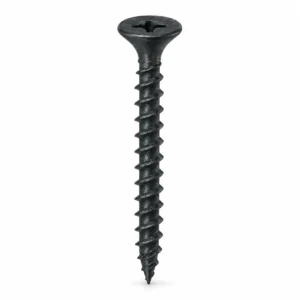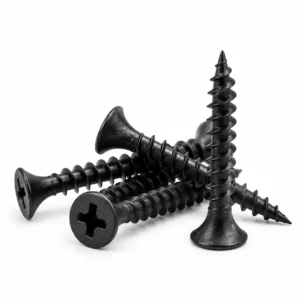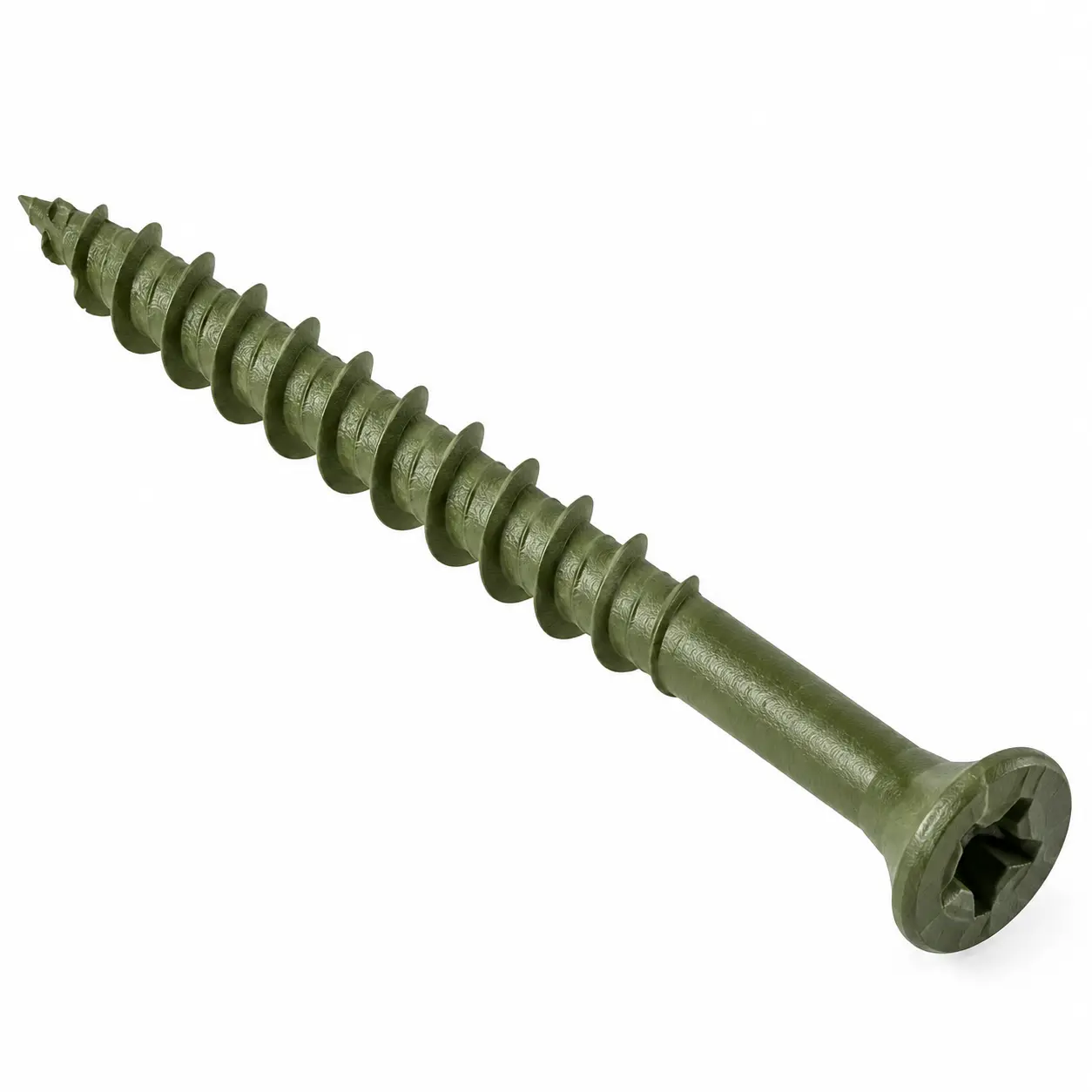
Yes. Zinc plated screws rust, and outdoors they do it faster than most buyers expect — a clear zinc plated fastener typically survives around 96 hours of salt spray before red rust appears, against 480 to 1,000 hours for hot-dip galvanised. Zinc plating is an indoor finish that happens to look like an outdoor one.
The confusion is worth clearing up because “zinc plated” and “galvanised” both mean a zinc coating, and the two get used interchangeably in catalogues. They are not the same product. One is a few microns thick and one is ten times that, and the gap between them is where warranty claims live.
How long each coating actually lasts
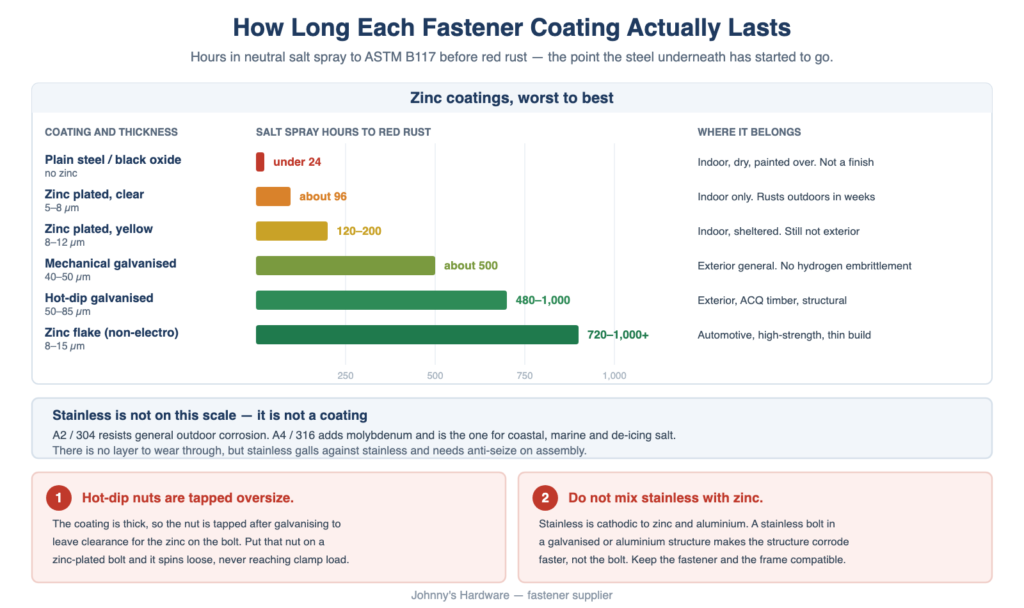
The industry measures this in neutral salt spray hours to ASTM B117 — how long a part sits in a salt fog chamber before red rust appears. Red rust matters because it means the steel underneath has begun to corrode; white rust before it is just the zinc doing its job.
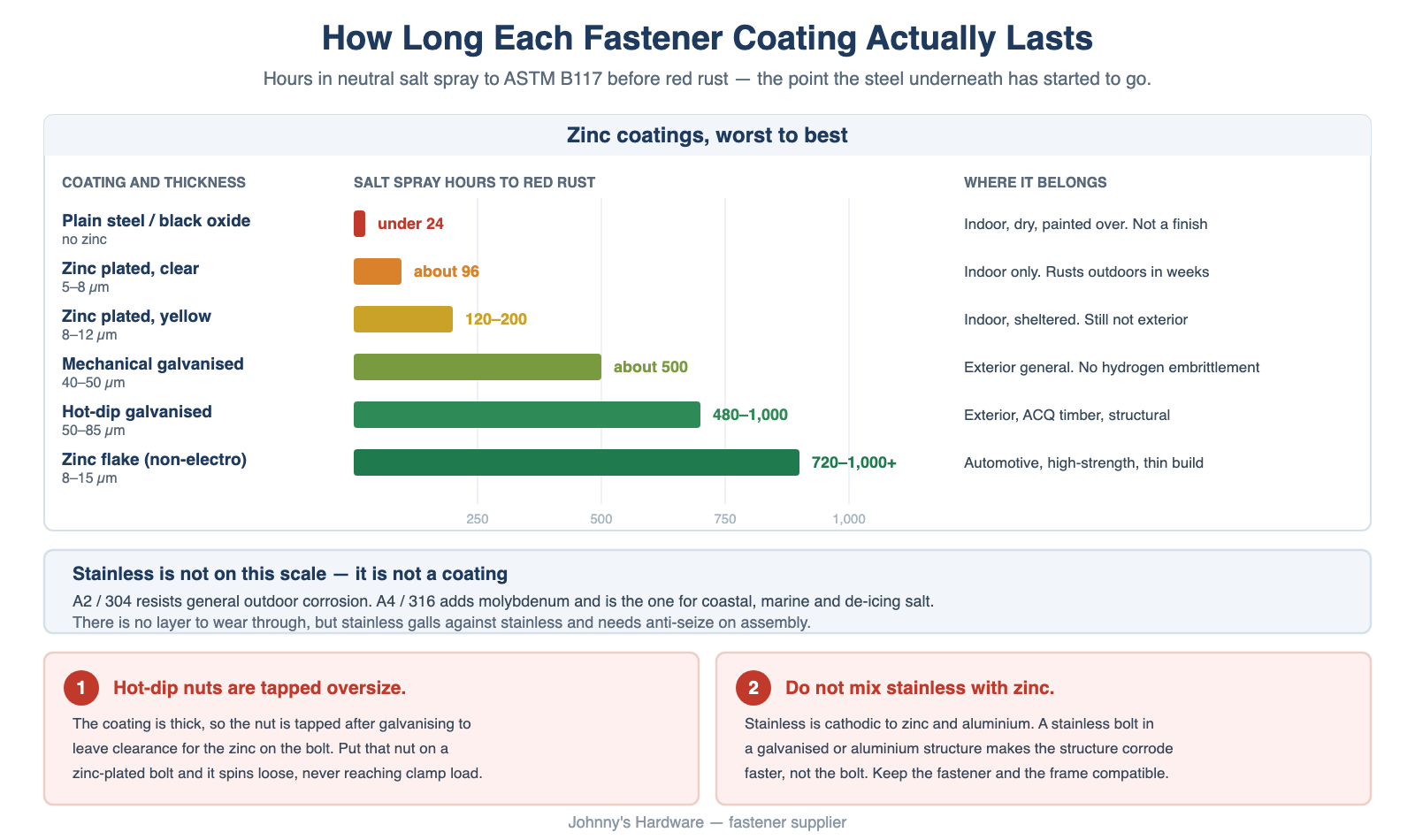
| Coating | Thickness | Salt spray to red rust | Where it belongs |
|---|---|---|---|
| Plain / black oxide | None | Under 24 hours | Indoor, dry, or painted over. Black oxide is an appearance and anti-glare finish, not corrosion protection |
| Zinc plated, clear or blue | 5–8 µm | About 96 hours | Indoor only. Visible rust outdoors within weeks in a wet climate |
| Zinc plated, yellow chromate | 8–12 µm | 120–200 hours | Indoor and sheltered. Better than clear, still not an exterior finish |
| Mechanical galvanised | 40–50 µm | About 500 hours | Exterior. Applied cold, so no hydrogen embrittlement risk on high-strength parts |
| Hot-dip galvanised | 50–85 µm | 480–1,000 hours | Exterior, structural, and treated timber. ASTM A153 Class D is the fastener spec |
| Zinc flake | 8–15 µm | 720–1,000+ hours | Automotive and high-strength work. Non-electrolytic, so no embrittlement, and thin enough not to affect thread fit |
The line worth pausing on is the last one. Zinc flake at 8–15 microns outlasts hot-dip at 50–85 microns. Thickness is a proxy for protection within one process, never across processes, so a specification written as “minimum 40 micron zinc coating” rules out the best-performing option on the list. Specify the performance you need, not the thickness you imagine delivers it.
Why zinc protects at all, and why that runs out
Zinc is less noble than steel, so in the presence of moisture it corrodes preferentially and the steel underneath is spared. This is why a scratched galvanised bolt does not rust from the scratch — the surrounding zinc protects the exposed steel sacrificially, across a small gap.
Two consequences follow, and both are practical:
- More zinc means more time, not better protection. The mechanism is identical at 5 microns and 80 microns. The thicker coating simply has more material to consume before it is gone. That is why the salt spray numbers scale roughly with thickness within a process.
- White rust is not failure. The powdery white bloom on galvanised parts is zinc oxide, the coating working. Red rust is failure. Buyers who reject a shipment for white rust after storage in a damp container are rejecting evidence that the coating is doing its job — though it does mean the parts were stored badly and some service life has been spent.
The pressure-treated timber problem
This one catches out anyone shipping fasteners into the North American deck and fencing market.
ACQ pressure-treated lumber — alkaline copper quaternary — replaced the old CCA treatment and carries a much higher copper content. Copper is far more noble than zinc, so a zinc coated fastener in wet ACQ timber becomes the sacrificial half of a galvanic cell and corrodes quickly. The organic components in the treatment also hold moisture against the fastener, which accelerates it further.
The result is a clear rule that US building codes and the treatment industry both reflect:
| For ACQ treated timber | Verdict |
|---|---|
| Hot-dip galvanised to ASTM A153 Class D | Suitable — the industry default |
| Stainless steel, 304 or 316 | Suitable — 316 for coastal exposure |
| Zinc plated (electroplated) | Not suitable |
| Aluminium, copper and copper alloys | Not suitable |
| Stainless-capped or zinc-alloy-headed screws | Not suitable — the cap hides a base metal that still corrodes |
If a customer’s programme includes deck screws, fence fixings or joist hangers for the US market, ASTM A153 Class D belongs on the specification explicitly. “Galvanised” alone does not distinguish hot-dip from electroplated, and the two behave completely differently in this application.
Two traps that produce returns
Hot-dip nuts are tapped oversize
A hot-dip coating is thick enough to fill a thread, so the nut is tapped after galvanising, oversize, to leave clearance for the zinc sitting on the bolt. That nut is correct on a hot-dip bolt and wrong on anything else. Put a hot-dip nut on a zinc-plated bolt and it will spin on loosely and never reach clamp load, while looking entirely normal.
The defence is simple: buy hot-dip bolts and nuts as matched sets from the same source, and never let a warehouse mix galvanised nuts into a plated bin because they are the same nominal size.
Do not mix stainless with zinc or aluminium
Stainless is cathodic to both zinc and aluminium. A stainless bolt through a galvanised or aluminium structure does not corrode — the structure around it does, faster than it otherwise would, because the small noble fastener drives corrosion in the large less-noble member.
This runs opposite to intuition, which says the better material is the safer choice. Where a stainless fastener genuinely has to go into aluminium, isolate the two with a nylon washer or sleeve, or accept the trade-off deliberately rather than by accident.
Choosing a coating for a programme
| Application | Specify |
|---|---|
| Indoor assembly, furniture, cabinets, electronics | Zinc plated, clear or blue |
| Sheltered exterior — carports, under cover | Zinc plated yellow at minimum; mechanical galvanised is safer |
| General exterior, decking, fencing, ACQ timber | Hot-dip galvanised to ASTM A153 Class D |
| Coastal, marine, de-icing salt | Stainless A4 / 316 |
| High strength, class 10.9 and above | Zinc flake or mechanical galvanised — both avoid the hydrogen embrittlement risk of electroplating |
That last row is the one that carries real risk. Electroplating introduces hydrogen into high-strength steel, which can cause delayed brittle fracture — a bolt that passes inspection and snaps days later under static load. Parts at class 10.9 and above should either be baked promptly after plating or, better, given a non-electrolytic coating instead. If a programme includes 10.9 or 12.9 fasteners, ask the supplier which coating process is used and whether baking is performed. It is a fair question and a real one.
For a general distributor, the practical stocking answer is two finishes rather than five: zinc plated for the indoor range and hot-dip galvanised for the exterior range, with stainless A2 and A4 quoted against demand. Mechanical galvanised and zinc flake are worth knowing about for the specific cases above rather than holding as stock.
Final thoughts
Zinc plated screws rust because they were never meant not to — a few microns of zinc buys a few months in a dry building, and that is the whole design intent. The question is never whether a coating rusts but how long it holds and in what environment, and salt spray hours make that comparable across products in a way that “galvanised” on a label never will. Put the process and the standard on the specification, and the finish stops being a guess.
FAQ
Do zinc screws rust?
Yes. Zinc plated screws typically reach red rust after around 96 hours of neutral salt spray testing, which in practice means a few years indoors and a few weeks to months outdoors in a wet climate. The zinc corrodes first and protects the steel, but there is only 5 to 8 microns of it. Once it is consumed the steel underneath rusts normally.
Are zinc plated screws rust proof?
No, and nothing marketed as rust proof genuinely is. Zinc plating delays corrosion by sacrificing itself; it does not prevent it. For outdoor use the realistic options are hot-dip galvanising, zinc flake or stainless steel. Treat “rust proof” in a product listing as marketing language and ask for a salt spray figure instead, which is measurable.
What is the difference between zinc plated and galvanised?
Thickness and process. Zinc plating is electroplated at 5 to 12 microns and is an indoor finish. Hot-dip galvanising dips the part in molten zinc at 50 to 85 microns and is an exterior finish, lasting roughly five to ten times as long in salt spray. Both are zinc coatings, which is why catalogues confuse them, but they are not interchangeable for any outdoor application.
Which is better, zinc or stainless steel screws?
They work differently. Zinc is a sacrificial coating on carbon steel, so it has a finite life. Stainless resists corrosion through its own chromium oxide layer, which self-repairs and does not wear out. Stainless is the better choice outdoors and the necessary one in marine conditions, but it costs more, is generally weaker than a class 8.8 bolt, and must not be mixed with galvanised or aluminium structure.
What screws should I use for pressure-treated wood?
Hot-dip galvanised to ASTM A153 Class D, or stainless steel in 304 or 316. ACQ treatment carries a high copper content that corrodes zinc rapidly through galvanic action, so electroplated zinc screws, aluminium, copper alloys and stainless-capped screws are all unsuitable. Specify A153 Class D by name, because “galvanised” alone does not exclude electroplated parts.
Is white rust on galvanised bolts a problem?
Not a defect, but a warning. White rust is zinc oxide — the coating corroding as designed rather than the steel. It usually means parts were stored damp or with poor ventilation, often in a sealed container. The fasteners are still serviceable, but some coating life has been spent. Store galvanised stock dry and ventilated, and avoid stacking parts wet.
How many salt spray hours do I need?
As a rough guide: under 200 hours for indoor use, 500 or more for general exterior, and 720 or more for automotive, coastal or heavy industrial exposure. Salt spray is an accelerated comparative test rather than a prediction of years in service, so use it to compare coatings against each other, not to promise a service life to a customer.
Can I use a hot-dip galvanised nut on a zinc plated bolt?
No. Hot-dip nuts are tapped oversize after coating to leave room for the thick zinc layer on the bolt. On a zinc plated bolt, which has a much thinner coating, that nut fits loosely and cannot develop proper clamp load, even though it threads on and looks correct. Buy hot-dip bolts and nuts as matched sets and keep the two finishes separated in stock.
Does plating affect high-strength bolts?
Yes, and it is a genuine safety issue. Electroplating can drive hydrogen into high-strength steel, causing delayed brittle failure in fasteners at class 10.9 and above. The mitigations are baking soon after plating to drive the hydrogen out, or using a non-electrolytic coating such as zinc flake or mechanical galvanising. Ask which process a supplier uses on high-strength parts.
What does ASTM B117 actually measure?
It is a neutral salt spray test: parts sit in a sealed chamber in a continuous fog of 5% salt solution at 35 °C, and the time to first white rust and first red rust is recorded. It is deliberately harsh and does not reproduce real weather, so the hours are useful for ranking coatings against one another under identical conditions rather than for converting into years outdoors.
Sourcing coated fasteners
Johnny’s Hardware supplies bolts, screws, nuts and threaded rod in zinc plated clear and yellow, mechanical galvanised, hot-dip galvanised to ASTM A153, zinc flake, black oxide and plain, plus A2 and A4 stainless throughout. Salt spray test reports are provided on request for any coating on the list.
Hot-dip bolts and nuts are supplied as matched sets with the nuts tapped for the coating, so the oversize-tapping problem does not reach your warehouse, and high-strength parts at class 10.9 and above are quoted with a non-electrolytic coating by default rather than electroplated. Orders consolidate across the bolts and nuts range, the screw supplier range and the wider fastener supplier catalogue, with private label and retail packaging through our OEM hardware supplier service.
If you are still fixing the rest of the specification, types of nuts and bolts covers which shapes suit which joint, and the bolt torque chart covers what each property class should be tightened to.
Send the application, environment, sizes and property class, and we will come back with a coating recommendation, salt spray data, mill certificates, carton data and lead times within 12 working hours.
– Johnny’s Hardware Team, QC Engineer