The name of a concrete anchor tells you how it grips. It does not tell you whether it is rated for cracked concrete, and that rating decides whether it can be used in an engineered design. Most guides sort anchors by shape and stop there.
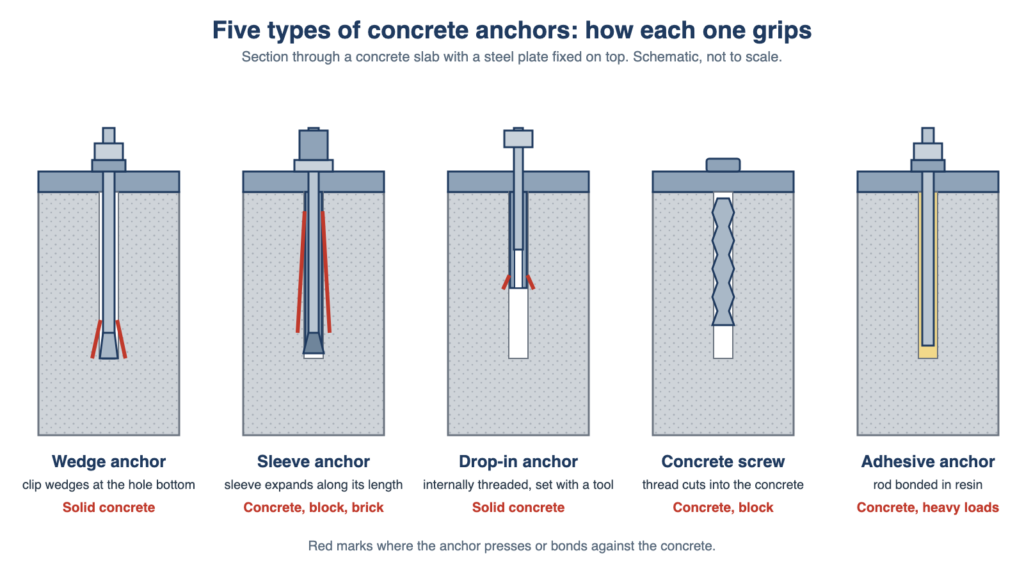
The main types of concrete anchors are wedge, sleeve, drop-in, concrete screw and adhesive anchors. Wedge anchors carry the most load in solid concrete, sleeve anchors also work in block and brick, and the cracked-concrete rating comes from the anchor’s evaluation report, not from its type.
Types of concrete anchors at a glance
The types differ in how they transfer load to the concrete: by friction at the bottom of the hole, along a sleeve, through a thread cut into the wall of the hole, or through a bonded rod.
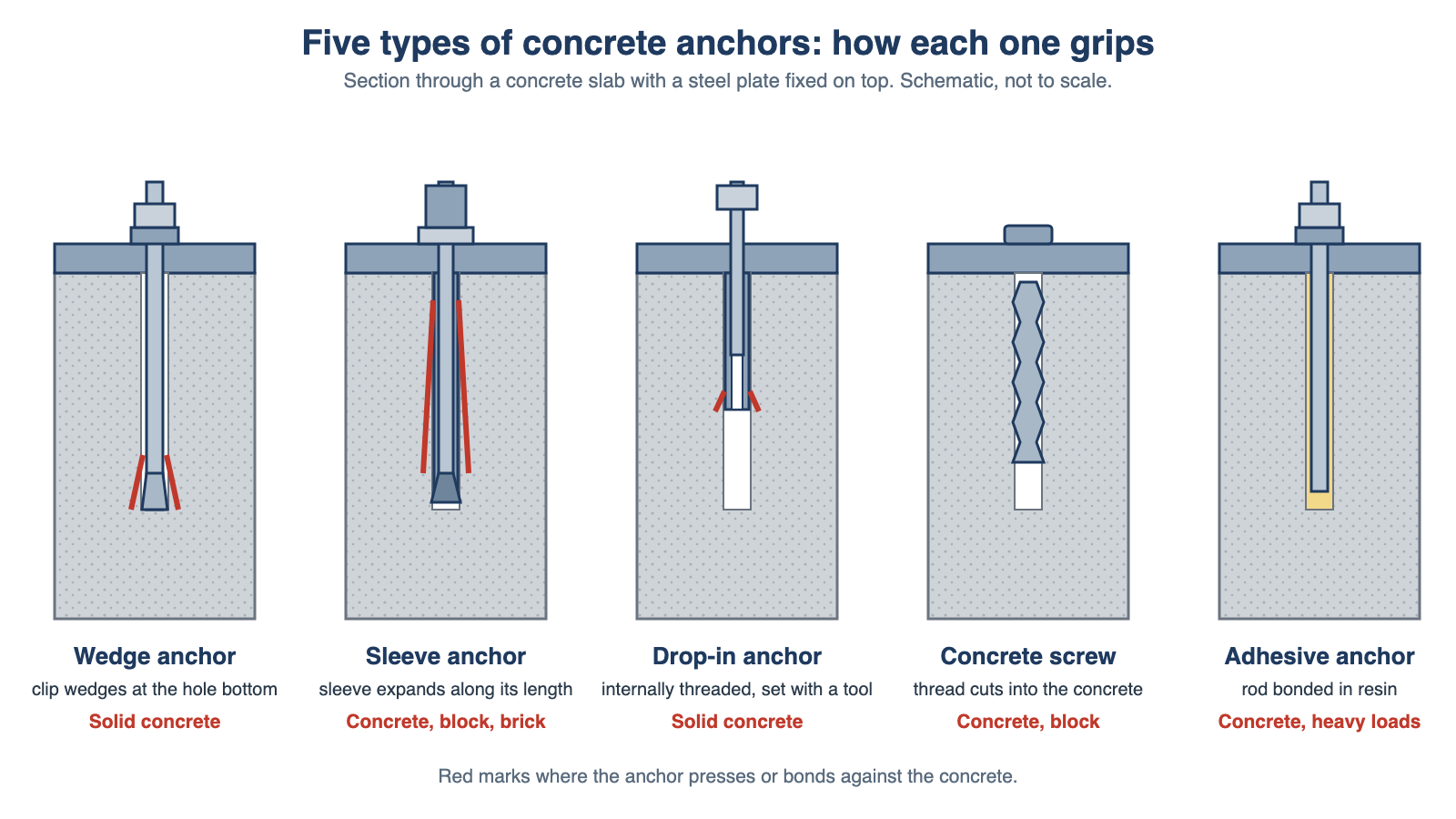
| Type | How it grips | Base material | Removable? | Typical use |
|---|---|---|---|---|
| Wedge anchor | A clip is forced against the hole wall at the bottom as the nut is tightened | Solid concrete only | Permanent | Steel base plates, heavy equipment, bracing |
| Sleeve anchor | A cone expands a sleeve along most of its length | Concrete, block, brick | Nut comes off, the sleeve stays | Handrails, fixtures, medium-duty fixings |
| Drop-in anchor | An internally threaded shell is expanded with a setting tool | Solid concrete | Bolt removable, shell stays | Threaded rod hangers, flush fixings |
| Concrete screw | A hardened thread cuts into the hole wall | Concrete, block | Yes | Light to medium fixings that may be moved |
| Adhesive anchor | A rod is bonded into the hole with resin | Concrete | Permanent | Heavy loads, and fixings where expansion stress is a concern |
Two further types are worth knowing by name. A lag shield is an expansion shell that takes a lag bolt in light to medium loads, and cast-in anchor bolts are set in the concrete before it is poured, so they are not a post-installed anchor at all. The drywall equivalent of this chart is in types of drywall anchors.
Wedge anchor vs sleeve anchor
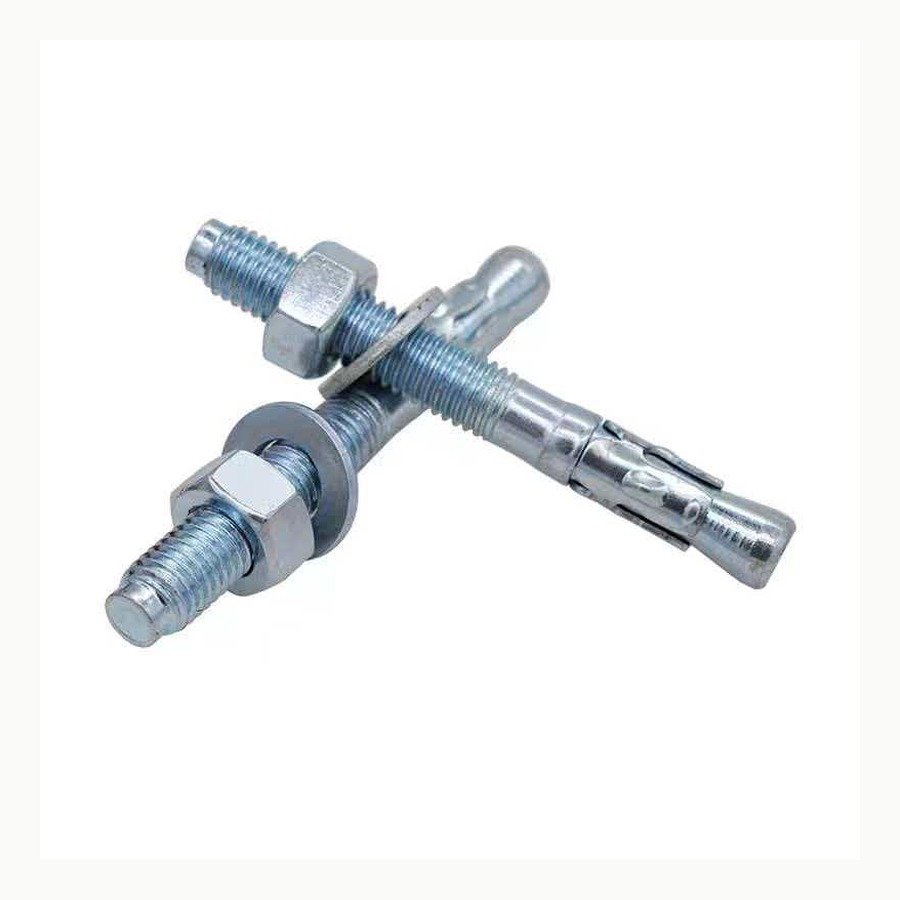
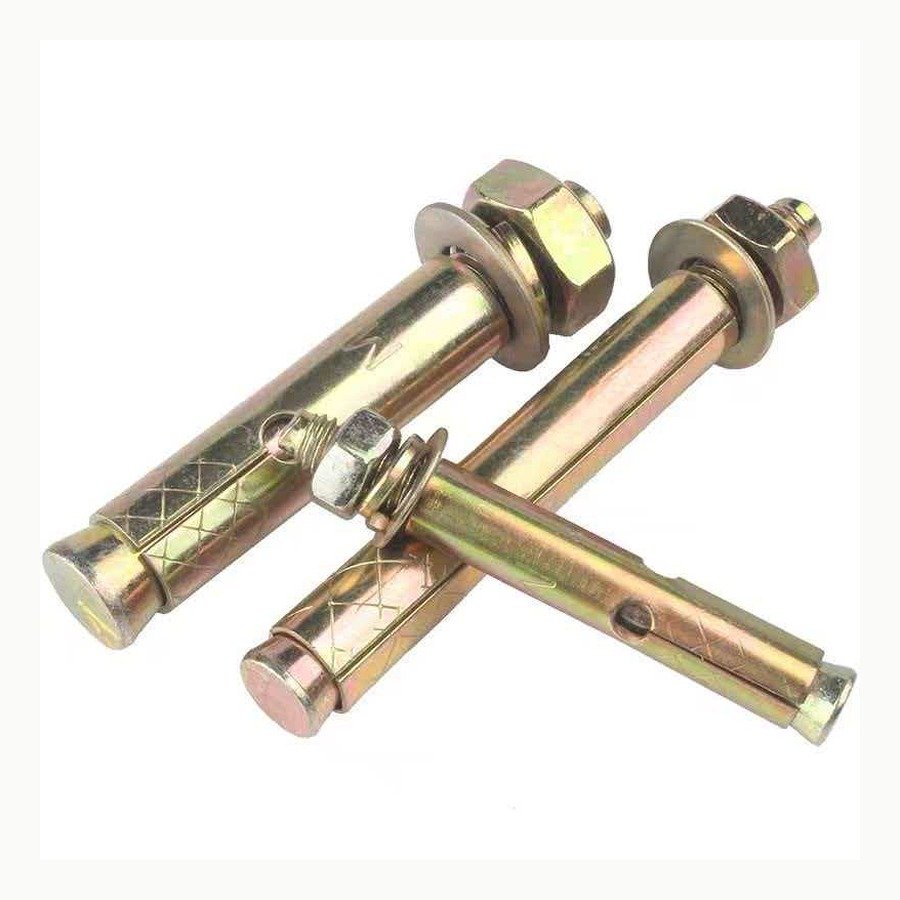
A wedge anchor carries more load but works only in solid concrete. A sleeve anchor carries less but works in block and brick as well, and it is the more forgiving choice where the base material is uncertain.
| Wedge anchor | Sleeve anchor | |
|---|---|---|
| How it expands | Clip at the bottom of the hole only | Sleeve along most of its length |
| Base material | Solid concrete only. Not for hollow block or brick | Concrete, brick and hollow block. Mortar joints only for low loads |
| Diameters | 1/4 to 1 in. | 1/4 to 3/4 in. |
| Load in solid concrete | Higher. Distributor catalogues show roughly 40 to 60% more than a sleeve anchor of the same diameter | Lower. Suited to medium-duty work |
| Removability | Permanent. Do not re-tighten a set anchor | The bolt can be replaced, the sleeve stays in the hole |
| Best for | Base plates, equipment, bracing, code-required fixings | Handrails, light fixtures, electrical boxes, mixed base materials |
The diameters, base materials and load comparison are from a distributor’s published guide and are catalogue figures for comparison. They are not design loads. For any design use, take the capacity from the product’s evaluation report.
Cracked concrete changes the choice
Concrete cracks in service, and an anchor that works in sound concrete can lose capacity when a crack passes through the hole. Whether an anchor is qualified for cracked concrete is therefore a separate rating from its type.
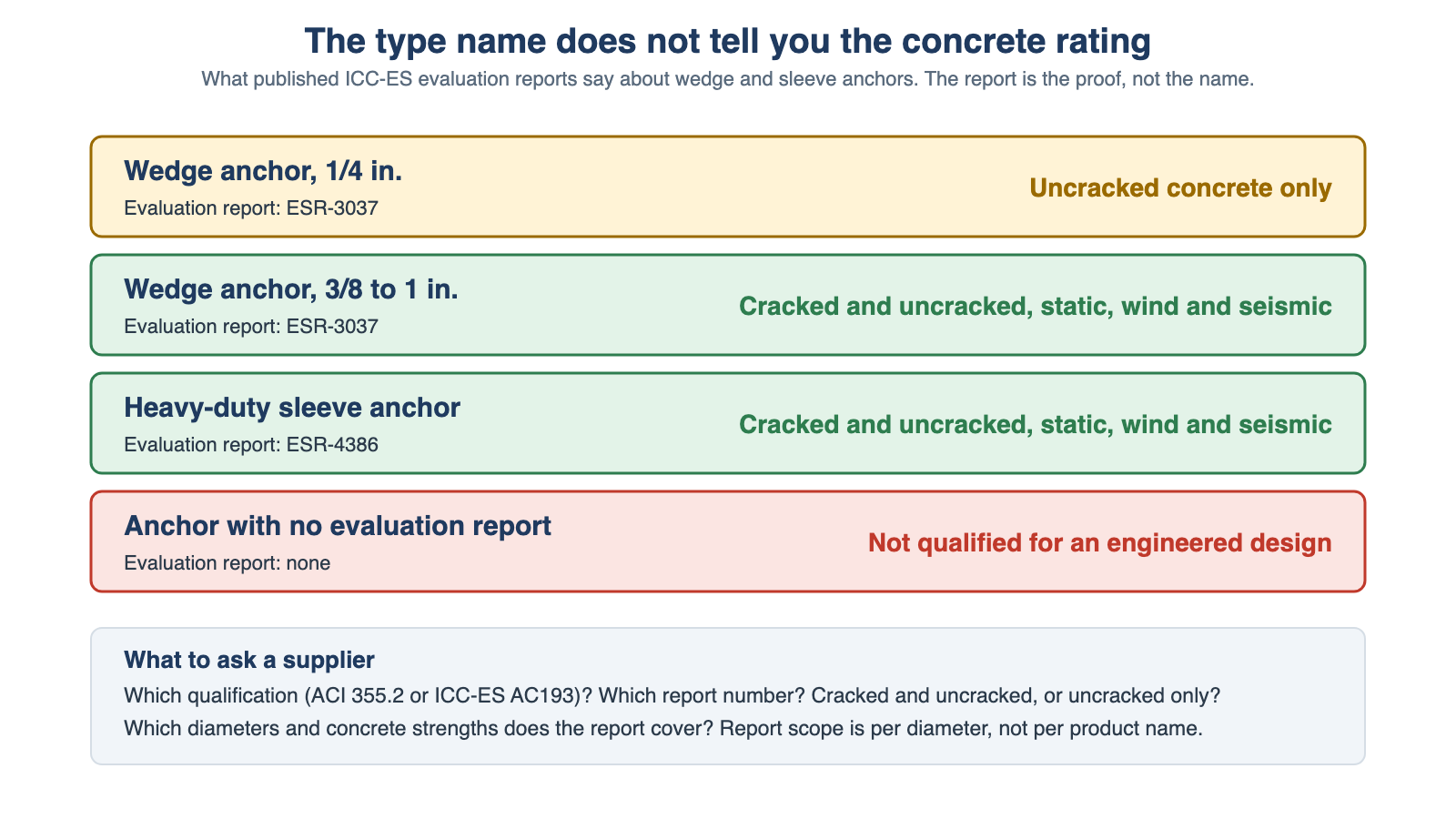
In the US, post-installed mechanical anchors must be qualified under ACI 355.2 or ICC-ES AC193 before the design rules of ACI 318, Chapter 17, can rely on them. The adhesive equivalents are ACI 355.4 and AC308. The qualification programme includes tests in cracked concrete, and the evaluation report states whether an anchor passed them. Where cracking is expected at the anchor, or in higher seismic design categories, the design has to assume cracked concrete unless the engineer can show that it does not occur.
Published reports show how much the type name misleads. ICC-ES report ESR-3037 covers a wedge anchor from 1/4 to 1 in. diameter. The 1/4 in. size is qualified for uncracked concrete only, while the 3/8 in. to 1 in. sizes are qualified for cracked and uncracked concrete, including static, wind and seismic loads, in concrete of 2,500 to 8,500 psi. ESR-4386 covers a heavy-duty sleeve anchor for cracked and uncracked concrete, and ESR-4236 covers a drop-in anchor for cracked and uncracked concrete. Wedge, sleeve or drop-in tells you nothing about this. Only the report does.
An anchor sold without an evaluation report is not necessarily a poor product, and it can be acceptable for non-engineered fixings. It cannot, however, be specified in an engineered design that relies on cracked-concrete capacity, and a supplier should not imply otherwise.
How to choose a concrete anchor
Choose by what is being fixed and what it is fixed into, then check the evaluation report. The lightest anchor that clears the load, edge and base-material requirements is the right one.
| Situation | Usual choice | Check |
|---|---|---|
| Steel base plate, equipment or bracing in solid concrete | Wedge anchor | Evaluation report scope, diameter and f′c |
| Handrails, light fixtures, electrical boxes, mixed base materials | Sleeve anchor | Base material. Mortar joints only for low loads |
| Threaded rod hangers and flush fixings | Drop-in anchor | Setting tool and embedment |
| A fixing that may be moved or removed | Concrete screw | Report scope, since capacity varies by product |
| Heavy loads, or where expansion stress near an edge is a concern | Adhesive anchor | Qualification under ACI 355.4 or AC308 |
| Hollow block or brick | Sleeve anchor or an anchor made for masonry | Do not use a wedge anchor |
What else limits the capacity of a concrete anchor
The type is only one input. The same anchor carries different loads depending on where and how it is installed, and the evaluation report is where those limits are written.
- Edge distance. An anchor close to an edge can break the corner out of the concrete before the steel yields.
- Spacing. Two anchors set too close share one cone of concrete, so their loads do not add.
- Embedment depth. Deeper embedment engages more concrete. The report lists the nominal and minimum depths.
- Concrete strength. Reports state the range of compressive strength covered, for example 2,500 to 8,500 psi.
- Load direction. Tension and shear have different capacities, and combined loads reduce both.
- Thickness of the member. A thin slab limits how deep the anchor can go.
Materials and finishes
Zinc-plated carbon steel suits dry interior concrete. For outdoor, damp or coastal use, hot-dip galvanized or stainless steel is the usual choice, and the nut and washer should match the anchor body. Mixing metals invites galvanic corrosion at the thread. The salt-spray hours behind these finishes are covered in do zinc screws rust.
What a distributor should ask for and stock
For a distributor, the useful split is between an anchor line with documentation and one without. Project buyers and engineers need the first. General trade customers are well served by the second, as long as nobody mistakes it for the first.
- Ask for the qualification. Which standard, which report number, and whether it covers cracked and uncracked concrete or uncracked only.
- Check the scope per diameter. A report can cover some sizes and not others.
- Label the limits on the pack. “For uncracked concrete only” or “Not for overhead or life-safety use” where it applies. One lag shield manufacturer states exactly that kind of limit for its product.
- Stock the common diameters in wedge and sleeve, with the matching nuts and washers in the same finish, and sell them as sets.
- Keep the two grades of range apart on the shelf and in the catalogue, so an undocumented line is never picked for a documented requirement.
The nuts and washers that go with these anchors are in the nuts and bolts range, and private label packaging with the limits printed is set up through an OEM hardware supplier.
Final thoughts
Choose the type by the base material and the load, then choose the product by its documentation. Wedge anchors for heavy loads in solid concrete, sleeve anchors for medium duty and mixed base materials, drop-in, screw and adhesive types for the cases they were made for. Whatever the type, ask for the evaluation report and read its scope, because the name will not tell you.
Frequently asked questions
What are the main types of concrete anchors?
The main types are wedge anchors, sleeve anchors, drop-in anchors, concrete screws and adhesive anchors. Lag shields are a lighter expansion shell for lag bolts, and cast-in anchor bolts are set in the concrete before the pour. Wedge and sleeve anchors are the two most compared, and they differ mainly in capacity and in which base materials they suit.
What is the difference between a sleeve anchor and a wedge anchor?
A wedge anchor expands with a clip at the bottom of the hole and needs solid concrete, but it carries more load. A sleeve anchor expands along most of its length and works in concrete, block and brick, at lower capacity. Wedge anchors are the choice for base plates and heavy equipment; sleeve anchors for handrails, fixtures and mixed base materials.
Which concrete anchor is the strongest?
Among mechanical anchors, a wedge anchor generally carries the most in solid concrete, and adhesive anchors are used for the highest loads. Strength depends on diameter, embedment, concrete strength and edge distance, so compare anchors by the capacities in their evaluation reports for the same diameter and concrete strength, not by type.
Can sleeve anchors be used in cracked concrete?
Some can. Published evaluation reports show heavy-duty sleeve anchors qualified for cracked and uncracked concrete, while other sleeve anchors have no such qualification. The type does not decide it, the report does. If the design assumes cracked concrete, ask the supplier for the report number and read its scope for the diameter you plan to use.
What is cracked concrete and why does it matter?
Cracked concrete is concrete in which cracks are expected at service loads, which is normal in many structures. A crack through the anchor hole can reduce capacity, so anchors for cracked concrete have to pass additional tests. In higher seismic design categories the design generally assumes cracked concrete, so the anchor’s report must cover it.
Can wedge anchors be used in hollow block?
No. A wedge anchor expands only at the bottom of the hole and needs solid concrete to grip, so it is not suitable for hollow block or brick unless the block has been filled solid. A sleeve anchor is the usual choice in block, with mortar joints reserved for low loads.
Are wedge anchors removable?
Not in a useful sense. The nut and washer come off, but the stud stays, and re-tightening a set wedge anchor is not advised, because the clip has already expanded. For a fixing that may be moved, a concrete screw is the removable choice. A sleeve anchor lets the bolt be replaced while the sleeve stays in the hole.
Is a concrete screw as good as a wedge anchor?
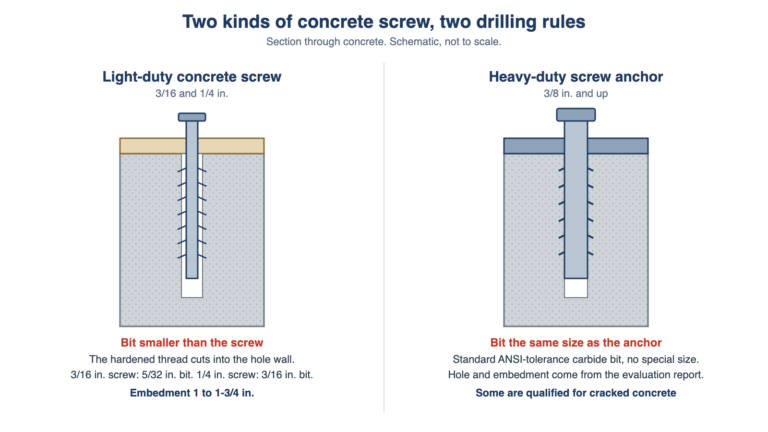
They suit different jobs. A concrete screw is removable and quick to fit, which suits light to medium fixings that may be moved. A wedge anchor is permanent and generally carries more in solid concrete. Capacities vary by product, so compare the evaluation reports for the diameters in question rather than the type. Sizes, bit rules and embedment for concrete screws are in concrete screw sizes.
What is an ICC-ES evaluation report for an anchor?
An ICC-ES evaluation report states that a product has been evaluated against the building code and its acceptance criteria, such as AC193 for mechanical anchors. For concrete anchors it lists the diameters, the concrete strengths, whether cracked concrete is covered, and the design values. It is the document an engineer relies on, not the product name.
Do concrete anchors need to be tested to a standard?
For engineered use, yes. Post-installed mechanical anchors are qualified under ACI 355.2 or ICC-ES AC193, with adhesive anchors under ACI 355.4 or AC308. ASTM E488 is the test method for the strength of anchors in concrete. An anchor without a qualification can still be sold for non-engineered fixings, but it should not be described as qualified.
Sourcing concrete anchors
Johnny’s Hardware supplies sleeve anchors in zinc plated finish with nut and washer, with wedge anchors and the rest of the fastener supplier range quoted in the same consolidated order. We state what documentation exists for each model and never imply an evaluation report that we do not hold. If your project needs a report for cracked concrete, say so at the enquiry stage and we confirm it model by model before quoting.
Send the anchor type, diameter, length, finish, the base material, any required qualification, pack size and quantity, and we will come back with specifications and carton data within 12 working hours.
– Johnny’s Hardware Team, QC Engineer