The weight printed on a drywall anchor pack is not a promise. It is the load at which that maker’s anchor failed in that maker’s own test, in half-inch board, pulled straight out. Most buying mistakes in this category start with reading it as a safe working load.
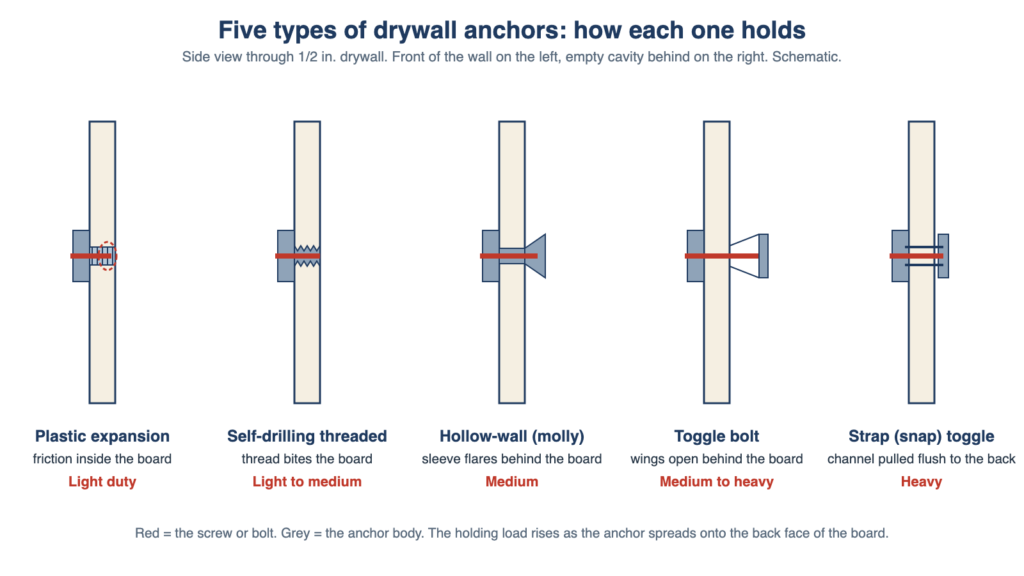
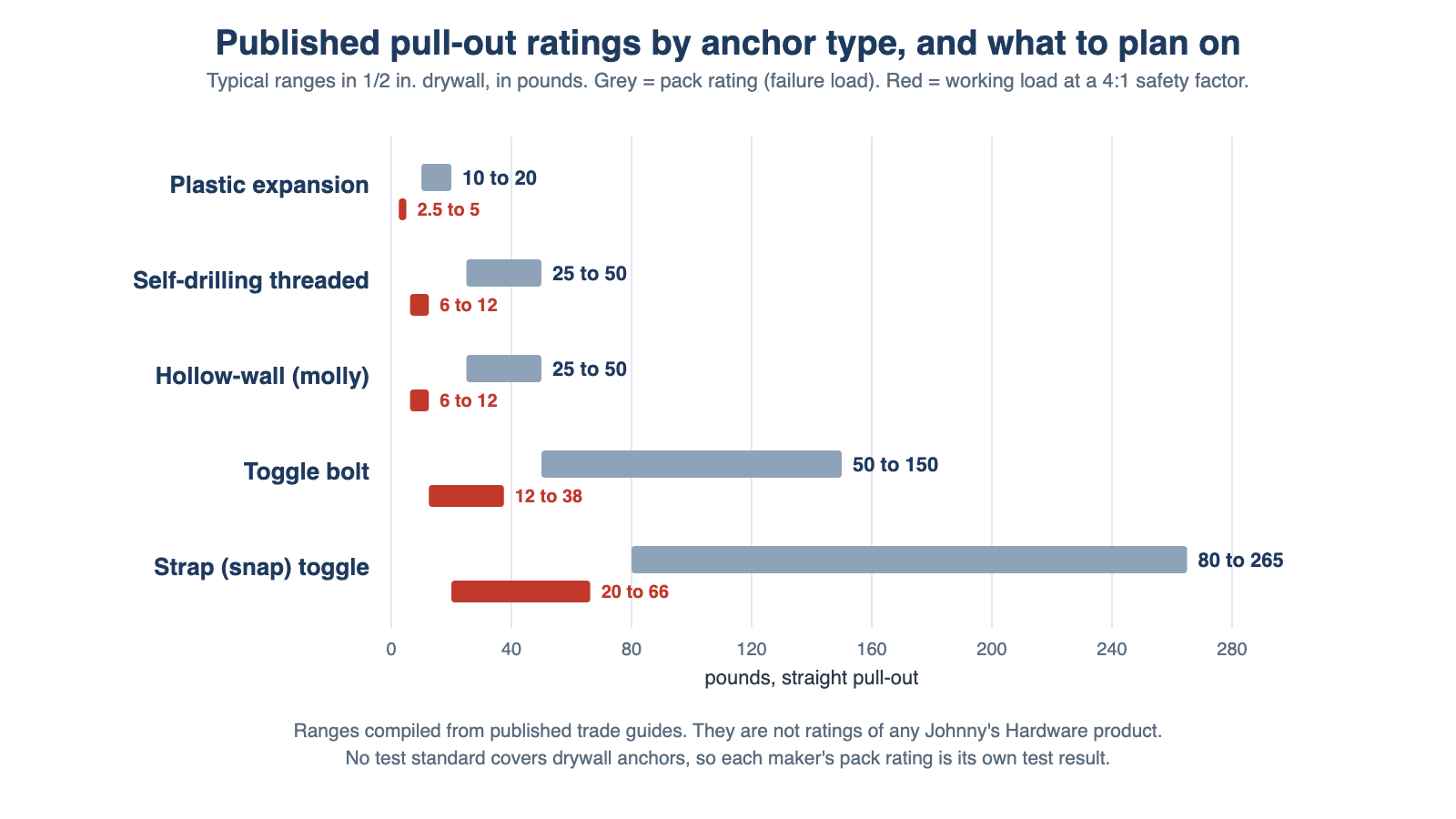
There are five main types of drywall anchors: plastic expansion, self-drilling threaded, hollow-wall (molly), toggle bolt and strap toggle. Published pull-out ratings run from about 10 lb for the plastic type to over 200 lb for strap toggles in 1/2 in. board, and a sensible working load is about a quarter of the pack figure.
Types of drywall anchors at a glance
Holding power rises as the anchor spreads its load over more of the back face of the board. A plastic plug grips only inside the hole. A toggle presses against the rear surface.
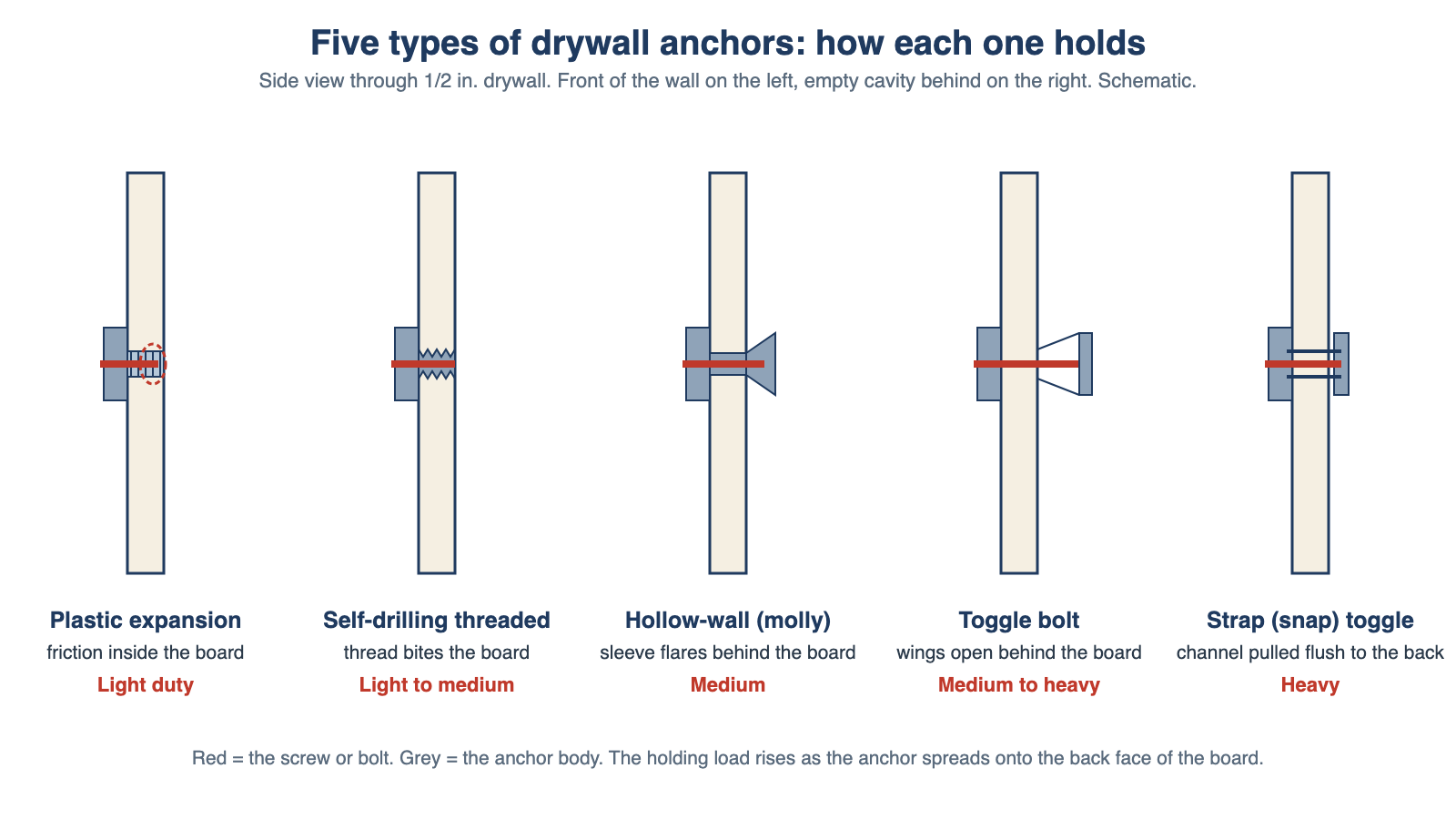
| Type | How it holds | Published pull-out, 1/2 in. board | Working load at 4:1 | Best for |
|---|---|---|---|---|
| Plastic expansion | Sleeve expands inside a drilled hole | 10 to 20 lb | 2.5 to 5 lb | Light frames and small fittings |
| Self-drilling threaded | Wide thread cuts into the board, no pre-drilling | 25 to 50 lb | 6 to 12 lb | Light to medium fittings, fast fixing |
| Hollow-wall (molly) | Sleeve collapses and flares behind the board | 25 to 50 lb | 6 to 12 lb | Medium fittings in drywall or plaster |
| Toggle bolt | Spring wings open behind the board | 50 to 150 lb | 12 to 38 lb | Shelves, cabinets, overhead lights |
| Strap (snap) toggle | Steel channel pulled flush to the back by a plastic strap | 80 to 265 lb | 20 to 66 lb | Heaviest loads the board will carry |
The pull-out ranges are compiled from published trade guides and are indicative of each type, not ratings of any one product. They are for straight pull-out. Shear (downward) ratings are typically higher, and the two should never be mixed.
How each type of drywall anchor works
Plastic expansion anchors have the least holding power
Plastic expansion anchors are the lowest-rated type, and the answer to “which type of anchor has little holding power”. A ribbed sleeve goes into a drilled hole and expands as the screw is driven. All the grip is friction inside the board, so the gypsum around the hole is the limit. They suit picture frames, small shelves and light fittings, and nothing that is pulled on.
Self-drilling threaded anchors need no pre-drilling
Self-drilling anchors carry a coarse thread that cuts straight into the board, so the fixing is a drill-and-drive job with no hole to size. They hold more than plastic expansion anchors because the thread bears on a larger volume of gypsum. They are made in zinc alloy or plastic. Metal ones are the usual choice for medium fittings and for fixing in volume, where speed matters.
Hollow-wall (molly) anchors flare behind the board
A hollow-wall anchor is a metal sleeve that collapses as the screw is tightened, folding into a flange against the back of the board. It spreads the load much wider than an expansion plug, and it stays in the wall as a permanent sleeve, so the screw can be removed and refitted. Published ranges sit in the same band as self-drilling anchors, and the molly is also used in plaster and thin hollow panels.
Toggle bolts hold heavier loads but need a larger hole
A toggle bolt passes a screw through spring-loaded wings, which open behind the board and pull against it. The back-face bearing makes it the first type with real load capacity. The drawbacks are the large hole it needs and that, if the bolt is removed, the wings fall into the cavity. So a toggle bolt is a one-time fixing, not one that can be taken down and refitted.
Strap (snap) toggles carry the highest published loads
A strap toggle pulls a steel channel up against the back of the board with a plastic strap, which is then snapped off. The channel stays put and the screw can be removed and refitted. Published pack ratings for strap toggles reach about 265 lb pull-out in 1/2 in. board, the highest of the types covered here. Like the toggle bolt, it needs a larger drilled hole.
One point for a range plan: a toggle bolt is itself a type of drywall anchor, not an alternative to one. The real comparison is between the expansion types, which grip inside the hole, and the toggle types, which bear on the back of the board. Anchors for solid concrete are a different family, compared in types of concrete anchors. For fixing the board itself to studs, see drywall screws.
Why the weight on the pack can’t be compared between brands
Two packs that both say “holds 50 lb” can describe very different anchors. No standard sets what that number means, so each maker’s figure is its own result under its own conditions.
- No test standard. One US anchor maker states in its own performance notes that wallboard is not a structural material and there are no specific national or international test standards for load testing gypsum board anchors. Its laboratory used ASTM E488, a standard written for anchors in concrete, as the closest guide. A mention of E488 on a pack therefore means a borrowed method, not a drywall standard.
- The load word means different things. The same maker notes that maximum load, ultimate load and failure load are the same thing. A recommended load is often a maximum with a safety factor applied, and manufacturers do not all use the same factor. Some do not say which one the pack shows.
- The board thickness differs. Most ratings are for 1/2 in. board. Some are for 5/8 in., which holds more because the board is usually what fails.
- The direction differs. A straight pull-out rating is not a shear rating. A shelf bracket or any item that sticks out from the wall loads the anchor in pull-out, and cantilevered items reduce the capacity substantially.
- The screw is part of the test. Ratings can apply only to the screw supplied in the pack. A longer or different screw can invalidate the figure.
How much weight can a drywall anchor hold?
Choose an anchor whose pack rating is at least four times the weight it will carry. That 4:1 margin is a trade convention, not a code requirement, and it is a sensible default for a static load pulling straight out.
| Item weight | Minimum pack rating at 4:1 | Types whose published range reaches it |
|---|---|---|
| 5 lb | 20 lb | Any type, at the top of the plastic range |
| 10 lb | 40 lb | Self-drilling and molly (upper range), toggle bolt, strap toggle |
| 25 lb | 100 lb | Toggle bolt (upper range), strap toggle |
| 50 lb | 200 lb | Strap toggle at the top of its range only |
| 75 lb or more | 300 lb or more | Beyond published drywall anchor ranges. Fix to studs or blocking |
Three corrections apply. Several anchors do not simply add up: anchors placed too close together can fail the board between them, so spacing matters more than count. Ceilings carry less than walls, because in a ceiling the whole load is pull-out. And a rating assumes new, sound board. Older, damp or crumbly gypsum holds less.
Best drywall anchors for common jobs
The best anchor is the lightest one that clears the 4:1 rule. A heavier anchor than the job needs costs more, needs a bigger hole and gains nothing.
| Job | Best choice | Why |
|---|---|---|
| Picture frames, small mirrors | Plastic expansion or self-drilling | Light, static, flush load |
| Curtain rods and towel rails | Hollow-wall or toggle | The rod pulls outward at the brackets, so plan on pull-out |
| Shelves and wall cabinets | Toggle bolt or strap toggle | Cantilevered load. Use studs where possible |
| Overhead lights | Toggle bolt | Hangs from the ceiling board |
| TV mounts, grab bars, wall-hung units | Studs or blocking | Safety-critical or heavy. Anchors are not the answer |
When no drywall anchor is enough
Where the load is heavy, the item is safety-critical, or the item’s own instructions say so, the fixing goes into the framing. Studs and blocking carry weight that gypsum cannot. Long wood screws from a screw supplier range cover that case, and the pattern for fixing the board itself is in drywall screw spacing.
What a distributor should print on the pack and data sheet
For a distributor or private-label buyer, the useful thing is to remove the ambiguity the market leaves in. Put the basis of the rating on the pack, and the comparison becomes honest.
- State the board thickness the rating assumes, 1/2 in. or 5/8 in.
- State the load type: failure load or recommended load, and the safety factor if there is one.
- Give pull-out and shear separately, never as a single bare number.
- Name the screw supplied, with type and length, because the rating applies to it.
- Print the hole size and drill bit for every type that needs one.
- Range in three tiers: light (plastic expansion, self-drilling), medium (hollow-wall) and heavy (toggle and strap toggle), so each customer finds one answer on the shelf.
Packaging that carries this information is a point of difference for a private-label line, and it is set up through an OEM hardware supplier.
Final thoughts
Choosing a drywall anchor is a matching job: the type to the load, the load to a quarter of the pack figure, and the rating to a board thickness and direction you can name. Plastic expansion for the lightest fittings, toggles for the heaviest, and studs for anything that matters. For a distributor, the opportunity is not a higher number on the pack but a rating basis the buyer can trust.
Frequently asked questions
Which type of drywall anchor has the least holding power?
Plastic expansion anchors have the least. Published pull-out ratings for them in 1/2 in. board are about 10 to 20 lb, and a working load at 4:1 is only 2.5 to 5 lb. They grip by friction inside the hole, so the gypsum around it is the limit. Use them for picture frames and light fittings, and for nothing that is pulled on.
What is the best drywall anchor for heavy items?
A strap (snap) toggle or toggle bolt, which bear on the back of the board. Published pack ratings reach about 150 lb for toggle bolts and 265 lb for strap toggles in 1/2 in. board. For anything safety-critical or over the 4:1 working limit, skip the anchor and fix into studs or blocking, which carry weight that gypsum cannot.
Is a toggle bolt stronger than a drywall anchor?
A toggle bolt is a type of drywall anchor, and it is stronger than the expansion types because it bears on the back face of the board rather than gripping inside the hole. The trade-offs are a larger hole, and that a spring toggle drops into the wall cavity if the bolt is removed. A strap toggle avoids that.
How much weight can a drywall anchor hold?
It depends on the type: published pull-out ratings run from about 10 to 20 lb for plastic expansion anchors up to roughly 80 to 265 lb for strap toggles in 1/2 in. board. Those are failure loads. A working load is about a quarter of that, so a 100 lb-rated anchor should carry about 25 lb in service.
How much weight can a drywall screw hold?
There is no meaningful rating, because manufacturers do not test a bare screw in gypsum. A screw alone has little hold in the soft core, which is why an anchor is used for anything beyond the lightest items. A screw fixed into a stud holds far more than a screw into board, so always look for the stud first.
Do two drywall anchors hold twice as much as one?
Not necessarily. Anchors placed close together can overstress the board between them, so the board fails and the second anchor adds little. Space them apart, and treat the combined capacity as less than the sum. The weakest part of the system is the gypsum, not the anchor, so more anchors only help if the load is spread.
Are drywall anchor ratings tested to a standard?
No test standard is written for them. One US maker states that no specific national or international standard covers load testing of gypsum board anchors, and that its laboratory used ASTM E488, a concrete anchor method, as a guide. Each pack rating is therefore the maker’s own result, which is why ratings cannot be compared between brands.
Does 5/8 in. drywall hold more than 1/2 in. drywall?
Yes. Gypsum board is usually what fails in an anchor test, so the thicker board holds more. Most packs state ratings for 1/2 in. board because it is the common residential thickness, while some quote 5/8 in. Check which thickness a rating assumes before comparing two anchors, because a 5/8 in. figure set against a 1/2 in. figure makes the first anchor look better than it is.
Sourcing drywall anchors
Johnny’s Hardware supplies wall plugs and anchors in its fastener supplier range, with screws and nails in one consolidated order. For drywall anchors, name the types you need and the board thickness they are rated for. We confirm the available styles, sizes and screws before quoting rather than assume.
Send the types, board thickness, pack size, whether you want the rating basis printed on the pack, and the quantity, and we will come back with specifications and carton data within 12 working hours.
– Johnny’s Hardware Team, Sourcing Advisor