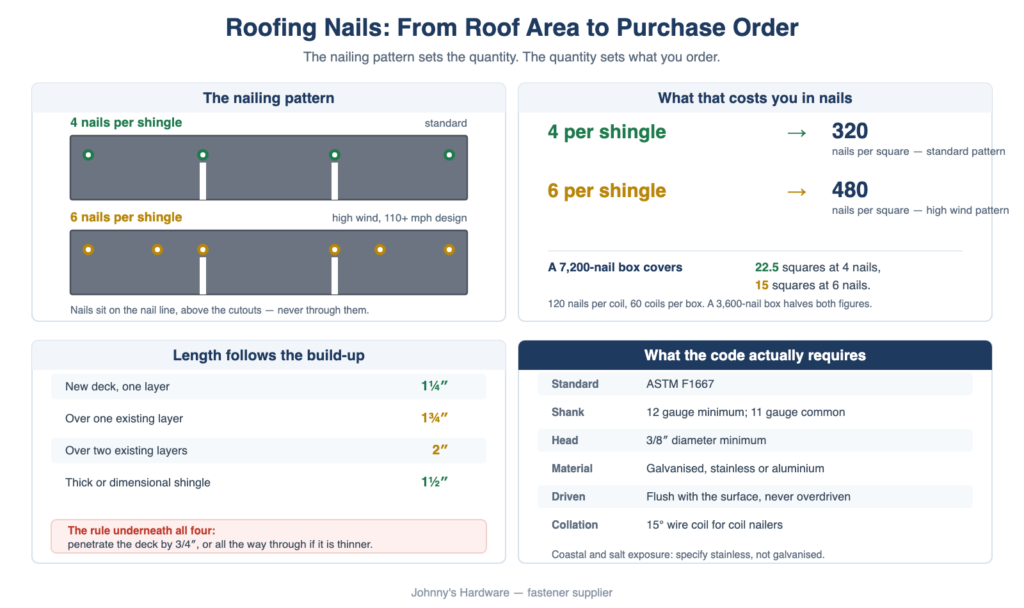
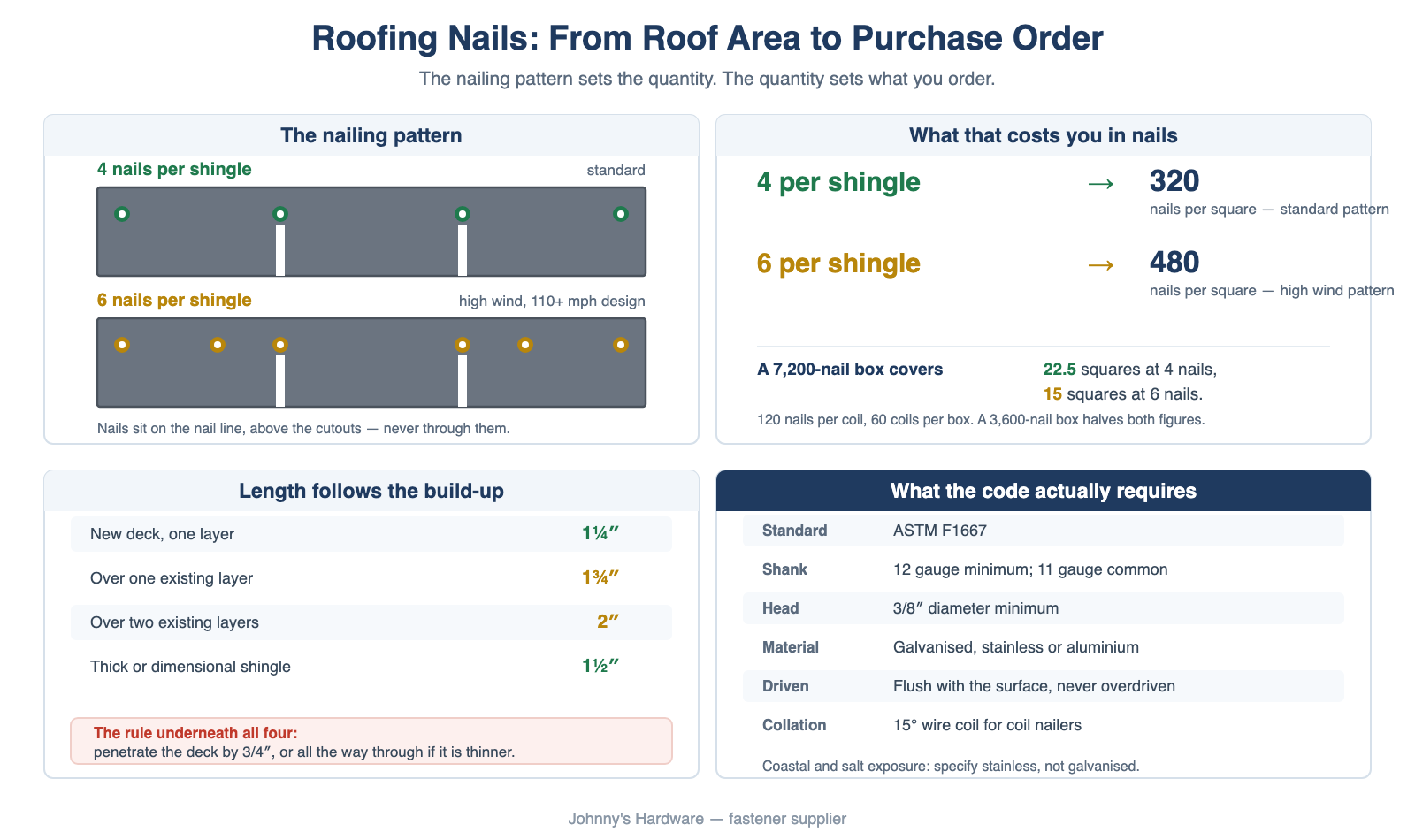
Four nails per shingle is the standard pattern and works out at 320 nails per square. Six nails per shingle, required in high wind areas, comes to 480 per square. A square is 100 square feet of roof, so those two numbers are all you need to turn a roof area into an order quantity.
Everything else about a roofing nail — length, gauge, head, coating — follows from the deck it goes into and the weather it sits in. This covers the arithmetic first, because that is what a purchase order needs, and then the specification.
How many roofing nails per square
| Pattern | Nails per square | When it applies |
|---|---|---|
| 4 nails per shingle | 320 | Standard exposure, normal wind design |
| 6 nails per shingle | 480 | High wind regions, typically 110 mph design and above, steep slopes, and wherever the shingle manufacturer’s warranty demands it |
Add roughly 10% for waste, hip and ridge caps, starter course and the nails that miss. On a 30-square roof at the standard pattern that means about 9,600 nails plus waste, so call it 10,600.
Turning that into boxes
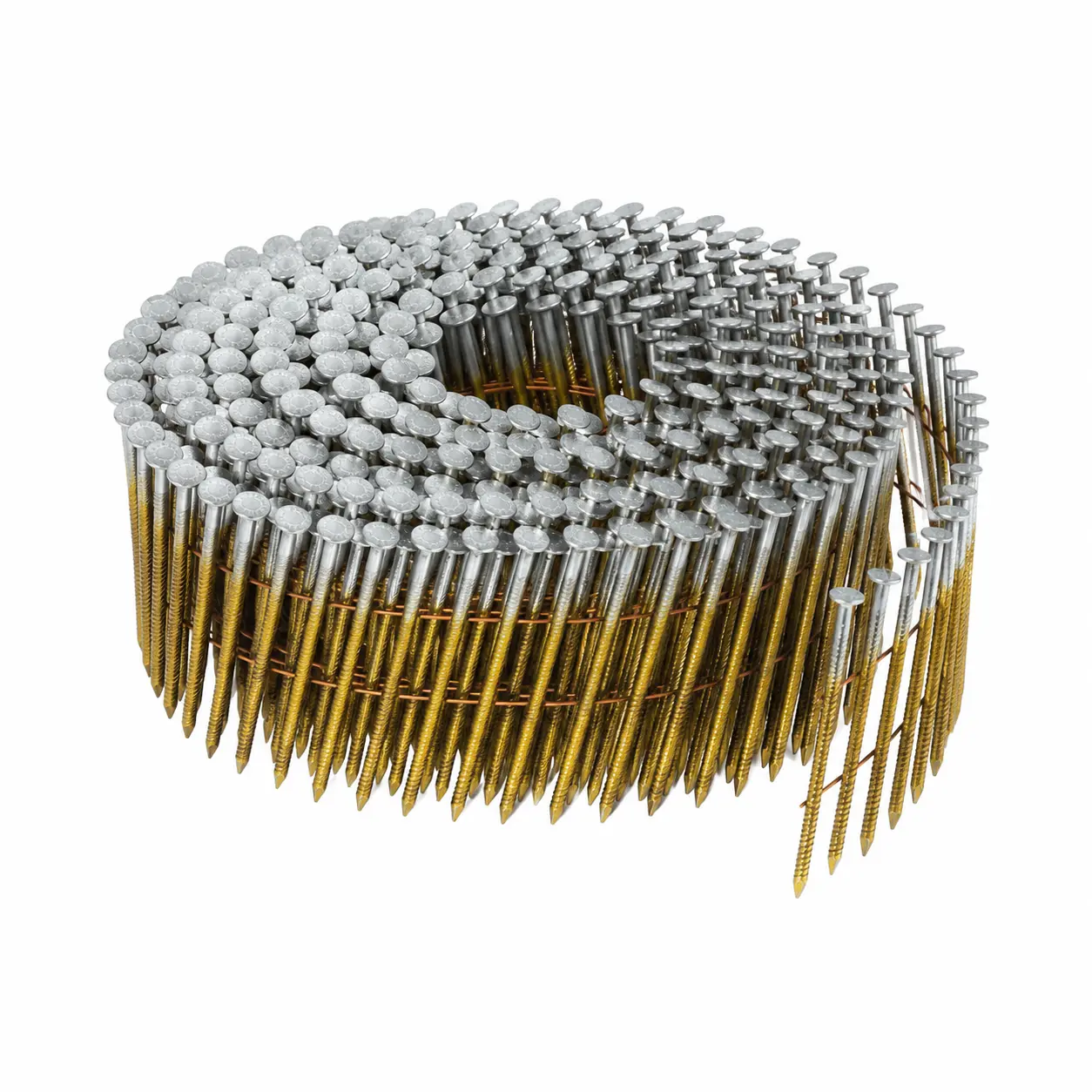
Coil roofing nails are packed to a consistent convention: 120 nails per coil, and either 30 or 60 coils per box — 3,600 or 7,200 nails. That gives a coverage figure you can quote directly:
| Box | At 4 nails / shingle | At 6 nails / shingle |
|---|---|---|
| 7,200 nails (60 coils) | 22.5 squares | 15 squares |
| 3,600 nails (30 coils) | 11.25 squares | 7.5 squares |
For a distributor this is the number worth putting on a shelf label or a quotation, because it is the one a roofing contractor is actually trying to work out. A typical 2,500 square foot roof is 25 squares, which is one 7,200 box plus a 3,600 at the standard pattern, or two 7,200 boxes if the job is in a high wind county.
What length to use
The governing requirement is penetration, not length: the nail must go at least 3/4 inch into the deck, or all the way through it where the deck is thinner than that. Length is simply whatever achieves it once you have counted what the nail has to pass through first.
| Situation | Length |
|---|---|
| New shingles on a bare deck | 1¼″ |
| Thick or dimensional shingles on a bare deck | 1½″ |
| Over one existing layer | 1¾″ |
| Over two existing layers | 2″ |
The 1¼″ nail is by far the highest-turning length and should carry the depth in any stocking plan. The longer lengths sell into re-roofing work, which is seasonal and regional, so they are better quoted against demand than held deep.
The specification the code actually asks for
| Property | Requirement | Why it is there |
|---|---|---|
| Standard | ASTM F1667 | The driven fastener specification US codes reference |
| Shank | 12 gauge minimum; 11 gauge (0.120″) is the common supply | Thin shanks pull through the shingle mat under wind load |
| Head | 3/8″ diameter minimum | The head is the working part — it is what actually holds the shingle down |
| Penetration | 3/4″ into the deck, or through it | Withdrawal resistance comes from the deck, not the shingle |
| Material | Galvanised, stainless or aluminium | Bright steel rusts and stains, then fails |
| Driven | Flush, not overdriven, on the nail line | An overdriven head cuts the mat; a high nail lifts the course above |
Two of those cause most of the failures on site. Overdriving is a compressor pressure problem rather than a nail problem, but it voids shingle warranties — the head cuts into the mat and the shingle tears away at the nail. And nailing above the nail line, in the shingle’s exposed area rather than under the course above, leaves an exposed head that both leaks and holds nothing.
Coating: where galvanised is not enough
Roofing nails are the most exposed fastener on a building. They sit under a heat-cycled asphalt mat that holds moisture, for a service life meant to run twenty years or more.
- Electro-galvanised is the commodity option and the one most coil nails carry. It is adequate for a normal inland climate and is what most of the market buys on price.
- Hot-dip galvanised carries five to ten times the coating and is the right answer for wet climates and longer warranty periods. It is worth quoting as a distinct line rather than assuming a customer knows to ask.
- Stainless is for coastal and salt exposure, and for use with cedar and treated timber, where the tannins and chemicals attack zinc.
The failure this prevents is not subtle. A rusting roofing nail loses head and shank together, and because it is buried under the course above, nothing is visible until shingles start lifting. Salt spray performance by coating type is covered in do zinc screws rust.
Cap nails are a different product
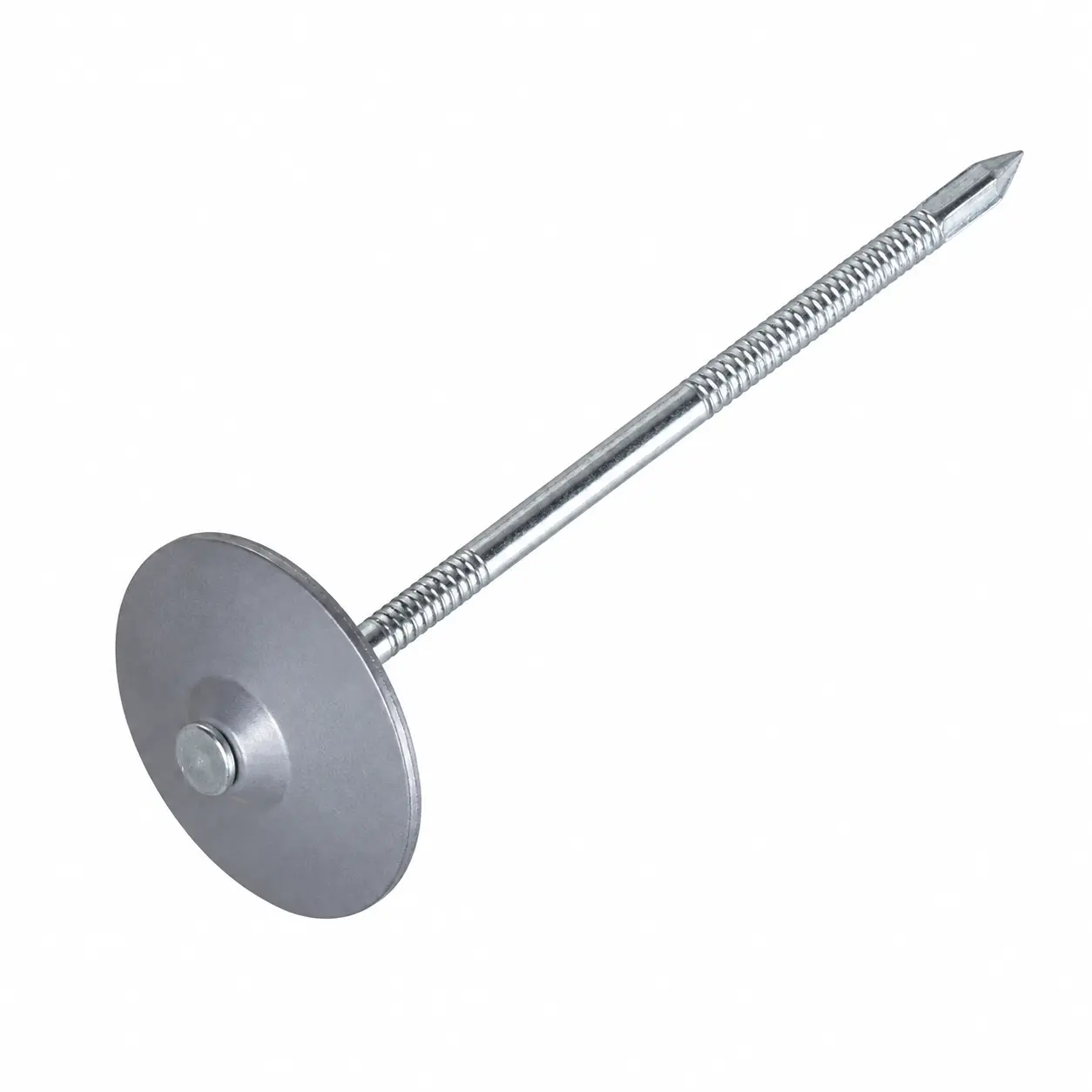
Worth separating, because buyers often lump them in. A cap nail has a plastic or metal washer of about one inch under the head, and it fastens underlayment — felt or synthetic — not shingles. The wide cap spreads the load so wind does not tear the underlayment off the deck before the shingles go on.
Some jurisdictions require cap nails rather than staples for underlayment. They are quoted per roll of underlayment rather than per square of shingle, so they belong on the order as their own line with their own quantity.
What to put on the order
| Field | Example |
|---|---|
| Length and shank | 1¼″ × 0.120″ (11 gauge) |
| Head | 3/8″ diameter |
| Shank type | Smooth or ring — ring for high wind and thin decks |
| Coating | Electro-galvanised / hot-dip / 304 stainless |
| Collation | 15° wire coil, or loose for hand driving |
| Pack | 7,200 per box, 120 per coil |
| Standard | ASTM F1667 |
For a distributor building a roofing programme, the core is narrow: 1¼″ × 0.120″ electro-galvanised smooth shank coil nails in 7,200 boxes carry the volume, with 1¾″ and 2″ for re-roofing, a hot-dip line for wet regions, ring shank for high wind counties, and cap nails alongside for underlayment. Everything else is quoted against a job.
Final thoughts
Roofing nails are one of the few fasteners where the quantity is genuinely calculable before the job starts, which makes them easy to quote accurately and easy to get wrong by a whole box. Fix the pattern first — four nails or six — and the arithmetic follows. Then let the deck decide the length and the climate decide the coating, and the specification writes itself.
FAQ
How many roofing nails per square?
320 at the standard four nails per shingle, and 480 at the six-nail pattern used in high wind areas. A square is 100 square feet of roof area. Add about 10% for hip and ridge caps, starter course and waste, so a 30-square roof at the standard pattern needs roughly 10,600 nails rather than the bare 9,600.
How many nails per shingle?
Four in normal conditions, placed on the nail line above the cutouts. Six is required in high wind regions, typically where the design wind speed is 110 mph or above, on steep slopes, and wherever the shingle manufacturer’s warranty specifies it. Fitting four where the manufacturer requires six will void the warranty even if the roof holds.
How long should roofing nails be?
Long enough to penetrate the deck by at least 3/4 inch, or right through it if the deck is thinner. In practice that is 1¼″ for new shingles on a bare deck, 1½″ for thick or dimensional shingles, 1¾″ over one existing layer and 2″ over two. Count what the nail must pass through before choosing the length.
What size roofing nails for shingles?
The usual specification is 1¼ inches long with a 0.120 inch shank, which is 11 gauge, and a 3/8 inch head. ASTM F1667 sets 12 gauge as the minimum shank, but 11 gauge is the common supply and the safer choice. The head diameter matters as much as the length, because the head is what holds the shingle.
How many roofing nails are in a box?
Coil roofing nails are packed 120 to a coil, with 30 or 60 coils per box, giving 3,600 or 7,200 nails. A 7,200-nail box covers 22.5 squares at the four-nail pattern or 15 squares at the six-nail pattern. Hand-drive roofing nails are usually sold by weight rather than count.
Should roofing nails be galvanised or stainless?
Electro-galvanised is adequate for normal inland climates and is what most of the market buys. Hot-dip galvanised carries far more coating and suits wet climates and long warranty periods. Stainless is necessary for coastal and salt exposure and for use with cedar or treated timber, whose chemistry attacks zinc coatings.
Can you use staples instead of roofing nails?
Not for asphalt shingles. Staples were once common and are now prohibited by most codes and shingle warranties, because the narrow crown provides far less holding area than a 3/8 inch head and pulls through the mat under wind load. Staples still appear for underlayment in some jurisdictions, though cap nails are increasingly required there too.
What happens if roofing nails are overdriven?
The head cuts into the shingle mat, so the shingle tears away from the nail under wind load rather than being held by it. It also voids most manufacturer warranties. Overdriving is a compressor pressure and tool depth setting issue rather than a nail problem, and it is one of the most common failures found in roof inspections.
What is a cap nail used for?
Fastening underlayment — roofing felt or synthetic — to the deck before the shingles go on. The plastic or metal cap of about an inch spreads the load so wind cannot tear the underlayment free. Cap nails are not used on shingles, and they are quantified per roll of underlayment rather than per square, so they belong on an order as their own line.
Do I need ring shank roofing nails?
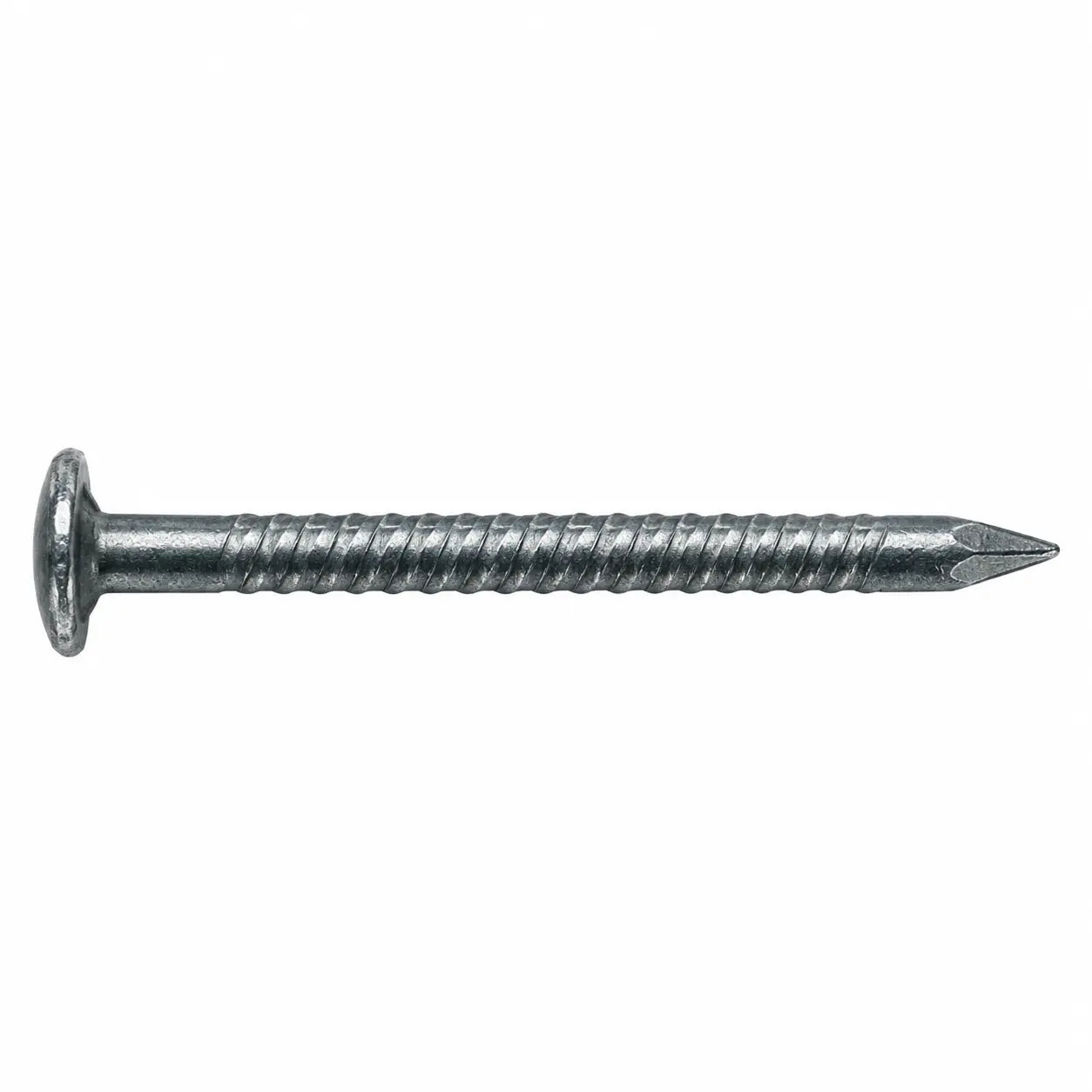
Not usually, but they are worth specifying in high wind areas and on thinner decks where withdrawal resistance is the limiting factor. The rings roughly double the pull-out resistance for very little extra cost. Smooth shank remains the standard supply and is adequate for most inland roofs on a full-thickness deck.
Sourcing roofing nails
Johnny’s Hardware supplies roofing nails from 1″ to 2″ with 0.120″ shanks and 3/8″ heads to ASTM F1667, in smooth and ring shank, electro-galvanised, hot-dip galvanised and 304 stainless, collated in 15° wire coils at 120 per coil in 3,600 and 7,200 boxes, or loose for hand driving. Cap nails for underlayment are supplied alongside.
Coil orders are quoted with the length, shank diameter, head diameter, coating, collation angle and pack count on the specification, so the coils fit the nailer and the box count matches the roof area. Roofing nails consolidate with the rest of the nail range — siding, common, framing and the trim types — and with the wider fastener supplier catalogue in one shipment, with private label and retail packaging through our OEM hardware supplier service.
If sizes are still open across the range, the nail size chart covers the penny and gauge systems on every nail type.
Send the length, shank, coating, collation and quantity in squares or boxes, and we will come back with specifications, carton data and lead times within 12 working hours.
– Johnny’s Hardware Team, QC Engineer