“High strength” does not name one specification. A buyer who asks for high strength bolts may mean a metric class 10.9 bolt, an SAE Grade 8 bolt or an ASTM A325 structural bolt, and the three are close in strength and different in almost everything else.
High strength bolts are bolts in the stronger property classes: metric 10.9 and 12.9, SAE Grade 8, and structural A325 and A490. The class or grade, not the words “high strength”, defines what you are buying.
What are high strength bolts?
There is no single definition, but in practice high strength bolts are bolts stronger than ordinary mild steel fasteners, usually class 8.8 and above in the metric system or Grade 5 and above in the inch system. Each system labels strength differently.
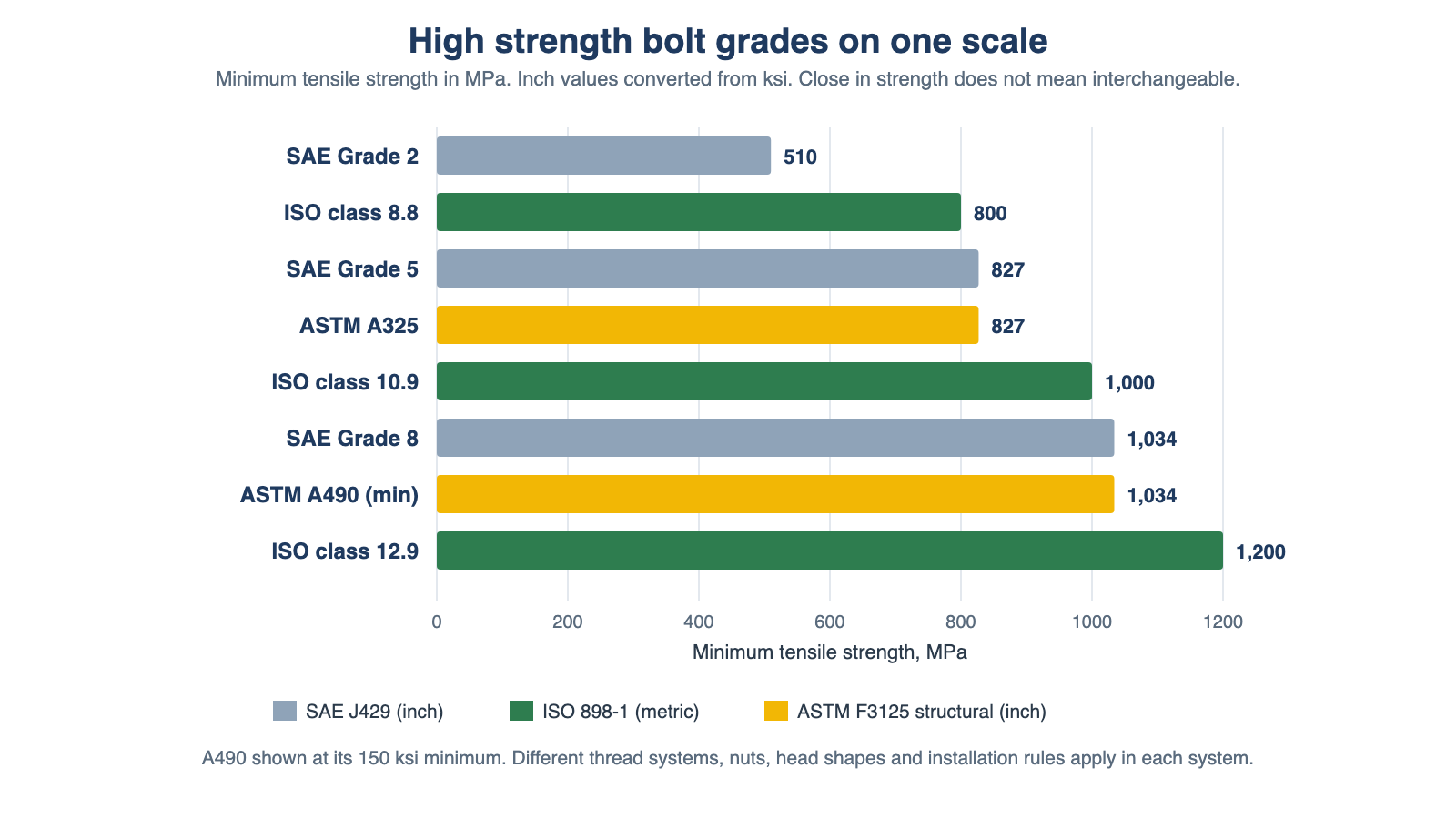
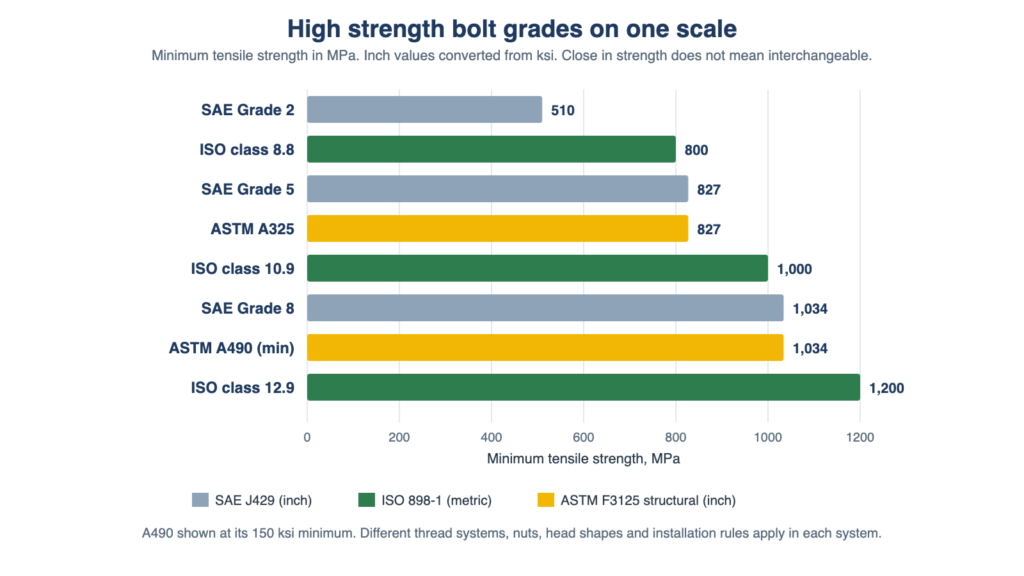
The chart shows why the confusion arises. Grade 8 is about 1,034 MPa and class 10.9 is 1,000 MPa. A325 matches Grade 5 at 827 MPa, and A490 matches Grade 8 at its 150 ksi minimum. Strength numbers align, but the standards, threads, nuts and installation rules do not.
Bolt grades 10.9, 8.8 and 12.9
A metric class is two numbers. The first, multiplied by 100, is the minimum tensile strength in MPa. The second, as a tenth, is the ratio of yield to tensile strength.
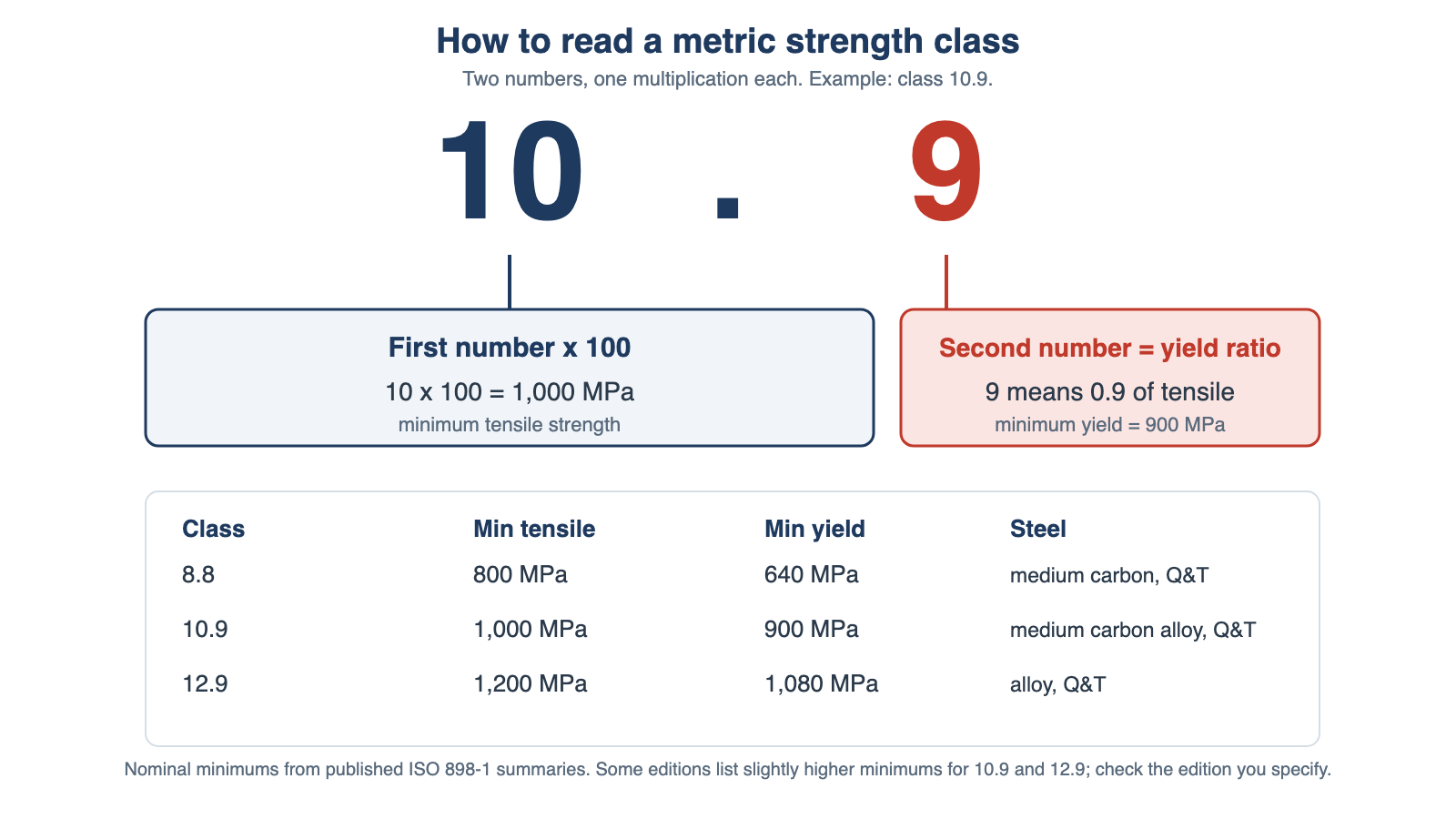
| Class | Minimum tensile | Minimum yield | In ksi (tensile / yield) | Steel and treatment |
|---|---|---|---|---|
| 8.8 | 800 MPa | 640 MPa | 116 / 93 | Medium carbon, quenched and tempered |
| 10.9 | 1,000 MPa | 900 MPa | 145 / 131 | Medium carbon alloy, quenched and tempered |
| 12.9 | 1,200 MPa | 1,080 MPa | 174 / 157 | Alloy steel, quenched and tempered |
These are the nominal minimums given in published summaries of ISO 898-1, and some editions of the standard list slightly higher minimum tensile values for 10.9 and 12.9, so check the edition you specify. Class 8.8 is the general-purpose metric bolt and is covered in the M8 bolt size guide. Class 10.9 is the usual step up where loads or clamp force are higher, and 12.9 is most often met in socket head cap screws.
Grade 8 and the SAE system
The inch system uses SAE J429 grades, with Grade 8 the strongest of the common three. The numbers are tensile strengths in ksi, and the head markings are the way to tell them apart.
| SAE grade | Minimum tensile | Proof | Head marking | In MPa (tensile) |
|---|---|---|---|---|
| Grade 2 | 74,000 psi (up to 3/4 in.) | 55,000 psi | No lines | 510 |
| Grade 5 | 120,000 psi | 85,000 psi | Three radial lines | 827 |
| Grade 8 | 150,000 psi | 120,000 psi | Six radial lines | 1,034 |
The calculated loads these strengths give for common sizes, and how shear is estimated from them, are set out in 3/8 bolt shear strength. The matching tightening torques are in the bolt torque chart.
Class 10.9 vs Grade 8
Class 10.9 and Grade 8 are very close in strength but they are not interchangeable. They are made to different standards, with different thread systems, sizes and nuts.
| Class 10.9 | SAE Grade 8 | |
|---|---|---|
| Standard | ISO 898-1 | SAE J429 |
| Minimum tensile | 1,000 MPa | 150,000 psi (1,034 MPa) |
| Yield | 900 MPa minimum | 130,000 psi (896 MPa) |
| Thread | Metric ISO thread, pitch in mm | Inch UNC or UNF, threads per inch |
| Marking | “10.9” on the head | Six radial lines on the head |
| Matching nut | Class 10 | Grade 8 |
| Swap one for the other? | No | No |
The strengths differ by about 3% on tensile and are nearly identical on yield, so for strength alone either would do. What blocks a swap is everything around the strength: the thread will not mate, the hole sizes differ and the nut class is different. The inch and metric systems are not interchangeable, as the bolt and nut size chart shows for sizes.
A325 and A490 structural bolts
A325 and A490 are structural bolts for steel connections, and they are not simply Grade 5 and Grade 8 with other names. ASTM F3125 now covers them, and the head markings are unchanged.
| A325 | A490 | |
|---|---|---|
| Minimum tensile | 120 ksi (827 MPa) | 150 to 173 ksi (1,034 to 1,193 MPa) |
| Head | Heavy hex | Heavy hex |
| Types | Type 1 (carbon or alloy) and Type 3 (weathering) | Type 1 and Type 3, alloy steel |
| Matching nut | Heavy hex nut, A563 grade DH | Heavy hex nut, A563 grade DH |
| Washers | F436 | F436 |
| Coatings listed | Hot-dip galvanized, mechanical galvanizing | F3393 coating; hot-dip galvanizing is not among those listed |
| Marking | A325 on the head | A490 on the head |
ASTM F3125 combines the former A325, A325M, A490, A490M, F1852 and F2280 standards. The strength numbers match Grade 5 and Grade 8, but a structural bolt is bought as an assembly with a heavy hex nut and a hardened washer and installed by a specified method. A plain Grade 8 bolt is not a substitute unless the engineer of record accepts it in writing. Structural connections are designed by engineers to the code, not by the buyer of the bolt.
Higher strength is not always better
The strongest class is not the best choice for every joint. Higher strength steel is harder, which brings trade-offs that a plain strength number hides.
- Hydrogen embrittlement. The highest strength classes, such as 12.9, are more sensitive to it, so plating and galvanizing of such bolts need controls. The F3125 coating list for the 150 ksi grade is shorter than the one for 120 ksi, so ask which coating process is used.
- Toughness. A harder bolt gives less warning before it fails, so for joints that need ductility a lower class may be the safer choice.
- Everything must match. A 10.9 bolt in a joint with a class 8 nut is only as strong as the nut allows, and the nut class has to follow the bolt class.
- The joint decides. Clamp force, bearing and the strength of the clamped parts often limit the joint long before the bolt does.
How to specify high strength bolts
A specification for high strength bolts names the system and the class or grade, never only “high strength”. Write the full line so the factory has nothing to decide.
- Metric: Hex bolt, ISO 4014, M12 x 1.75 x 60, class 10.9, zinc flake coated; hex nut, class 10.
- Inch: Hex bolt, ASME B18.2.1, 1/2-13 UNC x 2-1/2, SAE J429 Grade 8; hex nut, Grade 8.
- Structural: state ASTM F3125, grade A325 or A490, type, the nut and washer, and the coating.
- Check the head marking against the order, and ask for a certificate or mill test report where the joint matters.
- Write down the nut. Bolt and nut classes must match, as covered in nut vs bolt.
What a distributor should stock
For a distributor, a high strength range is two small ranges, one metric and one inch, with the structural bolt kept separate.
- Metric: class 8.8 as the volume line and class 10.9 as the step up, with matching nuts and washers in the same finish.
- Inch: Grade 5 and Grade 8, with the head marking visible on every pack.
- Structural: only where a customer needs it, bought against a certificate, and kept apart from the general lines.
- Label by system. Print the standard and class on the pack so inch and metric stock is never mixed, and do not sell “high strength” without the grade.
- Finish matters. The coating options for high strength classes are narrower, and the salt-spray behaviour of common finishes is covered in do zinc screws rust.
Final thoughts
High strength means a class or a grade, and the system matters as much as the number. Class 10.9 and Grade 8 are near-equals made to different standards. A325 and A490 are structural assemblies with their own rules. Specify the system, the class, the nut and the finish, and do not accept “high strength” as a description.
Frequently asked questions
What are high strength bolts?
High strength bolts are bolts in the stronger property classes and grades, such as metric class 10.9 and 12.9, SAE Grade 8, and structural A325 and A490. There is no single definition, so the term should always be backed by a class or grade. A request for high strength bolts without one leaves the supplier to guess.
What does class 10.9 mean on a bolt?
The first number, 10, multiplied by 100 gives the minimum tensile strength: 1,000 MPa. The second number, 9, is the yield ratio as a tenth, so minimum yield is 0.9 times that, or 900 MPa. Class 10.9 bolts are medium carbon alloy steel, quenched and tempered, and are stamped 10.9 on the head.
Is class 10.9 the same as Grade 8?
They are close in strength, about 1,000 MPa against 1,034 MPa tensile, but they are not the same. Class 10.9 is metric under ISO 898-1 and Grade 8 is inch under SAE J429, with different threads, sizes and nuts. One cannot replace the other in a joint without redesign, and a drawing that names one should not be filled with the other on the shelf.
What is the difference between 8.8 and 10.9 bolts?
Class 10.9 has a minimum tensile strength of 1,000 MPa against 800 MPa for 8.8, and a minimum yield of 900 against 640 MPa. Class 10.9 is made from alloy steel and is harder, which makes it stronger but less forgiving. It needs a matching class 10 nut, and its finish options are narrower.
Is Grade 8 stronger than A325?
A Grade 8 bolt has a minimum tensile strength of 150,000 psi and an A325 bolt 120,000 psi, so yes on paper. But A325 is a structural bolt with a heavy hex head, a matching heavy hex nut and a washer, installed by a specified method, and the two are not interchangeable in a steel connection.
What happened to A325 and A490 bolts?
ASTM combined A325, A325M, A490, A490M, F1852 and F2280 into one standard, ASTM F3125. The grades A325 and A490 still exist as grades inside it, and the head markings did not change. Drawings and specifications that call for A325 or A490 usually still do, and the bolts are bought to F3125.
Can I use Grade 8 bolts instead of A325?
Only if the engineer of record accepts it. A325 is a structural bolt supplied as an assembly with a heavy hex nut and a hardened washer, and installed by a controlled method. A plain Grade 8 bolt has none of that, so it is not a drop-in replacement in a structural connection.
What is a class 12.9 bolt used for?
Class 12.9, with 1,200 MPa minimum tensile and 1,080 MPa minimum yield, is the strongest common metric class, and is most often seen in socket head cap screws. It is more sensitive to hydrogen embrittlement, so plating and coating need controls, and it gives less warning before failure than a lower class.
Can high strength bolts be galvanized?
It depends on the grade and the process. The F3125 coating list for the 120 ksi grade includes hot-dip and mechanical galvanizing, while the 150 ksi grade lists a different coating and does not list hot-dip galvanizing. Higher strength steel is more sensitive to hydrogen embrittlement, so ask for the coating process and its controls.
How do you identify a high strength bolt?
By the head marking. Metric bolts show the class, such as 8.8, 10.9 or 12.9. SAE bolts show radial lines: three for Grade 5 and six for Grade 8. Structural bolts show A325 or A490. A bolt with no marking cannot be assumed to be any of these, and for a joint that matters should be treated as an unknown grade.
Sourcing high strength bolts
Johnny’s Hardware supplies hex bolts, nuts and washers in metric property classes 8.8, 10.9 and 12.9 and in SAE grades 2, 5 and 8, with A2 and A4 stainless, in one consolidated order with the rest of the nuts and bolts range and our fastener supplier lines. We supply mill certificates where the order requires them. We do not offer structural A325 or A490 bolts to ASTM F3125 unless an order states the standard and we confirm it in writing.
Send the system, class or grade, size, length, finish, nut and washer requirements, pack size and quantity, and we will come back with specifications and carton data within 12 working hours. Private label packs are set up through our OEM hardware supplier service.
– Johnny’s Hardware Team, QC Engineer