A screw head does three jobs at once: it transmits torque from the driver, it spreads the clamping load across the surface, and it decides whether the fixing finishes flush, proud or hidden. Choosing the wrong one rarely breaks the joint outright — it just leaves a head standing above a hinge plate, or a countersink that never pulls flush.
This guide covers the twelve head shapes worth knowing, what each one is actually for, and the two specification details that cause most of the seating complaints buyers receive.
Head shape is only one of the three axes a screw is specified on. For how it sits alongside application and drive type, see our guide to the types of screws.
Head shape and drive type are not the same thing
Worth clearing up first, because the two get used interchangeably and they are completely independent.
- Head shape is the outside profile — countersunk, pan, hex. It determines how the screw seats and how load spreads.
- Drive type is the recess cut into the top — Phillips, Pozidriv, Torx, square. It determines how much torque you can apply before the bit slips.
A pan head can carry a Phillips, Pozidriv or Torx recess. A countersunk head can carry any of them too. When you specify, you name both: “countersunk Pozidriv”, “hex washer head with Torx drive”.
The twelve head types
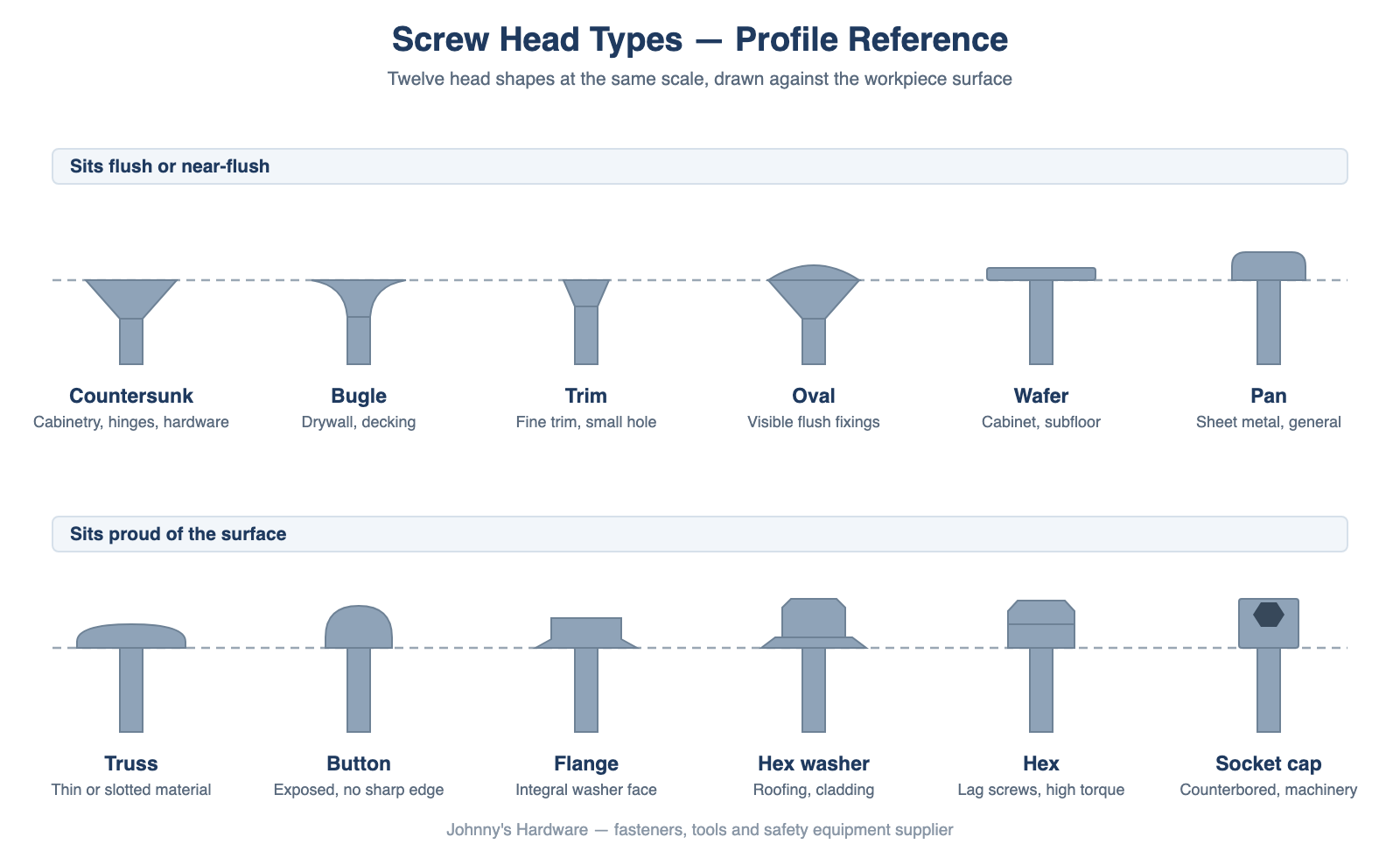
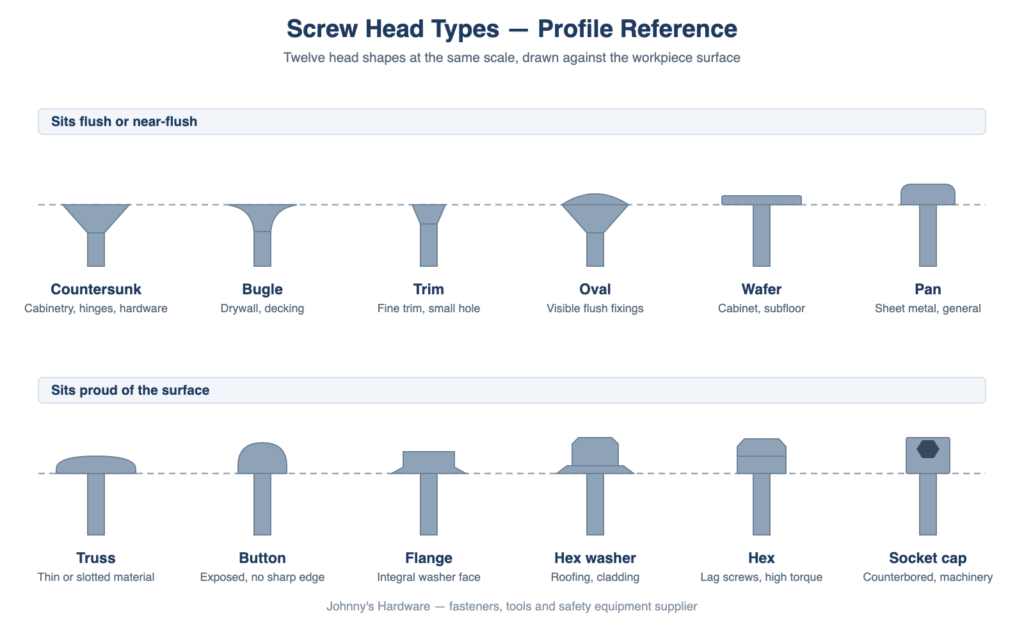
The cleanest way to organise them is by whether the head ends up below the surface or above it.
Heads that sit flush or near-flush
| Head | Profile | Where it is used |
|---|---|---|
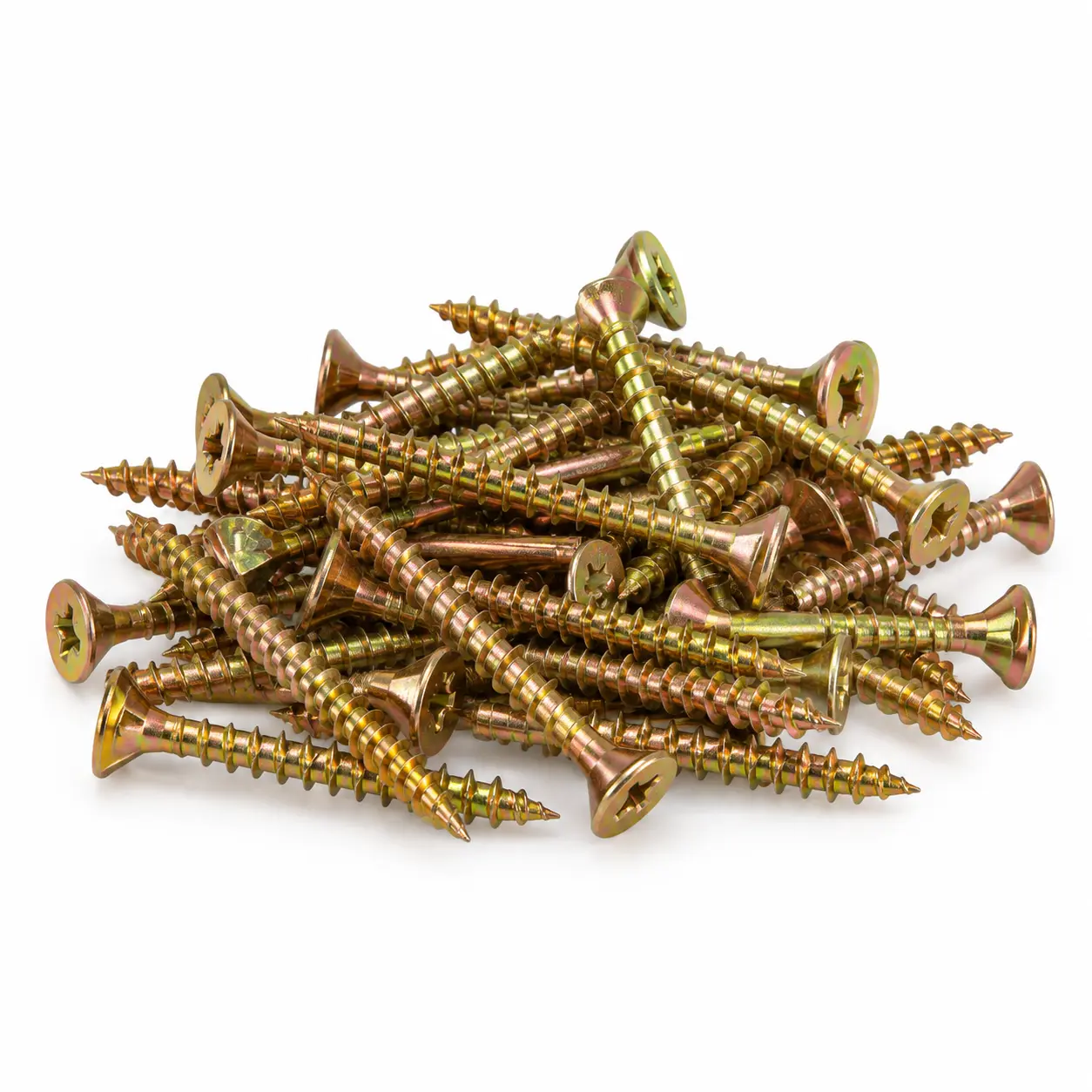
| Countersunk (flat) | Straight cone, flat top | Hinges, drawer runners, hardware plates — anywhere something mounts on top |
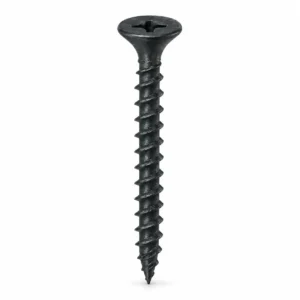
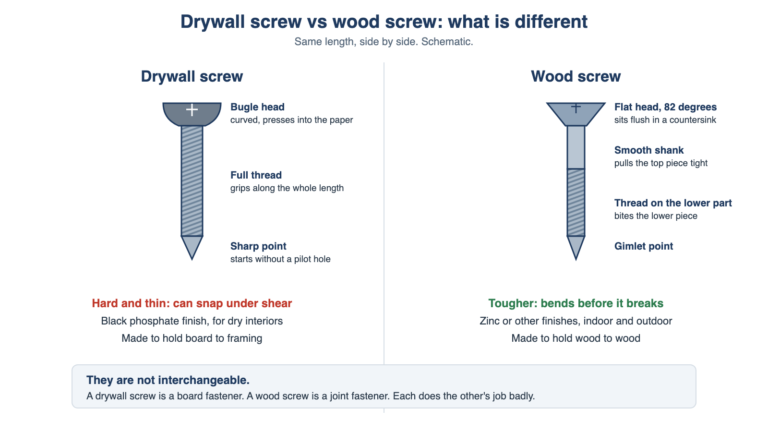
| Bugle | Curved flare instead of a straight cone | Drywall and decking — the curve sinks into soft board without tearing it |
| Trim | Small-diameter countersunk | Fine trim and moulding, where a full-size head would be visible |
| Oval (raised countersunk) | Countersunk cone with a domed top | Visible fixings that should still pull into a countersink — door furniture, switch plates |
| Wafer | Very wide, very thin flat head | Cabinet and subfloor work — large bearing area with almost no height |
| Pan | Low dome, flat bearing face underneath | The general-purpose head, and the default for sheet metal |
Heads that sit proud of the surface
| Head | Profile | Where it is used |
|---|---|---|
| Truss (mushroom) | Widest and lowest dome | Thin or slotted material where the load needs spreading over more area |
| Button (dome) | Taller rounded dome | Exposed fixings where a sharp edge would catch — handrails, furniture |
| Flange (washer head) | Head with an integral washer skirt | Removes a separate washer from the assembly — one less part to pick and lose |
| Hex washer head | Hex driven by socket, with a flange face | Roofing and cladding, usually with a bonded EPDM washer to seal the hole |
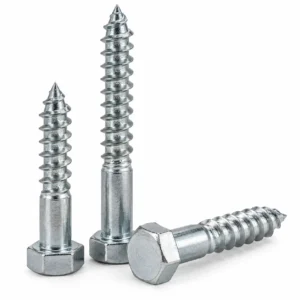
| Hex | Plain hexagon, no recess | Lag screws and heavy timber fixings — a socket takes far more torque than any bit |
| Socket cap | Cylindrical head with a hex socket | Machinery and jigs, usually dropped into a counterbore so the head finishes flush |
The 82° vs 90° problem
This is the specification detail that causes the most seating complaints, and it is invisible until the screws arrive.
A countersunk head is a cone, and that cone has an included angle. There are two standards in use, and they are not interchangeable:
- 82° — the imperial / ANSI standard, used across North America
- 90° — the metric / ISO standard, used across Europe and most of Asia
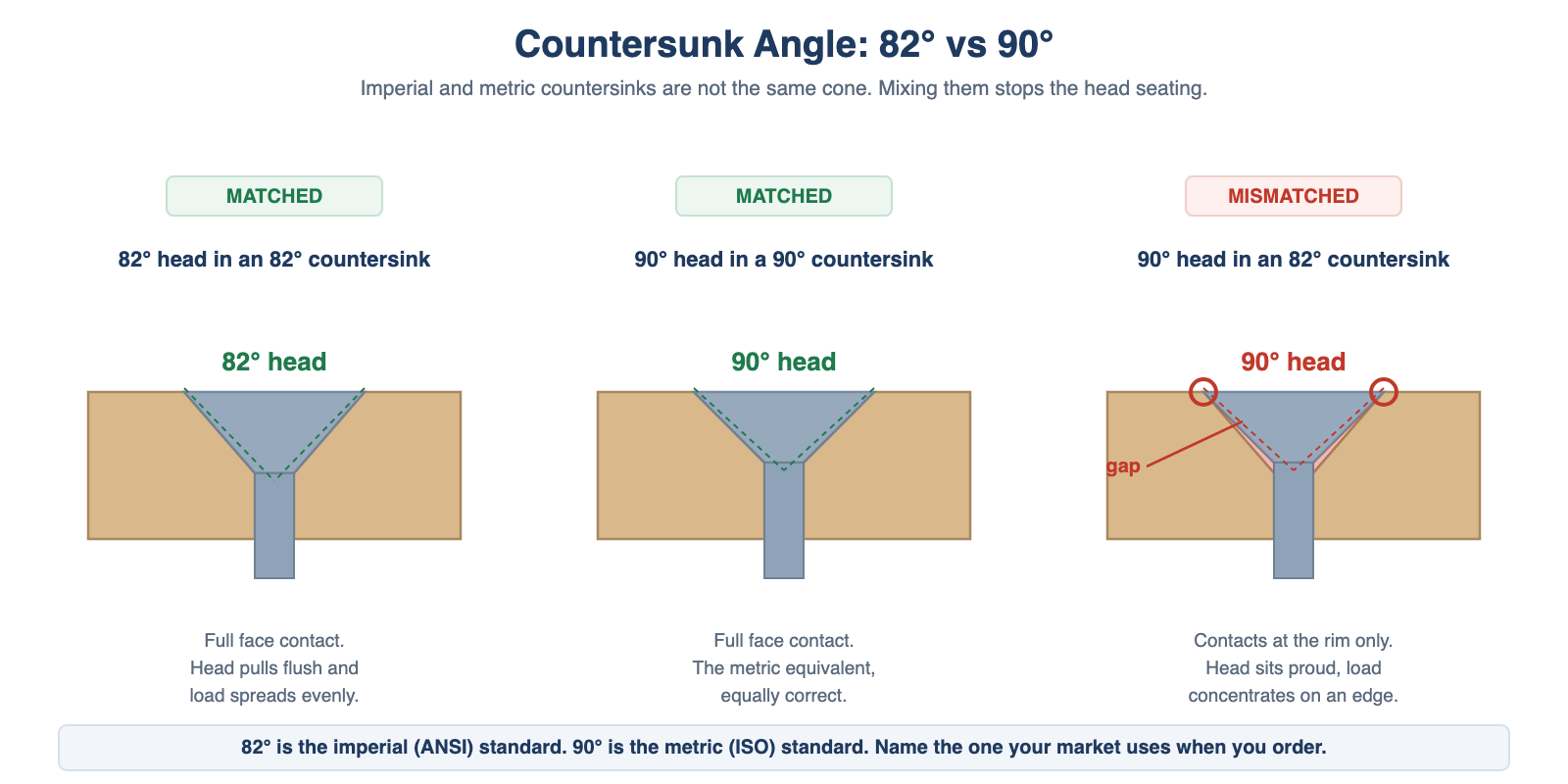
Match the head to the countersink and the whole cone face bears, the head pulls flush, and the load spreads. Mismatch them and the head touches at one ring only. It sits slightly proud, the contact stress concentrates on a narrow edge, and in softer material that edge digs in and crushes the countersink over time.
The practical rule for a buyer: name the angle in the specification, and match it to the destination market. A customer drilling with an 82° countersink bit and fitting 90° screws will send the shipment back, and they will be right to.
Standards that define head geometry
Head dimensions are set by the standard, not by the supplier. Naming the standard in a specification removes almost all of the ambiguity, because it fixes the head diameter, height and included angle at the same time.
| Head | Metric standard | Imperial equivalent | Included angle |
|---|---|---|---|
| Countersunk, cross recess | ISO 7046 / DIN 965 | ASME B18.6.3 | 90° metric / 82° imperial |
| Pan, cross recess | ISO 7045 / DIN 7985 | ASME B18.6.3 | n/a |
| Socket head cap | ISO 4762 / DIN 912 | ASME B18.3 | n/a |
| Socket countersunk | ISO 10642 / DIN 7991 | ASME B18.3 | 90° metric / 82° imperial |
Where a project specification cites a standard, quote against that standard rather than against a sample. A sample tells you what one supplier made; the standard tells you what the drawing requires.
Bearing area is what actually spreads the load
The underside of the head — the bearing face — is what transfers clamping force into the material. Bigger bearing area means lower pressure on the surface, which matters when the material is soft, thin, or slotted.
Ranked roughly from largest bearing area to smallest, among the protruding heads: truss, flange, hex washer, pan, button. This is why:
- Truss heads go into thin sheet — the wide, low dome stops the head pulling through.
- Flange heads replace a washer — the skirt does the same job the washer would, with one fewer component to stock, pick and lose on site.
- Button heads are the weakest of the group on bearing — they are chosen for appearance and edge safety, not load spreading.
Among the flush heads the logic inverts, because the cone bears against the countersink rather than the surface. That is exactly why the included angle matters more than the head diameter for a countersunk screw.
Head height and clearance
Head height is easy to forget until something does not fit. Two cases come up repeatedly:
- A moving part passes over the fixing — a drawer, a sliding panel, a door. Anything proud will catch. This is a countersunk, bugle or wafer job.
- The head drops into a counterbore — socket cap heads are dimensioned for this. If a customer specifies socket cap, confirm the counterbore diameter and depth as well, because the head has to clear.
What to specify when you order
A head specification that a factory can quote without asking questions names five things:
- Head shape — countersunk, pan, truss, hex washer, and so on
- Included angle, if countersunk — 82° or 90°
- Drive type — Phillips, Pozidriv, square, Torx, hex
- Head diameter, where the bearing area is doing real work
- Length, stated with the head type — countersunk heads are measured overall, protruding heads under the head. See the screw size chart
- Bonded washer, for hex washer heads used on roofing or cladding
Keep the head shape and drive consistent across a product range wherever the market allows. A shelf that mixes Phillips countersunk, Pozidriv pan and Torx wafer across similar products forces customers to own three sets of bits, and generates returns from people who bought the wrong one.
FAQ
What are the most common screw head types?
Countersunk, pan and hex cover the large majority of general hardware demand. Bugle dominates drywall and decking, truss and wafer appear where thin material needs a wide bearing face, and socket cap is standard in machinery. If a specification names only “screws” with no head shape, these are the ones worth confirming first, because they carry the most volume.
What is the difference between a flat head and a pan head screw?
A flat (countersunk) head is a cone that pulls down into a countersunk hole and finishes level with the surface. A pan head is a low dome that sits on top of the surface with a flat bearing face underneath. Use countersunk when something mounts over the fixing, pan when nothing does. The countersunk version also needs its included angle confirmed; the pan head does not.
Is countersunk the same as flat head?
In practice yes — “countersunk” is the common term in Europe and much of Asia, “flat head” in North America. Both mean the conical head that finishes flush. The naming is harmless, but the included angle behind it is not: the North American default is 82° and the metric default is 90°, so agreeing on the word without agreeing on the angle solves nothing.
What is a bugle head screw for?
Soft sheet materials. The curved flare distributes the seating force gradually instead of cutting a hard edge, so it sinks into plasterboard or timber decking without tearing the surface. That is why every drywall screw uses one. On dense material the same curve offers no advantage, and a straight countersunk head seats more predictably.
What is the difference between a flange head and using a washer?
Functionally very little — both spread load over a wider area. A flange head builds the washer into the screw, so there is one fewer part to stock, pick and lose on site. A separate washer is more flexible when the bearing area needs to change independently of the screw, or when a specification calls for a particular washer material.
Which head type takes the most torque?
Hex, because it is driven externally by a socket or spanner rather than by a bit sitting in a recess. Socket cap comes next. Any recess-driven head is limited by how well the bit grips before it cams out, which is why structural and high-torque applications move to hex or Torx rather than Phillips. Tightening values by size and grade are in our bolt torque chart.
Which standards cover screw head dimensions?
Head geometry is set by the standard, not by the supplier. Metric countersunk heads follow ISO 7046 or DIN 965 at 90°, pan heads follow ISO 7045 or DIN 7985, and socket cap heads follow ISO 4762 or DIN 912. Imperial flat heads follow ASME B18.6.3 at 82°. Naming the standard in the specification removes most of the ambiguity.
How should a counterbore for socket cap screws be specified?
Give the counterbore diameter and depth alongside the screw size, because the head has to clear and then seat. Socket cap head dimensions are fixed by ISO 4762 or DIN 912, so the counterbore is derived from the standard rather than chosen freely. If the drawing omits it, parts can arrive fully correct and still not fit the assembly.
Final thoughts
Head shape decides how the fixing seats and how load spreads; the included angle decides whether it seats at all. Of everything on this page, the 82° versus 90° distinction is the one that quietly fails an otherwise correct order, because nothing looks wrong until the screws reach site. Name the standard, name the angle, and the rest of the specification follows.
Sourcing screws by head type
Johnny’s Hardware supplies screws in countersunk, bugle, trim, oval, wafer, pan, truss, button, flange, hex washer, hex and socket cap heads, in both 82° and 90° countersinks, with Phillips, Pozidriv, square, Torx and hex drives, and bonded EPDM washers where the application needs them.
Sizes, finishes and order terms are listed on our screw supplier page. They ship with the rest of the fastener supplier range in one consolidated order, and can run under your own brand through our OEM hardware supplier program. If the range includes self-tapping and self-drilling screws, head and point type get specified together.
Send us the head shapes, angles, drives and finishes you need and we will come back with drawings, carton data and lead times within 12 working hours.
– Johnny’s Hardware Team, QC Engineer