
Screws are classified three ways at once: by what they fasten into, by the shape of the head, and by the recess the driver engages. A buyer who only thinks about the first one ends up with a shelf full of screws that customers cannot drive — the right thread for the job, in a drive type nobody in that market owns bits for. The three axes have to be specified together, or the order comes back wrong.
This guide walks through all three, then closes with what a hardware range actually needs to carry. If you are still deciding between screws and nails for a given job, start with our comparison of nails vs screws — this article picks up after that decision is made.
The three axes of screw classification
Every screw specification is really an answer to three separate questions. Confusing them is the single most common sourcing error.
| Axis | What it determines | Examples |
|---|---|---|
| Application (thread and point) | What material it bites into and whether it needs a pilot hole | Wood, drywall, deck, concrete, sheet metal, machine |
| Head shape | Whether it sits flush or proud, and how load spreads | Countersunk, pan, bugle, truss, button, hex |
| Drive type (recess) | How much torque before the bit slips out | Slotted, Phillips, Pozidriv, square, Torx, hex socket |
A single product code carries all three. “4.0 x 40 countersunk Pozidriv chipboard screw, zinc plated” names the application, the head, the drive, the size and the finish — and a quote that leaves any of them out will be quoted wrong.
Types of screws by application
This is the axis most buyers organise their shelf around, because it maps directly to what the customer is building.
| Screw type | Thread and point | Fastens into | Pilot hole? |
|---|---|---|---|
| Wood screws | Coarse thread, partially threaded, sharp point | Softwood, hardwood | Yes in hardwood |
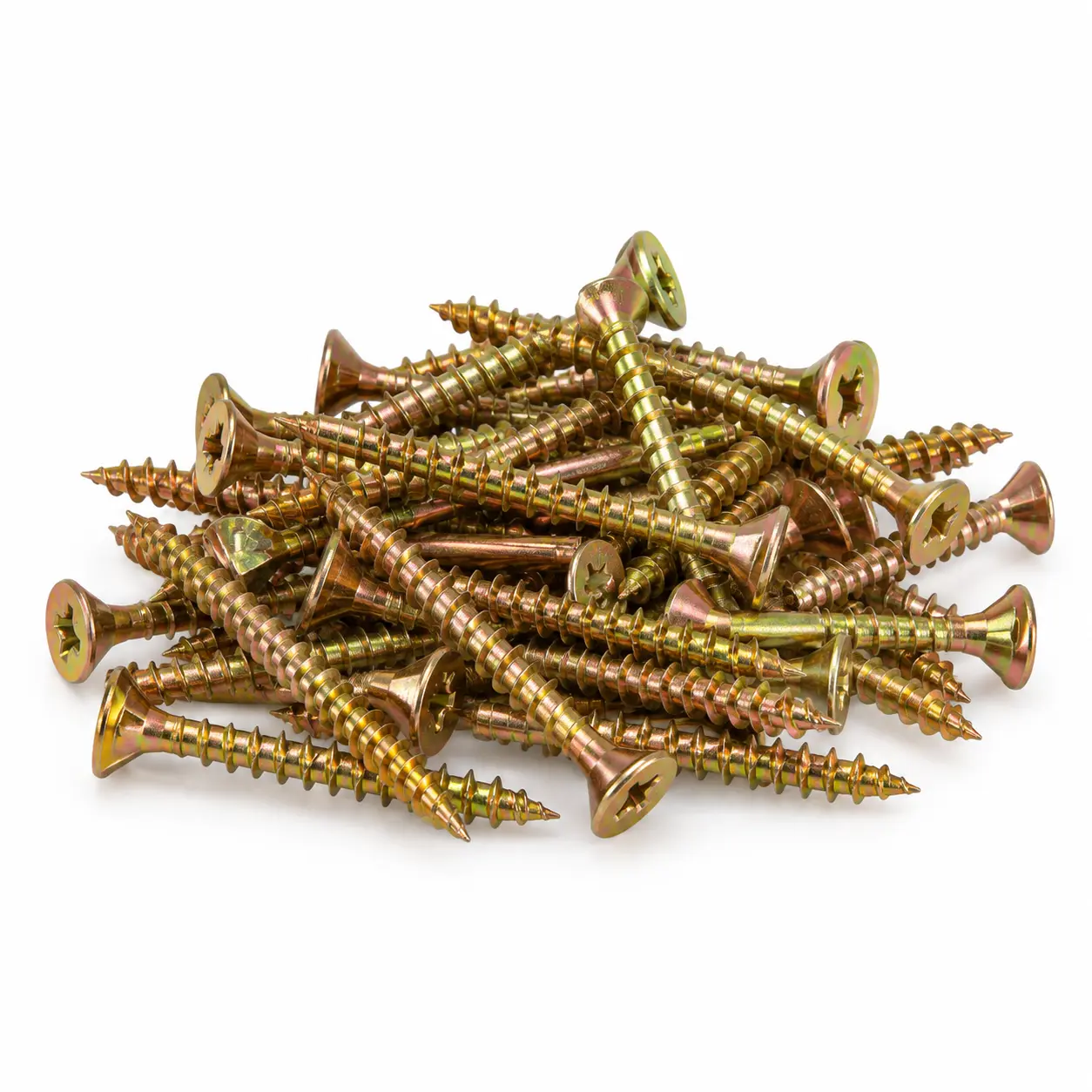
| Chipboard / construction screws | Coarse, fully threaded, sharp point | Chipboard, MDF, softwood | Usually not |
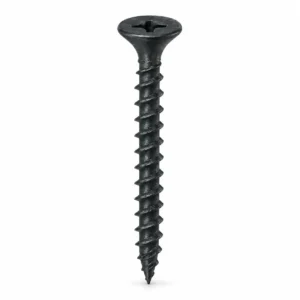
| Drywall screws | Bugle head; coarse for timber studs, fine for metal studs | Plasterboard into studs | No |
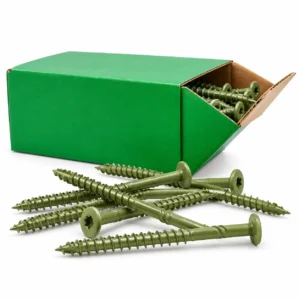
| Deck screws | Coarse thread, corrosion-resistant finish | Exterior timber, treated lumber | Usually not |
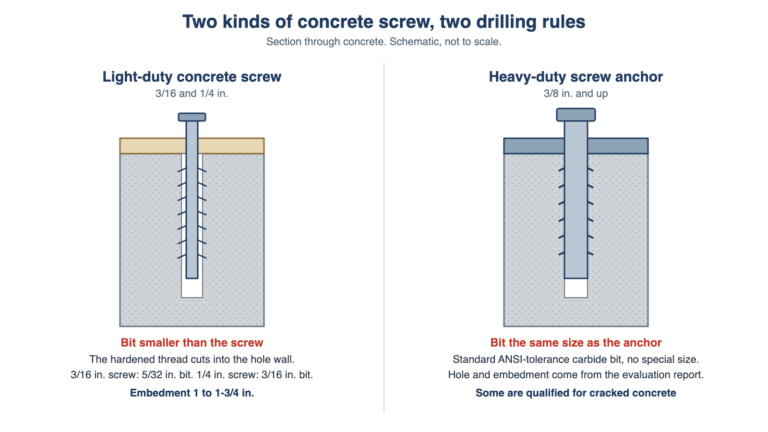
| Concrete / masonry screws | Hardened, alternating high-low thread | Concrete, brick, block | Yes — drilled to spec |
| Self-tapping screws | Cuts its own thread; needs a starter hole | Sheet metal, plastic | Yes — small |
| Self-drilling (Tek) screws | Drill-bit point, drills and threads in one pass | Steel sheet, purlins, roofing | No |
| Machine screws | Uniform machine thread, blunt end | A tapped hole or a nut | Tapped hole required |
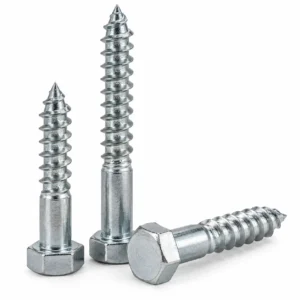
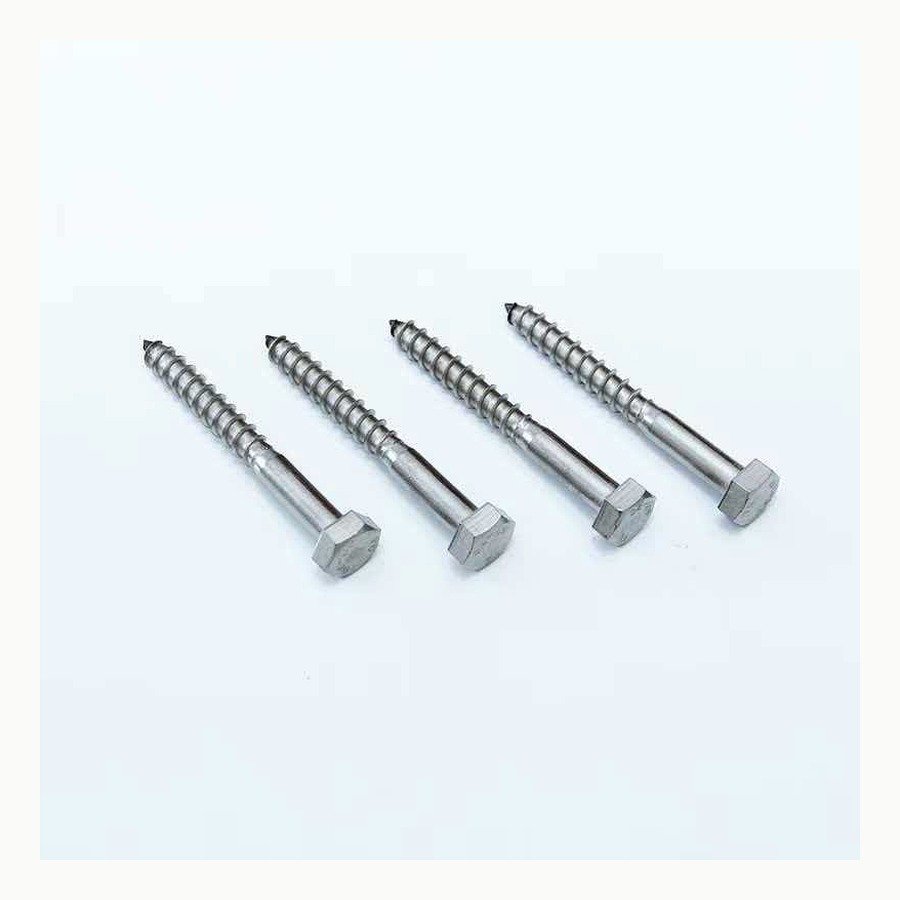
| Lag screws (lag bolts) | Heavy coarse thread, hex head | Structural timber | Yes — always |
| Set screws (grub screws) | Headless, fully threaded | Locking a pulley or collar to a shaft | Tapped hole required |
| Security screws | Tamper-resistant recess | Public fittings, signage, meters | Varies |
The distinction buyers get wrong most often
Self-tapping and self-drilling are not the same product. A self-tapping screw forms its own thread but still needs a pilot hole to start. A self-drilling screw has a small drill bit machined into its tip, so it makes the hole and the thread in one pass. Ordering “self-tapping” when the customer wanted “self-drilling” means every unit on the shelf is wrong for the job. We cover the point types, TEK drill capacities and the bi-metal stainless problem in a separate guide to what a self-tapping screw is.
The second common mix-up is coarse versus fine thread drywall screws. Coarse thread grips timber studs. Fine thread is for metal studs. Stocking only one covers roughly half your drywall demand.
Types of screws by head shape
The head decides whether the fixing finishes flush, how the load spreads across the surface, and whether the fixing is visible in the finished job.
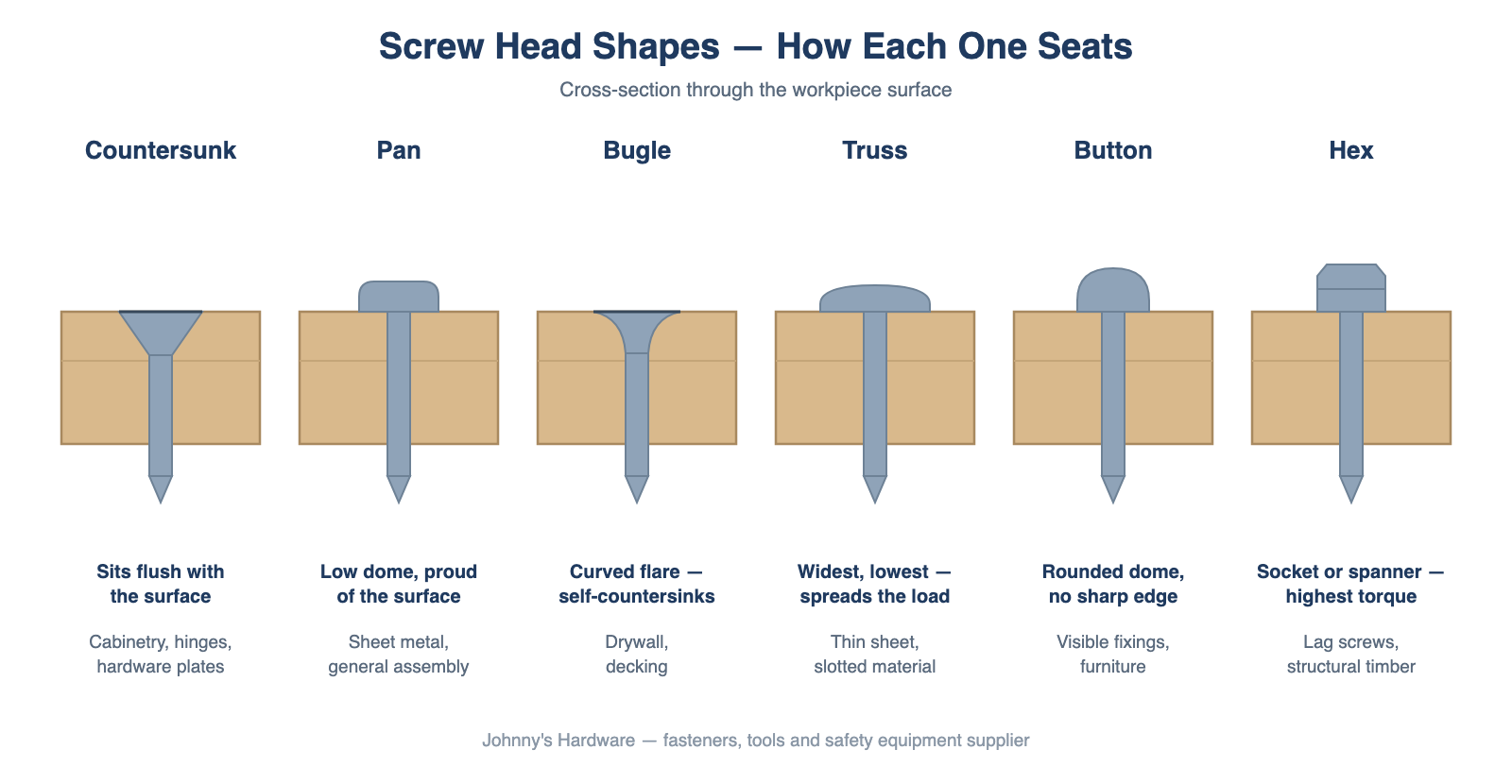
- Countersunk (flat) — the cone pulls itself into a countersunk hole and finishes level with the surface. The default wherever something else mounts on top: hinges, drawer runners, hardware plates.
- Bugle — a countersunk head with a curved flare instead of a straight cone. The curve lets it sink into soft board without tearing the paper face, which is why every drywall screw uses it.
- Pan — a low dome that sits on the surface with a flat bearing face underneath. General-purpose, and the standard choice for sheet metal.
- Truss — the widest and lowest head. Used where the material is thin or slotted and the load needs spreading over more area.
- Button — a taller rounded dome. Chosen when the fixing stays visible and a sharp edge would be a problem.
- Hex — driven by a socket or spanner rather than a bit, so it takes far more torque than any recess. Standard on lag screws and heavy timber fixings.
Six more shapes exist beyond these — trim, oval, wafer, flange, hex washer and socket cap — along with the 82° versus 90° countersink detail that decides whether a head seats flush at all. All twelve are covered in our guide to screw head types.
Types of screws by drive type
The recess is the axis buyers most often ignore, and the one that generates the most complaints. It decides how much torque reaches the screw before the bit cams out and rounds the recess.
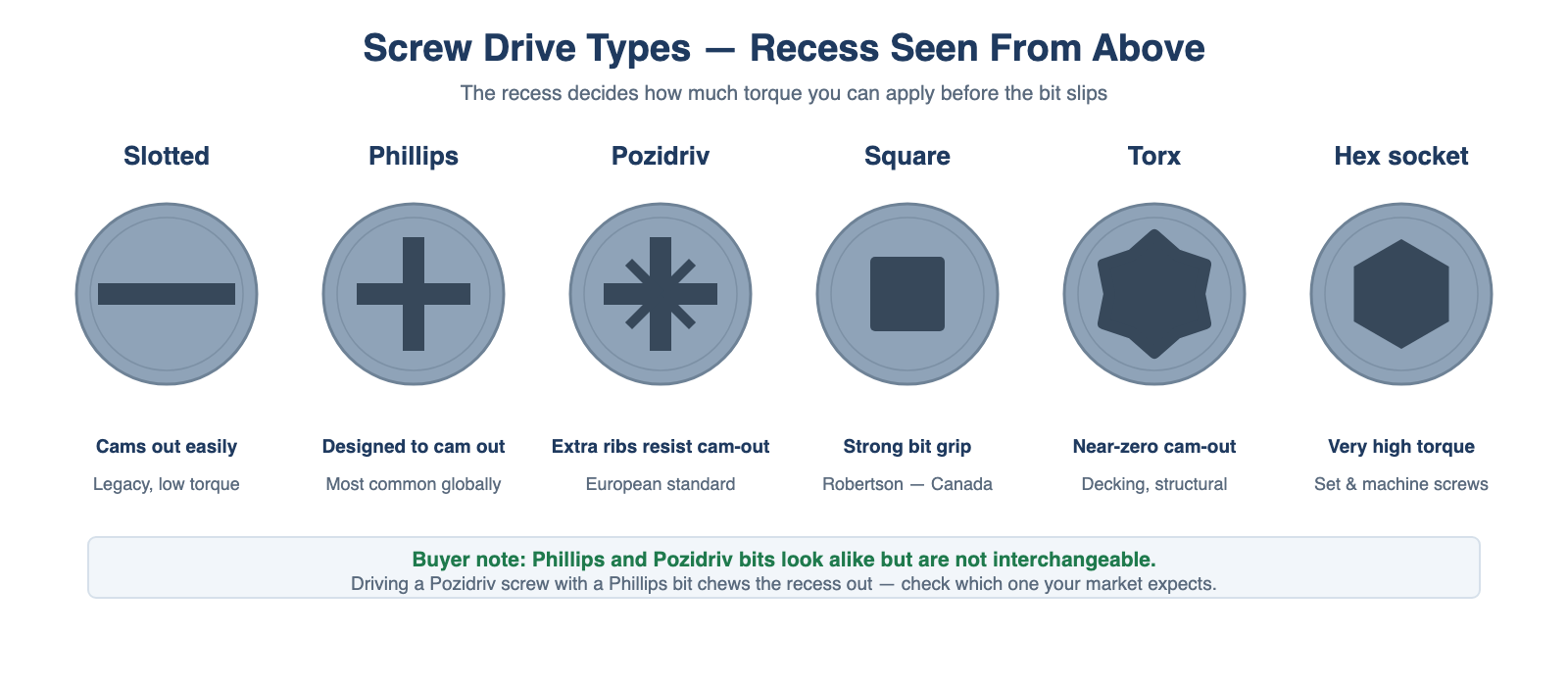
Two points matter commercially:
Phillips was designed to slip. The taper is deliberate — it cams the bit out once the screw is seated, which protected early production lines from over-tightening. That is a liability on a modern impact driver, and it is why Torx has taken over decking and structural screws.
Drive preference is regional. Pozidriv dominates in Europe, Robertson square drive in Canada, Phillips across most of the US and Asia. Pozidriv and Phillips look almost identical but are not interchangeable — driving a Pozidriv screw with a Phillips bit chews the recess out. Confirm the drive type your destination market expects before committing to a production run.
Materials and finishes
Application, head and drive describe the geometry. The finish decides service life, and for outdoor work it matters more than any of the three.
| Material / finish | Suitable for | Notes |
|---|---|---|
| Bright / plain carbon steel | Interior only | No corrosion protection |
| Zinc plated (electro-galvanised) | Interior, sheltered exterior | Thin coating; rusts in sustained damp |
| Hot-dip galvanised | Exterior, treated timber | Much thicker zinc; the practical outdoor default |
| Stainless AISI 304 (A2) | Exposed exterior, visible fixings | No rust streaking on the timber |
| Stainless AISI 316 (A4) | Coastal, marine | Molybdenum resists chloride attack |
One trap worth flagging to customers: modern copper-based timber preservatives attack plain and lightly zinc-plated steel. Anything going into pressure-treated lumber should be hot-dip galvanised or stainless as a minimum.
How screws are sized
Two systems are in use, and quotes get confused when the buyer and the factory are not using the same one.
- Metric — diameter in millimetres, then length. A “4.0 x 40” screw is 4 mm across the thread and 40 mm long. Standard in Europe, Asia and most of the world.
- Imperial gauge — a gauge number for diameter, then length in inches. A “#8 x 1 1/2” screw is gauge 8. Higher gauge number means a thicker screw, which is the opposite of how nail gauges work.
Note that reversal, because it catches people out constantly: for screws a bigger gauge number is a bigger screw; for nails a bigger gauge number is a thinner nail. Full conversion tables, thread pitch and pilot hole sizes are in our screw size chart.
What a hardware range actually needs to stock
For a distributor or DIY retail program, the question is not “how many types of screws exist” but “which handful covers most of the demand”. The list below covers the large majority of general hardware sales.
| Priority | Line | Why it earns the shelf space |
|---|---|---|
| 1 | Chipboard / construction screws, countersunk, zinc | The single highest-turnover screw line in most markets |
| 2 | Drywall screws, coarse and fine thread | Both are needed — timber studs and metal studs |
| 3 | Deck screws, hot-dip or stainless | Seasonal peak, higher unit margin |
| 4 | Self-drilling (Tek) screws | Trade demand, little DIY competition on shelf |
| 5 | Concrete screws | Replaces plug-and-screw for many fixings |
| 6 | Machine screws + nuts, assorted | Low volume individually, but customers expect it |
Across all six lines, hold the drive type constant wherever the market allows. A shelf that mixes Phillips, Pozidriv and Torx across similar products forces customers to own three sets of bits and generates returns.
Screws also combine well with the rest of a fastener order. Most importers we work with consolidate screws with nails, bolts, anchors and wall plugs in one shipment rather than running separate suppliers and separate minimums — see our screw supplier page for sizes, finishes and order terms, the full fastener supplier range, or the OEM hardware supplier page if the program needs private label packaging.
FAQ
How many types of screws are there?
There is no fixed number, because screws are classified on three axes at once — application, head shape and drive type. In practice around ten application types, six head shapes and six drive types cover almost everything a general hardware channel sells. Any given product is one combination of the three, which is why a specification that names only the application is incomplete.
What is the difference between a self-tapping and a self-drilling screw?
A self-tapping screw cuts or forms its own thread but still needs a pilot hole to start. A self-drilling screw has a drill point machined into the tip, so it makes the hole and the thread in one action. All self-drilling screws are self-tapping; the reverse is not true. Ordering the wrong one means every unit on the shelf is wrong for the job.
Can I use drywall screws for woodworking?
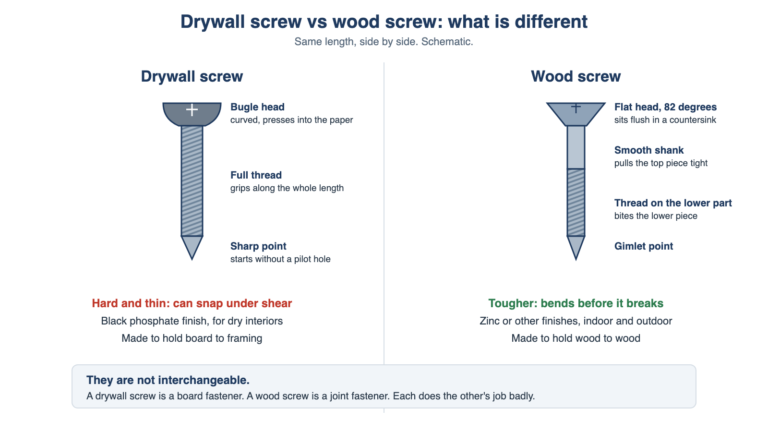
Not for anything structural. Drywall screws are hardened and brittle, with a thin shank that snaps under shear load or when over-torqued. They are fine for temporary jigs and light interior work where nothing carries weight. For joints that take load, stock wood or construction screws instead — the extra cost per piece is trivial against a callback.
What is the difference between a screw and a bolt?
A screw cuts or forms its own mating thread in the material, or fits a pre-tapped hole, and is tightened by turning the screw itself. A bolt passes through a clearance hole and is tightened with a nut on the far side. The practical consequence for stocking: bolts need matching nuts and usually washers, so they are three lines, not one.
Which screw drive type should I specify for export?
Follow the destination market. Pozidriv for most of Europe, square drive for Canada, Phillips for the US and much of Asia, and Torx wherever the product is decking or structural. Getting this wrong makes an otherwise correct screw unsellable, because the customer has no bits for it. Confirm the drive before committing to a production run, not after.
Do bigger gauge numbers mean bigger screws?
For screws, yes — a #10 screw is thicker than a #8. For nails it is the opposite: a 23 gauge pin nail is much finer than a 16 gauge finish nail. The two systems run in opposite directions, which catches out buyers who move between the two categories. Metric sizing avoids the problem entirely by stating diameter in millimetres.
Which screws should a hardware store stock first?
Chipboard or construction screws, drywall screws in both coarse and fine thread, wood screws and deck screws cover most of the demand in a general hardware or DIY channel. Add self-drilling screws for trade customers, and concrete screws once the basics turn over. Keep the drive type consistent across those lines so customers need only one set of bits.
What is the difference between coarse and fine thread screws?
Coarse thread grips soft material — timber studs, chipboard, plasterboard fixed into wood. Fine thread is for metal, including steel studs, where a coarse thread would strip. Drywall screws are sold in both for exactly this reason, and stocking only one covers roughly half the demand. If a customer asks for drywall screws, ask which stud type before quoting.
Final thoughts
The three axes are the whole discipline: name the application, the head and the drive together and a quote comes back right the first time. Name only one and it does not. For a buyer building a range, that discipline matters more than knowing every screw type — six well-chosen lines with a consistent drive will outsell a wider range nobody has bits for.
Sourcing screws in bulk
Johnny’s Hardware supplies wood, chipboard, drywall, deck, concrete, self-tapping, self-drilling, machine and lag screws from China to importers, distributors and DIY retail programs, in the head shapes, drive types and finishes each market expects. Screws ship alongside nails, bolts, nuts, washers, anchors and wall plugs in a single consolidated order.
Send us the sizes, drive types, finishes and pack formats you need and we will come back with specifications, carton data and lead times within 12 working hours.
– Johnny’s Hardware Team, Sourcing Advisor