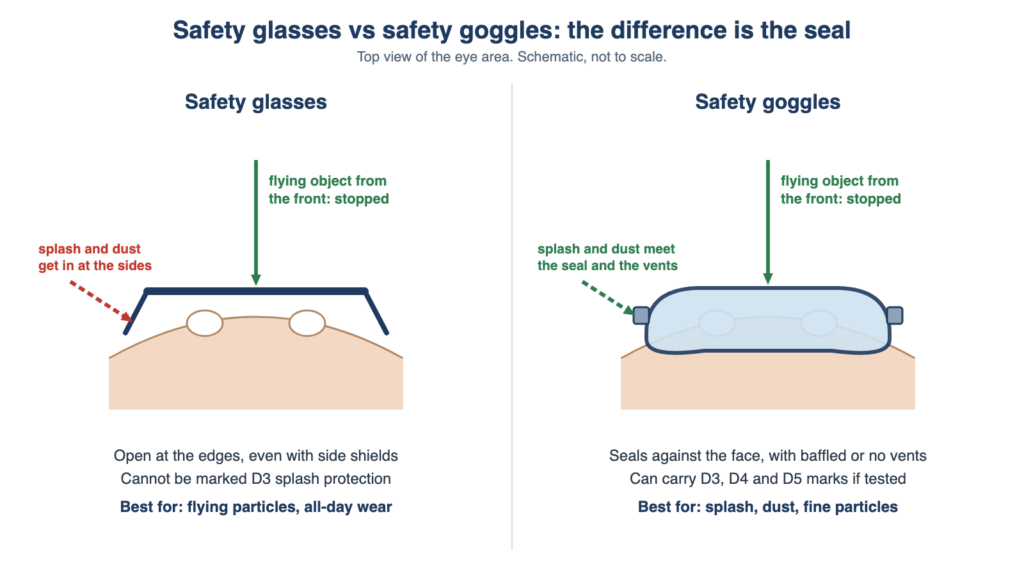
Safety glasses stop what flies at the eye. Safety goggles also stop what drifts, drips or sprays around it. The difference is not the strength of the lens. It is the seal, and the seal decides which hazards each one can be certified for.
Safety glasses protect against flying particles, and only sealed safety goggles marked D3, D4 or D5 protect against splash and dust. A buyer who treats goggles as heavier-duty glasses will specify the wrong product for chemical or dusty work.
Safety glasses vs goggles at a glance
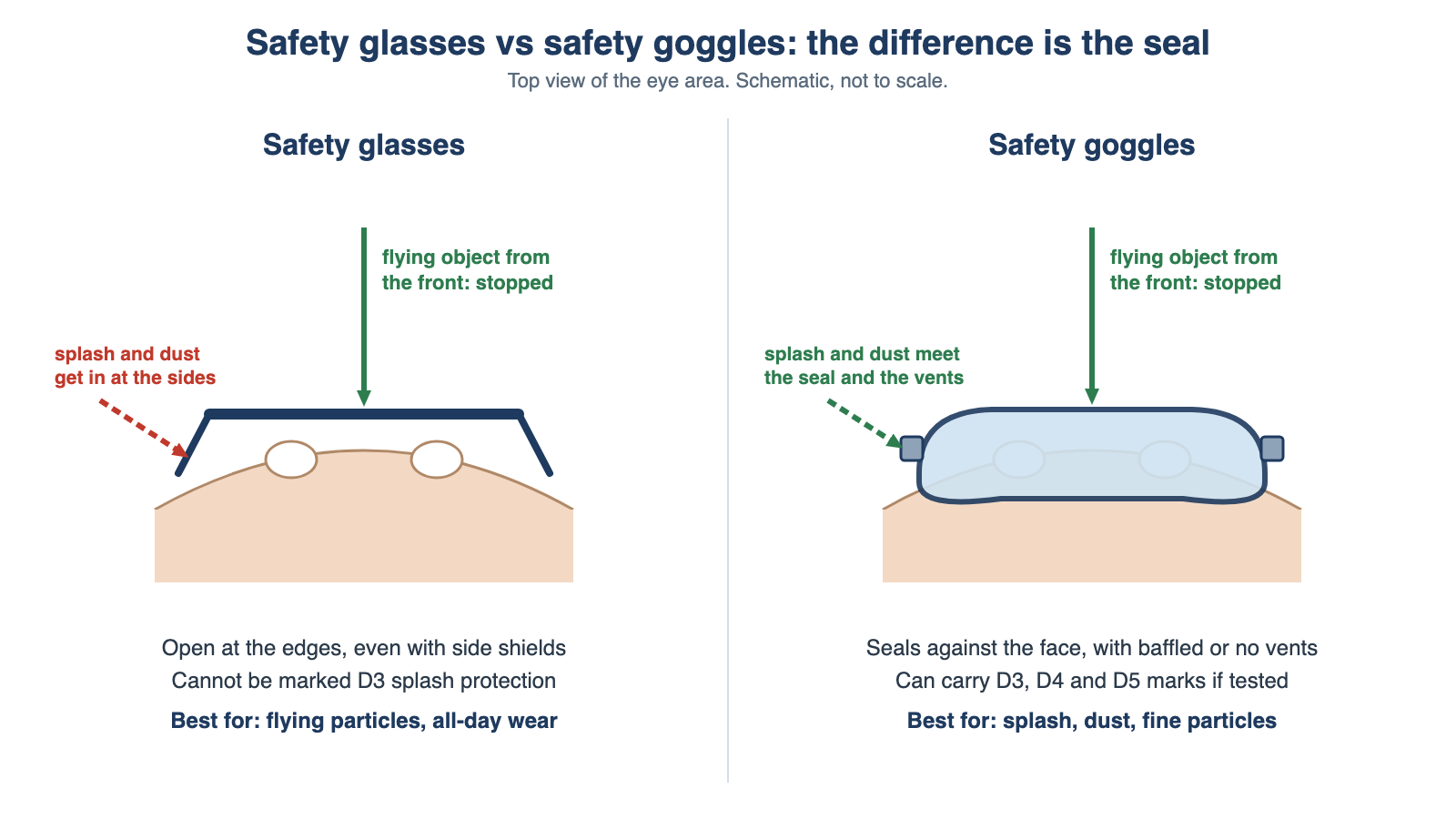
Glasses are open at the edges even when they wrap around or have side shields. Goggles seal against the face. Everything else in the comparison follows from that.
| Safety glasses | Safety goggles | |
|---|---|---|
| Fit | Rests on the nose and ears. Open at the edges | Seals against the face, held by a strap |
| Stops | Flying particles from the front and, with side protection, from the side | Flying particles plus splash, droplets and dust, when marked |
| Z87.1 hazard marks | Impact (Z87 or Z87+). No D3 splash mark | Impact, plus D3, D4 or D5 where tested |
| Comfort | Light, cool, easy to wear all day | Warmer and more prone to fogging |
| Over prescription lenses | Over-glasses styles exist | Over-the-glasses goggles are common |
| Typical work | Drilling, sawing, assembly, general site work | Chemical handling, cleaning, dusty demolition, plaster, cement |
What the Z87, Z87+ and D codes mean is covered in ANSI Z87.1 safety glasses. This article is about which form to put those marks on.
What are safety goggles?
Safety goggles are sealed eye protectors that fit against the face around the eyes and are held on by a strap. The seal keeps splash, droplets and dust from reaching the eye, which open-sided glasses cannot do.
Goggles are made with different ventilation. A goggle with direct vents lets air, and anything in it, pass straight through. A goggle with indirect, baffled vents lets air in by a longer path, and an unvented goggle has none. The design decides what the goggle can be certified for, which is why the Z87.1 marks on the product matter more than the look of it. Common uses are chemical handling, laboratory and cleaning work, grinding and demolition where dust is a hazard, and plaster and cement work.
What are safety glasses?
Safety glasses are impact-rated spectacles with side protection. They are the standard product for flying particles from drilling, sawing, hammering and assembly, and they are the default for general site work because people will actually keep them on.

The US rule that sets the baseline is OSHA 29 CFR 1910.133. It requires eye or face protection where employees are exposed to flying particles, molten metal, liquid chemicals, acids or caustic liquids, chemical gases or vapours, or injurious light radiation. It also requires protection that provides side protection where there is a hazard from flying objects, and it accepts detachable side shields that meet the section’s requirements. Wraparound frames with integral side shields are the usual way to meet it.
Which hazard needs which eye protector?
Choose by hazard, not by price or appearance. Flying particles need glasses or goggles; splash and dust need goggles carrying the matching mark; a whole-face hazard adds a face shield worn over the eye protection.
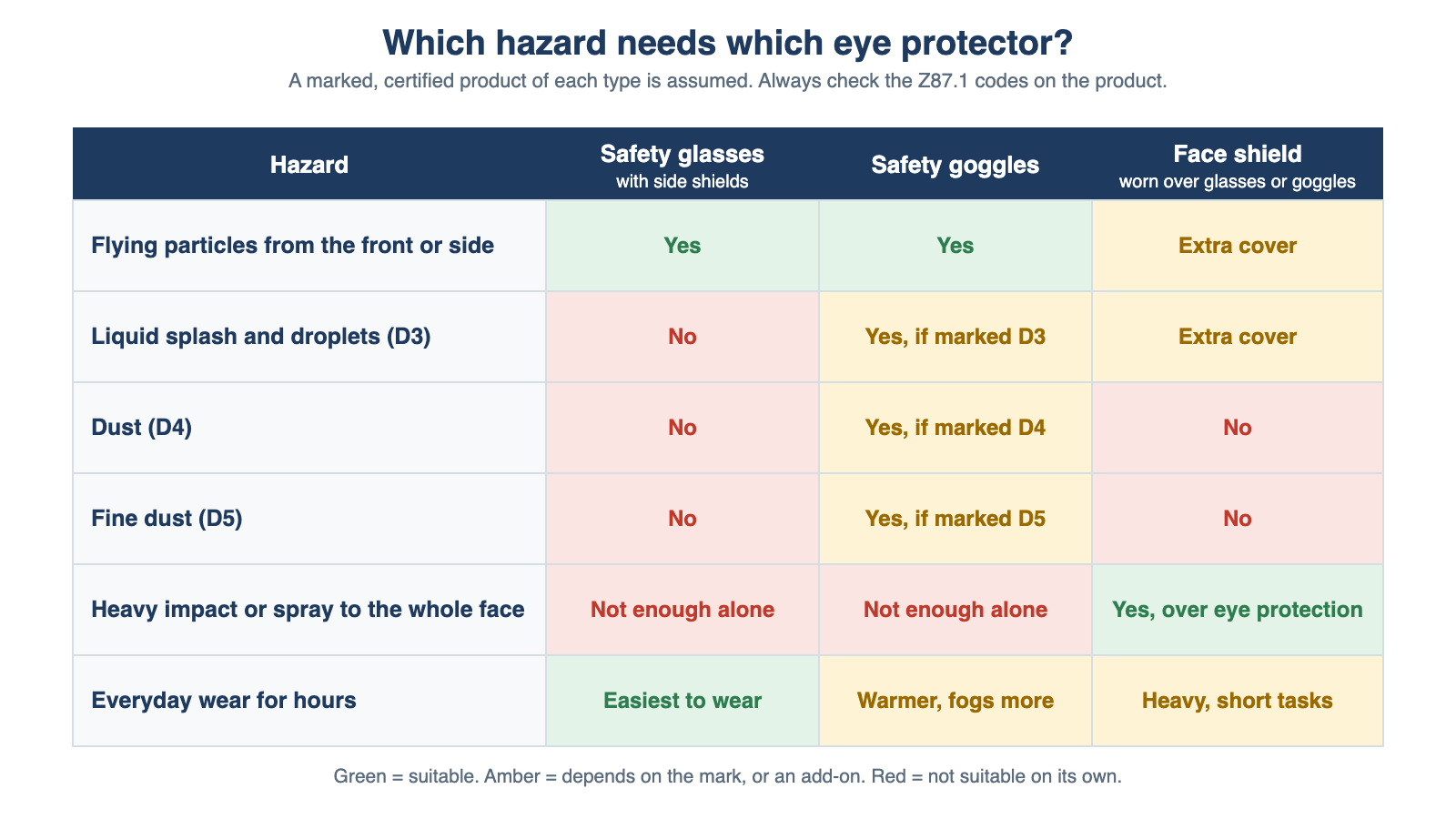
- Flying particles (drilling, sawing, hammering): glasses with side protection are enough. Specify Z87+ where powered tools or grinding produce fast particles.
- Liquid splash and droplets (chemicals, cleaning, laboratory): goggles marked D3. Glasses cannot reach this mark, because the edges are open.
- Dust (sweeping, demolition, bulk handling): goggles marked D4.
- Fine dust (cement, plaster, silica-bearing work): goggles marked D5.
- Whole-face impact or spray: a face shield over glasses or goggles. A face shield is a secondary protector and never replaces the eye protection under it.
Impact rating applies to both
The impact rating is independent of the form. Glasses and goggles can each be Z87 (basic impact) or Z87+ (high impact), and the D marks are independent of both. A Z87+ goggle is not automatically D3, and a Z87+ glasses frame is not automatically anything but impact-rated. The full explanation of the basic and high-impact tests is in the ANSI Z87.1 guide. In short: if the work involves powered tools, buy Z87+, in whichever form the other hazards require.
Safety glasses vs regular glasses
Regular glasses are not safety glasses. They have no Z87 marking, no impact rating and no side protection, and they can shatter or slide away on impact.
For people who wear prescription lenses, OSHA requires protection that either incorporates the prescription or can be worn over the prescription lenses without disturbing their position. In practice that means prescription safety glasses, over-the-glasses safety glasses, or over-the-glasses goggles. A face shield alone does not solve it, since it is secondary protection.
Fit, fogging and whether people wear them
Protection that is not worn does nothing. Goggles protect against more, but they run warmer and fog more, so a worker may pull them off. Glasses are easier to wear all shift.
Anti-fog and anti-scratch coatings are useful features, but neither is evidence of certification. The anti-fog claim counts only when the protector has been tested against the standard’s criteria, as the Z87.1 article explains. When choosing goggles, indirect vents and a good anti-fog lens matter more than the colour of the strap.
What a distributor should stock
Stock one default pair of glasses and one splash-capable goggle, not a dozen of each. Most customers need the first, and the second is bought for the specific jobs glasses cannot cover.
- A general-purpose pair of glasses: Z87+ clear polycarbonate, wraparound, anti-fog and anti-scratch. This is the volume line.
- A D3-marked goggle with indirect vents, for chemical, cleaning and laboratory buyers.
- An over-the-glasses option in glasses or goggle form, for customers who wear prescription lenses.
- Print the marks and the hazard on the pack. The Z87+ and D codes should be on the front, with a plain line such as “splash protection” or “not splash protection”, so buyers do not rely on appearance.
- Do not shelve goggles as heavy-duty glasses. Place them with chemical and dust items, and the glasses with general PPE.
The wider question of which items belong to a PPE range is covered in what does PPE stand for.
Final thoughts
Choose safety glasses for flying particles and comfort, and safety goggles when splash or dust is the hazard, with the matching D mark on the product. Add a face shield only on top of the eye protection. Whatever the form, the impact rating and the hazard marks are what a buyer should check, not the look of the frame.
Frequently asked questions
What are safety goggles?
Safety goggles are sealed eye protectors that fit against the face around the eyes and are held by a strap. The seal keeps splash, droplets and dust away from the eye, which open-sided glasses cannot do. Goggles can carry the Z87.1 D3, D4 and D5 marks for splash, dust and fine dust, where tested, in addition to an impact rating.
What is the difference between safety glasses and safety goggles?
The difference is the seal. Safety glasses are open at the edges and protect against flying particles. Safety goggles seal against the face and, when marked D3, D4 or D5, also protect against splash, dust and fine dust. Both can have a Z87 or Z87+ impact rating, and the hazard marks are separate from it.
What are safety goggles used for?
Safety goggles are used where splash, droplets or dust can reach the eye from the side, below or above, not only the front. Typical jobs are chemical handling, cleaning, laboratory work, demolition and sweeping, and cement or plaster work. For flying particles from drilling or sawing, safety glasses are normally enough.
Can safety glasses replace goggles for chemical work?
No. Open-sided glasses cannot exclude a liquid splash, whatever the lens is made of, so they cannot carry the D3 splash mark. For chemical handling, specify goggles marked D3 and check the mark on the product, not the description. Where the hazard also reaches the face, add a face shield worn over the goggles.
Are safety glasses the same as regular glasses?
No. Regular glasses carry no Z87 marking, no impact rating and no side protection, and they can shatter on impact. Prescription wearers need prescription safety glasses, or safety glasses or goggles designed to fit over their own glasses without disturbing the position of the lenses. Ordinary dress glasses should never be treated as a substitute for any of these.
Can you wear safety goggles over prescription glasses?
Yes, if they are over-the-glasses goggles. OSHA requires protection that can be worn over prescription lenses without disturbing their position, so a standard goggle that presses the frame against the face is not suitable. Over-the-glasses goggles have a deeper shell and a wider seal to give the room, and the D marks still apply to them.
Do safety goggles need to be Z87+?
Not always. The impact rating depends on the hazard: Z87 is basic impact and Z87+ is high impact. Powered tools and grinding call for Z87+. A goggle can be Z87 or Z87+ and, separately, carry D3, D4 or D5 marks, so check each mark rather than assuming one implies the other.
When do I need a face shield as well as goggles?
A face shield covers the face against impact and spray. It is worn over safety glasses or goggles, never instead of them, because it is secondary protection. Add one for grinding, chemical pouring or any task where the hazard reaches beyond the eyes. A face shield alone does not protect against dust.
Sourcing safety glasses and goggles
Johnny’s Hardware supplies safety glasses in clear and tinted lenses with anti-fog and anti-scratch options, as part of the safety equipment range, in one consolidated order with the rest of our protective gear. Sealed safety goggles are supplied alongside for splash and dust work. Tell us the D mark you need, and we confirm the goggle style and its marks model by model before quoting. We never offer glasses where a splash requirement applies.
Send the destination market, the standard (ANSI Z87.1 or EN 166), the impact rating, the hazard marks, lens options, packing and quantity, and we will come back with specifications and carton data within 12 working hours. Private label packaging is set up through our OEM hardware supplier service.
– Johnny’s Hardware Team, Sourcing Advisor