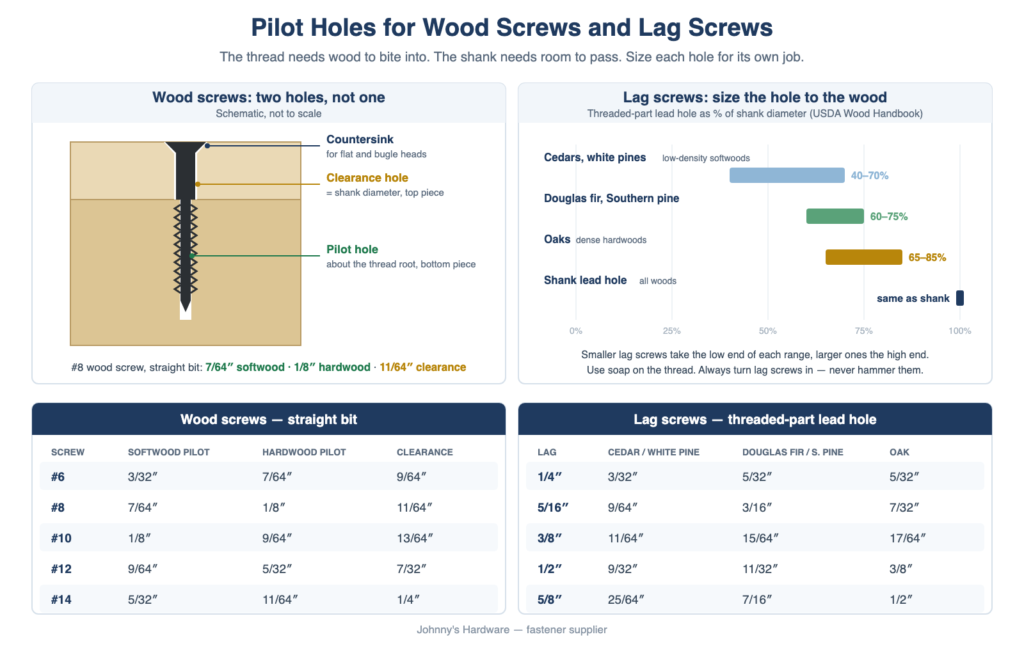
A #8 wood screw needs a 7/64 inch pilot hole in softwood and a 1/8 inch pilot hole in hardwood, drilled with a straight bit, plus an 11/64 inch clearance hole through the top piece if the screw is pulling two boards together. A 5/16 inch lag screw in Douglas fir needs a 3/16 inch lead hole for the thread and a full 5/16 inch hole for the smooth shank.
Those two answers share one idea. A screw does two different jobs along its length — the thread grips, the shank passes through — and each part needs its own hole. The charts below give the sizes, and the sections after them explain where the numbers come from, because published charts do not all agree.
Why a screw needs two holes
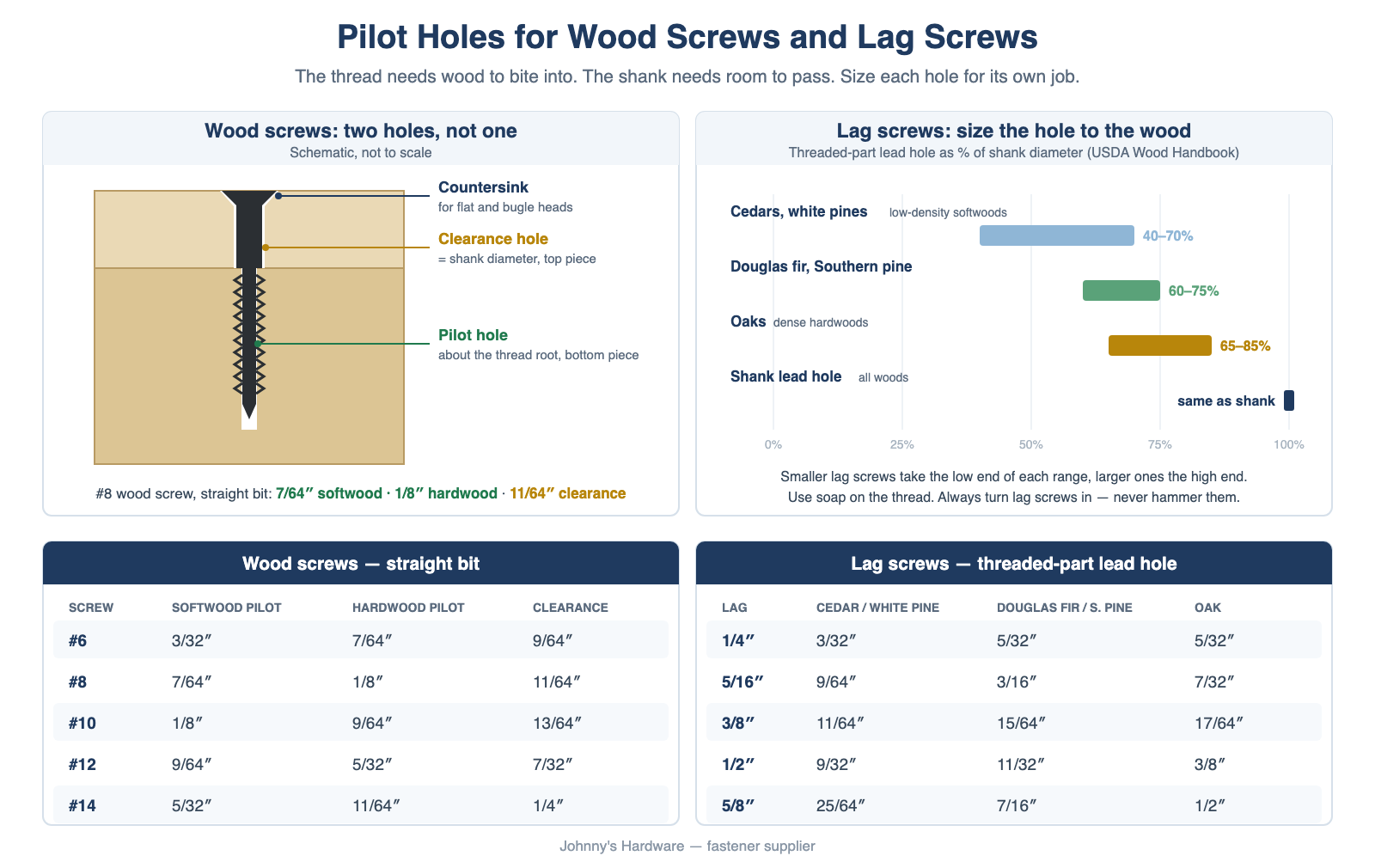
- Pilot hole, in the piece that receives the thread. It is sized close to the thread’s root diameter — the solid core inside the threads — so the core slides in without forcing the wood apart, while the thread cuts into solid wood.
- Clearance hole, in the top piece. It is the size of the shank, so the screw passes freely. Without it, the thread grips both boards and cannot pull them together; the joint stays open no matter how hard the screw is driven.
- Countersink, for flat and bugle heads, so the head sits flush without splitting the surface.
A combination bit drills all three in one pass, which is why it is the tool most trades reach for on repeat work.
Wood screw pilot hole chart
Straight bits are ordinary twist or brad-point bits. Tapered bits follow the taper of a traditional wood screw, and their nominal size is taken at the widest part, so the figures are larger than for a straight bit doing the same job. The two columns are not interchangeable.
| Screw | Shank diameter | Softwood pilot straight bit | Hardwood pilot straight bit | Softwood / hardwood tapered bit | Clearance hole |
|---|---|---|---|---|---|
| #4 | 0.112″ | 1/16″ (1.6 mm) | 5/64″ (2.0 mm) | 3/32″ / 7/64″ | 1/8″ |
| #6 | 0.138″ | 3/32″ (2.4 mm) | 7/64″ (2.8 mm) | 1/8″ / 9/64″ | 9/64″ |
| #8 | 0.164″ | 7/64″ (2.8 mm) | 1/8″ (3.2 mm) | 5/32″ / 11/64″ | 11/64″ |
| #10 | 0.190″ | 1/8″ (3.2 mm) | 9/64″ (3.6 mm) | 3/16″ / 13/64″ | 13/64″ |
| #12 | 0.216″ | 9/64″ (3.6 mm) | 5/32″ (4.0 mm) | 13/64″ / 7/32″ | 7/32″ |
| #14 | 0.242″ | 5/32″ (4.0 mm) | 11/64″ (4.4 mm) | 15/64″ / 1/4″ | 1/4″ |
Shank diameters are the standard gauge figures published in the USDA Forest Products Laboratory Wood Handbook. Pilot sizes follow the common trade rule of drilling to the thread root in hardwood and about 15% smaller in softwood. Clearance holes are the smallest common fractional drill at or above the shank diameter, so the screw passes without binding. Metric-sized wood screws, such as a 4.0 mm screw sold as an #8 equivalent, are slightly smaller than the inch gauge and take slightly smaller holes; the screw size chart gives the metric figures.
What the research says, and why charts disagree
Search for a pilot hole chart and you will find numbers that differ by a drill size or two. That is not carelessness. It reflects a real trade-off.
The Wood Handbook, the reference behind US wood design values, bases its screw withdrawal figures on lead holes of about 70% of the root diameter in softwoods and about 90% in hardwoods. Most trade charts, including the one above, recommend larger holes than that — the full root in hardwood. The larger hole drives more easily and splits less, which matters in dense timber, near ends and edges, and with brass or small screws that shear easily. The smaller hole holds harder but risks splitting the wood or snapping the screw.
The practical conclusion: use the chart as a starting point, then test one screw in an offcut of the actual timber. If the screw strains or the wood cracks, go up one size. If the screw spins or strips, go down one. The Wood Handbook also recommends a little soap or similar lubricant on the thread in dense woods, which eases driving with little effect on holding power.
Lag screw pilot hole chart
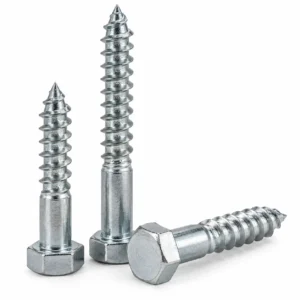
Lag screws are larger and carry real structural load, and the guidance for them is more specific. The Wood Handbook sets two rules:
- The shank lead hole is the same diameter as the shank. In practice it is drilled as deep as the smooth, unthreaded part of the screw will sit.
- The threaded lead hole is a percentage of the shank diameter that depends on wood density: 40% to 70% for low-density softwoods such as cedars and white pines, 60% to 75% for Douglas fir and Southern pine, and 65% to 85% for dense hardwoods such as oaks. Smaller lag screws take the low end of each range and larger ones the high end.
| Lag screw | Shank hole | Thread hole: cedar, white pine | Thread hole: Douglas fir, Southern pine | Thread hole: oak |
|---|---|---|---|---|
| 1/4″ | 1/4″ | 3/32″ | 5/32″ | 5/32″ |
| 5/16″ | 5/16″ | 9/64″ | 3/16″ | 7/32″ |
| 3/8″ | 3/8″ | 11/64″ | 15/64″ | 17/64″ |
| 1/2″ | 1/2″ | 9/32″ | 11/32″ | 3/8″ |
| 5/8″ | 5/8″ | 25/64″ | 7/16″ | 1/2″ |
| 3/4″ | 3/4″ | 17/32″ | 9/16″ | 41/64″ |
These thread-hole sizes were calculated from the Wood Handbook percentages, moving from the low end of each range at 1/4 inch to the high end at 3/4 inch, and rounded to the nearest common fractional drill. They are a sound starting point for work that is not engineered. Where a lag screw connection is part of a structural design, the engineer’s specification and the National Design Specification for Wood Construction govern.
Two more rules from the same source matter in practice. Lubricate the thread with soap or a similar lubricant, and for long lag screws drill the lead hole slightly larger than the chart to keep the torque manageable. And always turn a lag screw in with a wrench: hammering one in tears the wood fibres and damages the thread, seriously reducing its capacity. The difference between a lag screw and a lag bolt, which are the same fastener, is covered in bolt vs screw.
When a pilot hole matters most
| Situation | Pilot hole? |
|---|---|
| Hardwood of any kind | Yes — otherwise screws snap and heads strip |
| Near the end or edge of a board | Yes — the wood splits along the grain |
| Lag screws | Yes — both the shank hole and the thread hole |
| Brass and other soft-metal screws | Yes, generously — they shear easily |
| Small screws in the middle of a softwood board | Often not needed |
| Self-drilling, drywall and many modern construction screws | Usually not — their points and threads are designed to drive without one; follow the maker’s guidance |
The last row is worth noting for a range buyer. Much of the modern screw market, including chipboard, construction and self-drilling screws, is designed to reduce or remove pre-drilling. Traditional wood screws, brass screws and lag screws still need it. Pocket hole screws, which are self-tapping, are a special case covered in pocket hole screw size chart.
Final thoughts
Pilot holes follow a simple logic once the screw is seen as two parts: size the pilot to the thread root so the thread bites, size the clearance hole to the shank so the joint pulls tight, and size lag screw holes to the density of the wood. Charts disagree by a drill size because easy driving and maximum grip pull in opposite directions. Start from the chart, test in the real timber, and adjust one size either way.
FAQ
What size pilot hole for a #8 wood screw?
Drill 7/64 inch (2.8 mm) in softwood and 1/8 inch (3.2 mm) in hardwood with a straight bit. With a tapered bit, use 5/32 inch in softwood and 11/64 inch in hardwood. If the screw is clamping a top board to a bottom one, drill an 11/64 inch clearance hole through the top board so the thread only grips the bottom piece.
What size pilot hole for a #10 screw?
Use 1/8 inch (3.2 mm) in softwood and 9/64 inch (3.6 mm) in hardwood with a straight bit, and a 13/64 inch clearance hole through the top piece. A #10 shank is 0.190 inch, so the clearance hole is the smallest common drill that lets it pass without binding.
What size pilot hole for a #6 screw?
Use 3/32 inch (2.4 mm) in softwood and 7/64 inch (2.8 mm) in hardwood with a straight bit, and a 9/64 inch clearance hole. Small #6 screws in the middle of a softwood board often drive without a pilot, but near an edge or in hardwood a pilot prevents splitting and snapped screws.
What size pilot hole for a 5/16 lag screw?
Drill a 5/16 inch hole as deep as the smooth shank, then a thread hole of about 3/16 inch in Douglas fir or Southern pine, 9/64 inch in cedar or white pine, and 7/32 inch in oak. The thread hole sizes come from the USDA Wood Handbook percentages for each wood density.
What size pilot hole for a 3/8 lag screw?
Drill a 3/8 inch shank hole to the depth of the unthreaded shank, then a thread hole of about 15/64 inch in Douglas fir or Southern pine, 11/64 inch in cedar or white pine, and 17/64 inch in oak. For long lag screws, go slightly larger and lubricate the thread to keep the torque manageable.
What size pilot hole for a 1/4 lag screw?
Drill a 1/4 inch shank hole, then a thread hole of about 5/32 inch in Douglas fir, Southern pine or oak, and 3/32 inch in cedar or white pine. Small lag screws sit at the low end of the Wood Handbook percentage ranges, which is why the softwood hole is proportionally smaller than for larger lags.
Do you need a pilot hole for wood screws?
In hardwood, near the end or edge of a board, and for lag screws and brass screws, yes. Small screws in the middle of a softwood board often drive cleanly without one. Many modern construction, chipboard and self-drilling screws are designed to go in without pre-drilling; follow the manufacturer’s guidance for those.
What happens if a pilot hole is too big?
The thread has too little wood to cut into and the screw loses holding power; in the worst case it spins without tightening. The Wood Handbook illustrates this for lag screws: a correctly sized hole gives clean, deep thread penetration, while an oversized hole gives rough, shallow penetration. If a screw spins, go down a drill size.
What is the difference between a pilot hole and a clearance hole?
A pilot hole is smaller than the screw and drilled into the piece that receives the thread, so the thread can grip. A clearance hole is the size of the shank and drilled through the top piece, so the screw passes freely and can pull the two pieces together. A combination bit drills both, plus the countersink, in one pass.
Should I use a tapered or straight drill bit?
Either works if you use the matching column of the chart. Tapered bits follow the shape of traditional tapered wood screws and are measured at their widest part, so their nominal sizes run larger; a straight-bit size used with a tapered bit, or the other way round, will be wrong. Modern parallel-thread screws pair naturally with straight bits.
Sourcing wood screws and lag screws
Johnny’s Hardware supplies wood screws from #4 to #14 (3.0 to 6.0 mm) with countersunk heads and Pozidriv or Torx drives, lag screws, and chipboard and construction screws, alongside drywall, deck, concrete and self-tapping screws. Sizes, finishes and packing are quoted against the order.
Screws consolidate with the rest of the screw supplier range and the wider fastener supplier catalogue in one shipment, with private label and retail packaging handled through our OEM hardware supplier service. For the full picture of screw families and heads, see types of screws and screw head types.
Send the screw types, gauges, lengths, finish, packing and quantities, and we will come back with specifications, carton data and lead times within 12 working hours.
– Johnny’s Hardware Team, QC Engineer