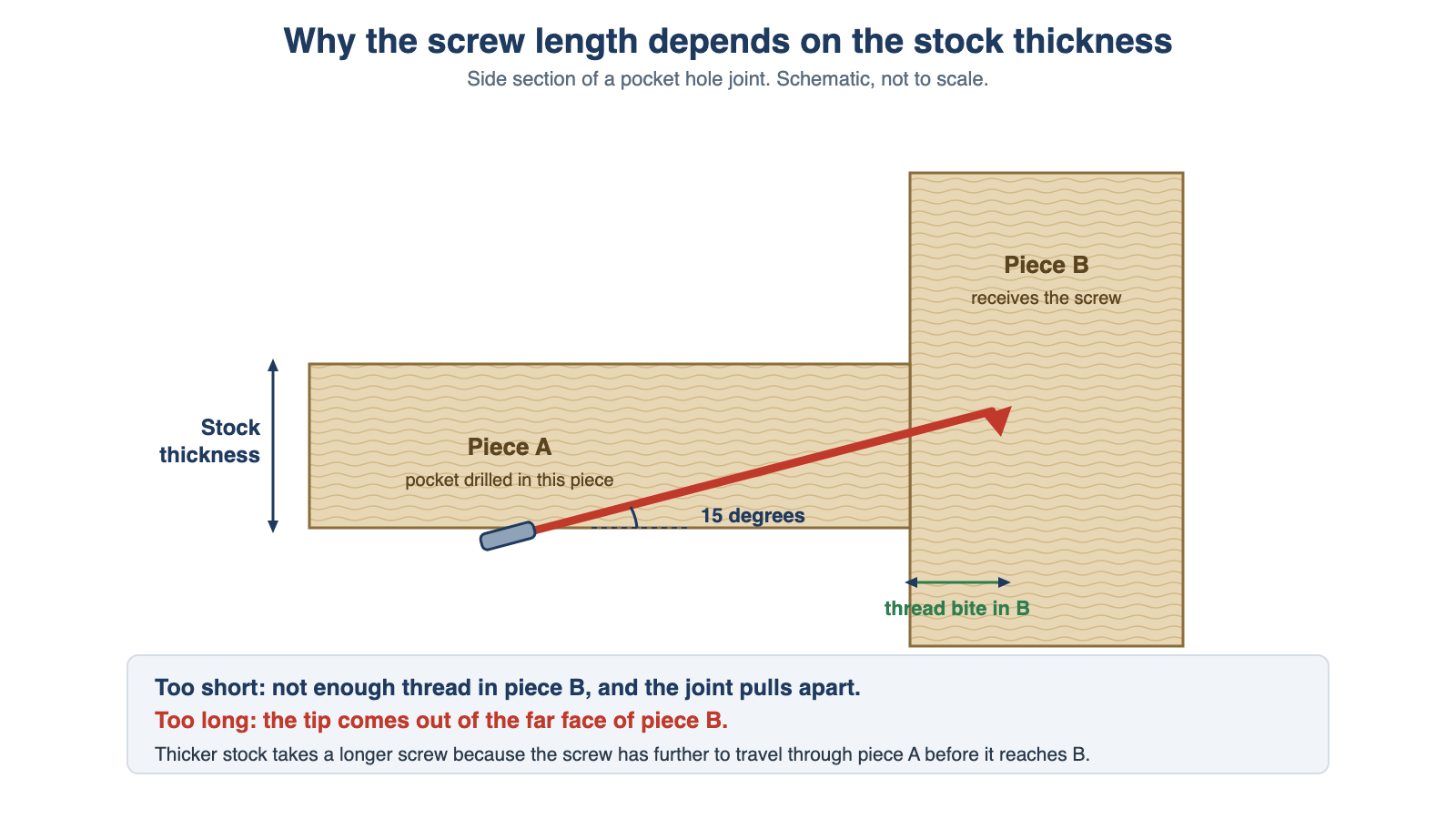
A pocket hole screw is chosen by the thickness of the wood it passes through, not by the size of the project. Pick one that is too short and the joint pulls apart. Pick one that is too long and the tip comes out of the far face of the board.
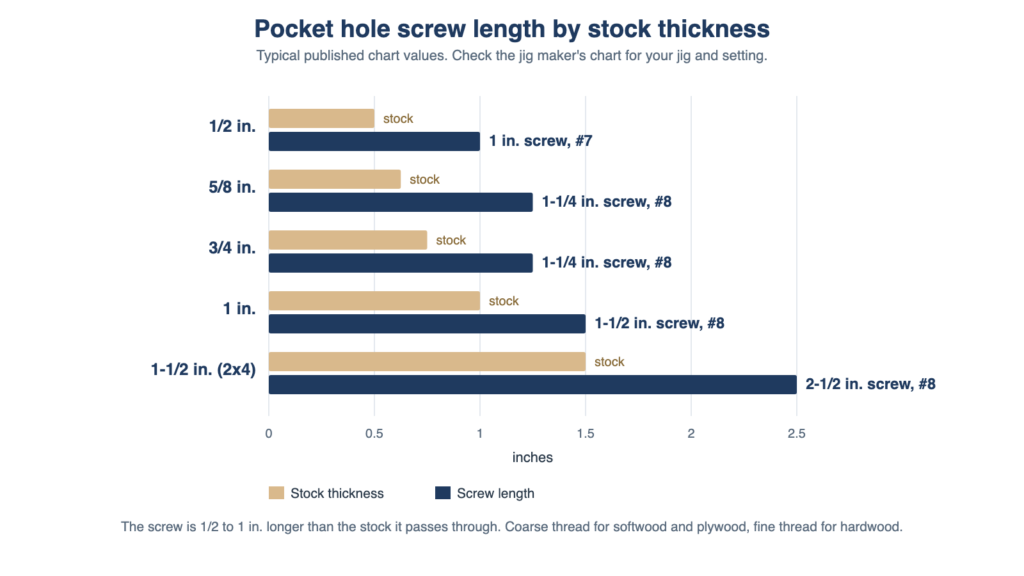
For 3/4 in. plywood or timber, use a 1-1/4 in. pocket hole screw. The usual chart is 1 in. for 1/2 in. stock, 1-1/4 in. for 5/8 in. and 3/4 in., 1-1/2 in. for 1 in., and 2-1/2 in. for a 1-1/2 in. 2×4, in coarse thread for softwood and fine thread for hardwood.
Pocket hole screw size chart
The chart runs from thin stock to a 2×4. There is no standard for pocket hole screws, so the values below are the ones most published guides agree on. Check the chart for your own jig and its collar setting before ordering.
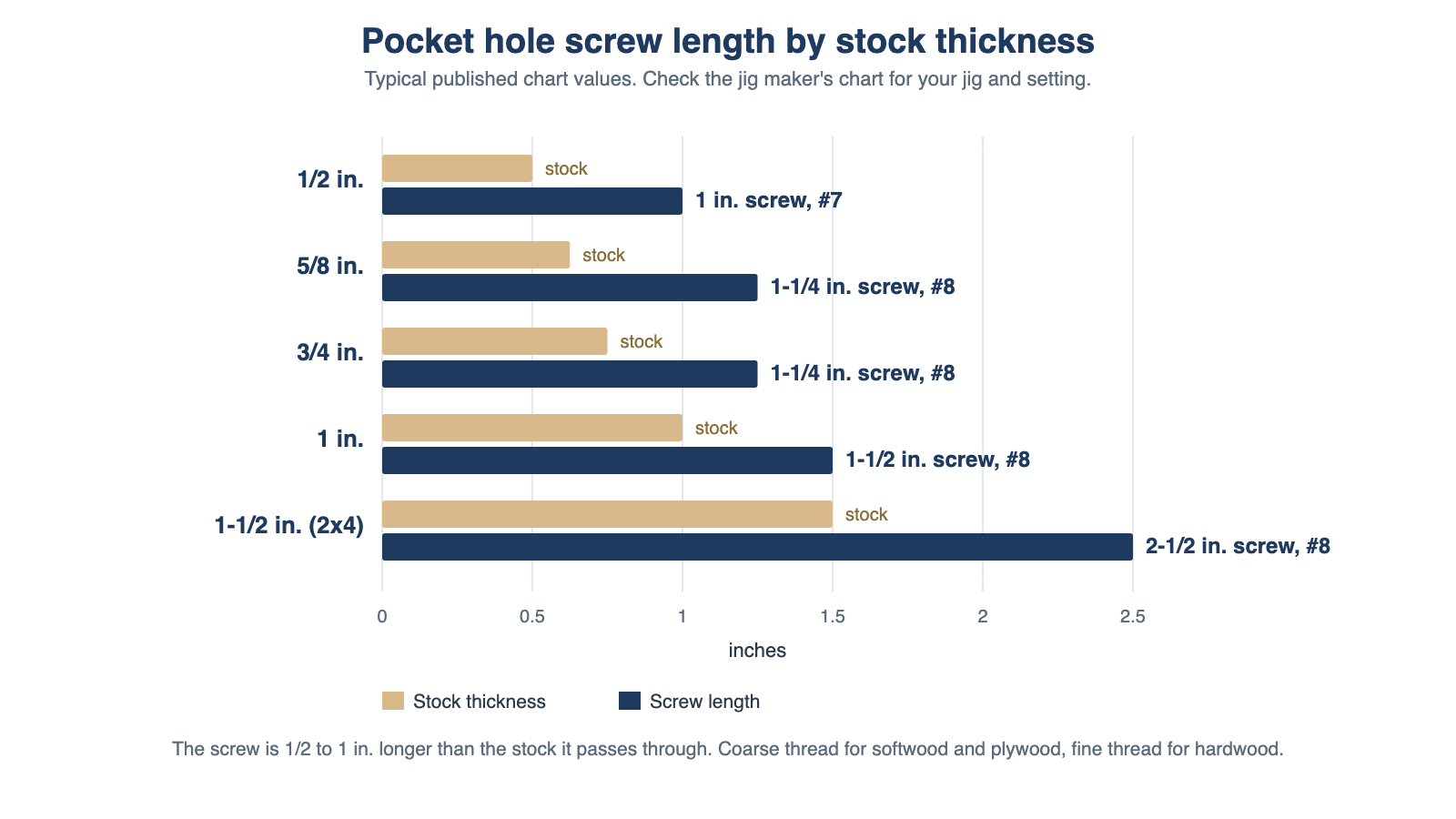
| Stock thickness | Screw length | Gauge | Thread | Typical use |
|---|---|---|---|---|
| 1/2 in. | 1 in. | #7 | Coarse for softwood and plywood | Small frames, light boxes, drawer parts |
| 5/8 in. | 1-1/4 in. | #8 | Coarse or fine | Light cabinet parts |
| 3/4 in. | 1-1/4 in. | #8 | Coarse for plywood and softwood, fine for hardwood | Cabinets, shelves, face frames |
| 1 in. | 1-1/2 in. | #8 | Coarse or fine | Heavier furniture frames |
| 1-1/2 in. (2×4) | 2-1/2 in. | #8 | Coarse | Workbenches, outdoor frames |
Thickness means actual thickness, not the nominal size. A 2×4 is 1-1/2 in. thick, and 3/4 in. plywood is usually a little under 3/4 in., which is why jig settings and screw charts are written to the nominal stock. One chart lists a 3/4 in. screw for 1/2 in. plywood used for drawer bottoms and cabinet backs, while the more common chart gives 1 in. If the two disagree for your stock, test a joint on offcuts first.
How to choose the right length
The screw has to pass through the first piece and still have enough thread left in the second. A quick check is the stock thickness plus 5/8 in., rounded down to the nearest stock length.
| Stock | Thickness + 5/8 in. | Rounded to a stock length | Common chart | Agree? |
|---|---|---|---|---|
| 1/2 in. | 1-1/8 in. | 1 in. | 1 in. | Yes |
| 5/8 in. | 1-1/4 in. | 1-1/4 in. | 1-1/4 in. | Yes |
| 3/4 in. | 1-3/8 in. | 1-1/4 in. | 1-1/4 in. | Yes |
| 1 in. | 1-5/8 in. | 1-1/2 in. | 1-1/2 in. | Yes |
| 1-1/2 in. | 2-1/8 in. | 2 in. | 2-1/2 in. | No: the chart is longer |
The check works up to 1 in. stock and fails at 2×4. For 1-1/2 in. stock the usual chart calls for 2-1/2 in., half an inch longer than the check suggests, because the thicker piece gives the screw further to travel before it reaches the second board. Where the chart and the check differ, use the chart. The check is a sanity test, not a replacement for the jig maker’s table.
Most pocket hole jigs drill at a shallow angle, usually 15 degrees, and the collar or stop sets the pocket depth to the stock. The screw length in the chart assumes the stop is set to the thickness of the piece being drilled.
What size pocket hole screws for common materials
3/4 in. plywood
Use a 1-1/4 in. coarse-thread #8 pocket hole screw. Coarse thread suits plywood and softwood, and 1-1/4 in. is the standard length for 3/4 in. stock. This is also the answer for cabinet carcass joints in 3/4 in. plywood.
1/2 in. plywood
Use a 1 in. #7 pocket hole screw, the common chart value, in coarse thread. A shorter pan-head screw is often used on thin stock because its head is smaller than a washer head.
2×4 lumber
Use a 2-1/2 in. coarse-thread pocket hole screw, with the jig set for 1-1/2 in. stock. A 2×4 is 1-1/2 in. thick, so it follows the 1-1/2 in. row of the chart.
Hardwood face frames and furniture
Use fine thread. For 3/4 in. oak, maple or cherry the length is still 1-1/4 in., but the closer thread spacing grips dense grain without stripping or splitting it. Exotic hardwoods may still need a pilot hole even with fine thread.
Pilot-hole sizes for other wood screws are in the pilot hole size chart, and the gauge numbers behind #7 and #8 are in the screw size chart.
Coarse thread or fine thread
Coarse thread goes in softwood, plywood, MDF and particleboard, and fine thread goes in hardwood. The wider spacing of coarse thread grips soft fibre, and the tighter spacing of fine thread avoids stripping dense grain.
| Material | Thread | Reason |
|---|---|---|
| Pine, fir, cedar, poplar | Coarse | Soft fibre, coarse thread bites well |
| Plywood (softwood face), MDF, particleboard | Coarse | Soft or composite core holds a coarse thread |
| Oak, maple, ash, cherry, walnut | Fine | Dense grain, fine thread avoids stripping |
| Birch plywood | Fine | Dense face veneer |
| Ipe, teak and other exotics | Fine, with a pilot hole | May split even with fine thread |
What is a pocket hole screw?
A pocket hole screw is a small wood screw made to be driven through an angled, stepped hole, joining two pieces of wood without visible fasteners on the face. The features differ from a general-purpose screw because of the pocket.
| Feature | Typical pocket hole screw | Why |
|---|---|---|
| Head | Washer head, or a smaller pan head for thin stock | A wide flat bearing surface sits on the step of the pocket |
| Tip | Self-tapping, with a notch in the tip | Cuts its own thread in the second piece without a pilot hole |
| Drive | Square drive, with Torx and Phillips also made | Reduces cam-out in a deep pocket |
| Gauge | #6, #7 or #8 | #8 is the common structural gauge, #7 or #6 for thin stock |
| Length | 1 in. to 2-1/2 in., and longer | Set by the stock thickness, as the chart shows |
| Thread | Coarse or fine | Matched to the wood |
| Finish | Zinc plated, blue-coated, or stainless | Indoor use or exterior exposure |
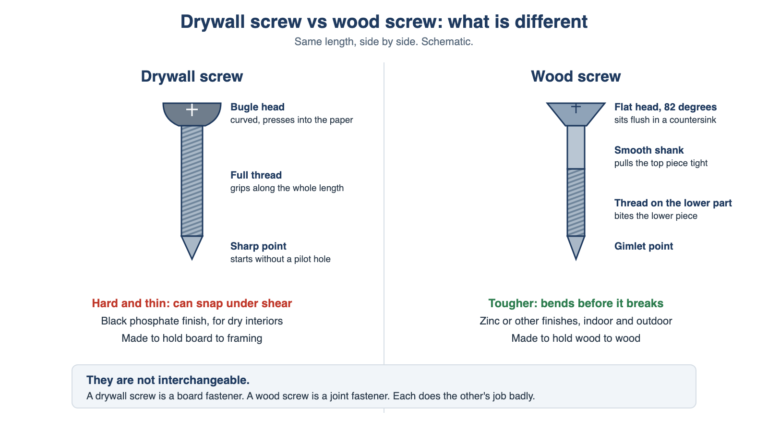
The specification above is typical of published pocket hole screws, and a regular wood screw is a poor substitute. Its head does not sit well on the pocket step and it lacks the self-tapping notch, so it can split the second piece or fail to seat.
What a distributor should specify and stock
For a distributor, a pocket hole screw range is organised by length and thread, and every line has to be written out in full. A short line such as “pocket screws 1-1/4” leaves four decisions to the factory.
- Write the full specification: Pocket hole screw, #8 x 1-1/4 in., coarse thread, washer head, square drive, self-tapping tip, zinc plated.
- Stock the core lengths: 1 in., 1-1/4 in. and 2-1/2 in. in coarse thread, with 1-1/4 in. in fine thread for hardwood users.
- Print the chart on the pack or inside the lid, so the customer can pick the right length without asking.
- Separate indoor and exterior finishes. Zinc-plated screws are for dry interior use. Exterior joints need an exterior-rated coating or stainless.
- Do not assume jig compatibility. Match the screw to the jig maker’s chart, and do not imply compatibility with, or approval by, any jig brand.
Other timber fixings are in the screw supplier range, and the general-purpose line is wood screws.
Final thoughts
Choose a pocket hole screw by the stock it passes through: 1 in. for 1/2 in., 1-1/4 in. for 3/4 in., 1-1/2 in. for 1 in. and 2-1/2 in. for a 2×4. Match the thread to the wood, the finish to the exposure, and the jig setting to the stock. Where charts disagree, test on offcuts, because a screw that exits the far face cannot be fixed afterwards.
Frequently asked questions
What size pocket hole screws for 3/4 plywood?
Use a 1-1/4 inch coarse-thread #8 pocket hole screw, with the jig set for 3/4 inch stock. Coarse thread suits plywood, and 1-1/4 inch is the standard length for 3/4 inch material. For hardwood plywood with a dense face, fine thread may grip better. Test on an offcut if you are not sure.
What size pocket hole screws for 2×4?
Use a 2-1/2 inch coarse-thread pocket hole screw, with the jig set for 1-1/2 inch stock. A 2×4 is 1-1/2 inch thick, and the usual chart gives 2-1/2 inch for that thickness. The quick check of thickness plus 5/8 inch would suggest 2 inch, so follow the chart for 2×4 lumber.
What is a pocket hole screw?
A pocket hole screw is a small wood screw made to be driven through an angled, stepped hole to join two pieces of wood without a visible fastener. It has a washer or pan head that sits on the pocket step, a self-tapping tip and usually a square drive. The length is set by the thickness of the stock.
What size pocket hole screws for 1/2 inch plywood?
A 1 inch #7 pocket hole screw is the common chart value, in coarse thread. Some charts show a shorter 3/4 inch screw for 1/2 inch plywood used for drawer bottoms and cabinet backs. Because the two disagree, test a joint on an offcut and check that the tip does not come out of the far face.
What is the difference between coarse and fine thread pocket hole screws?
Coarse thread has fewer threads per inch and grips soft materials such as pine, plywood, MDF and particleboard. Fine thread has more threads per inch and suits hardwood such as oak, maple and cherry, where it avoids stripping or splitting dense grain. Choose the thread by the wood the screw drives into.
Can I use regular screws for pocket holes?
It is not a good idea. A regular screw’s head does not sit well on the step of a pocket hole, and without a self-tapping notch it can split the second piece or fail to seat. Pocket hole screws have a washer or pan head, a self-tapping tip and a drive made for a deep pocket.
What gauge are pocket hole screws?
They are made in #6, #7 and #8. The #8 gauge is the common choice for structural joints in stock from 5/8 inch upward, while #7 or #6 is used for thin stock such as 1/2 inch. Charts differ on this, so check the gauge in the product listing against the jig maker’s table.
What angle is a pocket hole?
Most pocket hole jigs drill at about 15 degrees to the face of the board, with a stepped hole that gives the screw head a flat shoulder to bear on. The screw runs through the first piece and into the second at that shallow angle. Check the manual of your own jig for the exact figure.
What length pocket hole screws for cabinets?
For 3/4 inch plywood cabinet carcasses, use a 1-1/4 inch coarse-thread screw. For 3/4 inch hardwood face frames, use a 1-1/4 inch fine-thread screw. Cabinet backs in 1/2 inch plywood use a 1 inch screw. Always set the jig stop to the thickness of the piece being drilled, and check the pack for the thread type before using it on hardwood.
Do pocket hole screws need a pilot hole?
Usually not, because the self-tapping tip cuts its own thread in softwood, plywood and most hardwoods. Very dense or exotic woods such as ipe and teak can split even with fine thread, so a small pilot hole in the second piece is advisable. Test on an offcut of the actual wood first.
Sourcing pocket hole screws
Johnny’s Hardware supplies wood screws in coarse and fine thread, in zinc plated and other finishes, within its screw supplier range, in one consolidated order with the rest of our fastener supplier lines. Pocket hole screws are quoted against the order: we confirm the gauge, length, head, drive and tip before quoting, and we do not imply compatibility or approval by any jig brand.
Send the gauge, length, thread, head and drive type, finish, pack size and quantity, and we will come back with specifications and carton data within 12 working hours. Private label packs, with the chart printed, are set up through our OEM hardware supplier service.
– Johnny’s Hardware Team, Sourcing Advisor