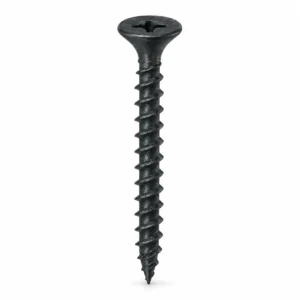
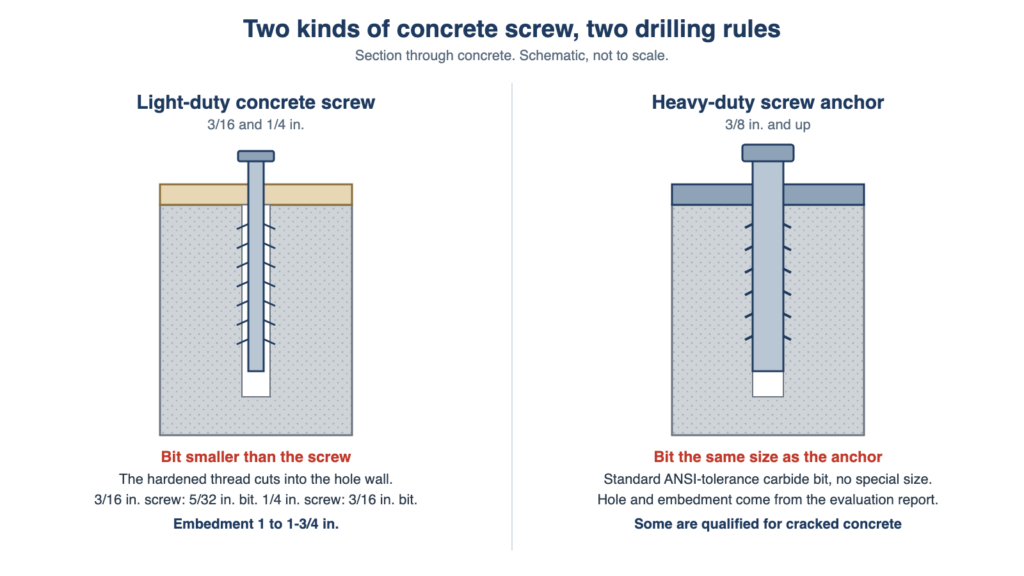
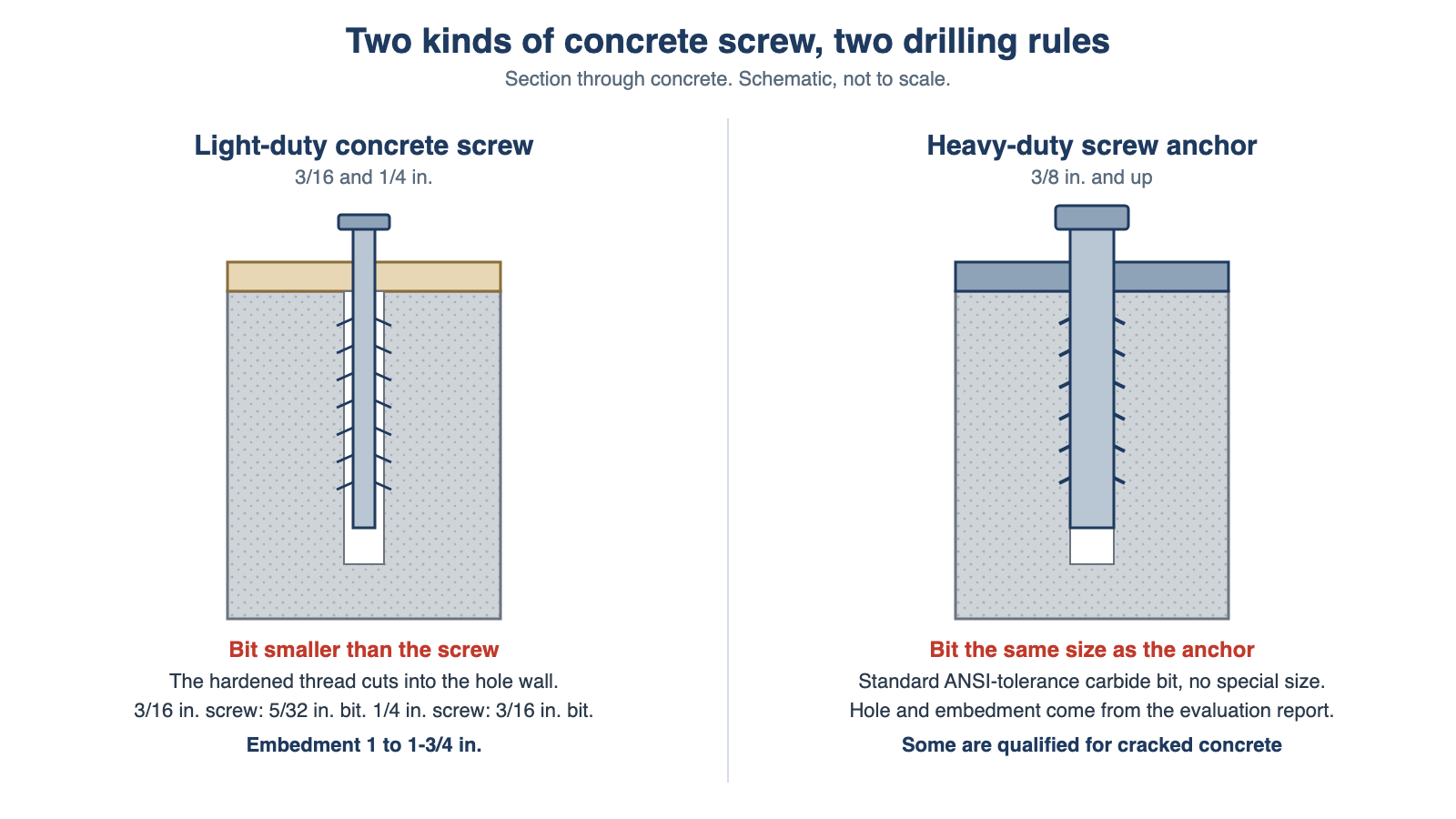
Concrete screws come in two families, and each has its own drilling rule. The small ones cut their thread into a hole drilled with a bit smaller than the screw. The large ones need a bit the same size as the anchor. Using the wrong rule for either is the commonest way to ruin a hole.
For concrete, brick or block, use a 3/16 or 1/4 inch concrete screw with a 5/32 or 3/16 inch carbide bit, long enough to embed 1 to 1-3/4 inches. For heavier loads, use a heavy-duty screw anchor of 3/8 inch or more, drilled with a bit of the same size.
Concrete screw sizes at a glance
A concrete screw is a hardened screw whose thread cuts into a drilled hole in concrete, brick or block, so it needs no plug or sleeve. The light-duty size range is narrow and the drilling data is specific.
| Screw diameter | Carbide bit | Hex head driver | Flat head driver | Lengths |
|---|---|---|---|---|
| 3/16 in. | 5/32 in. | 1/4 in. | #2 Phillips | 1-1/4 to 6 in. |
| 1/4 in. | 3/16 in. | 5/16 in. | #3 Phillips | 1-1/4 to 6 in. |
Stock lengths run 1-1/4, 1-3/4, 2-1/4, 2-3/4, 3-1/4, 3-3/4, 4, 5 and 6 inches. The bit should meet ANSI B212.15 for carbide-tipped masonry bits, and it must be used in a hammer drill. These are installation-guide figures for the light-duty class and not a standard. For any screw sold under an evaluation report, the report’s table governs.
What size screw for concrete?
The length is the thickness of the fixture plus the embedment into the concrete. Embed the screw at least 1 inch and no more than 1-3/4 inches, so a screw is 1 to 1-3/4 inches longer than the material it fixes.
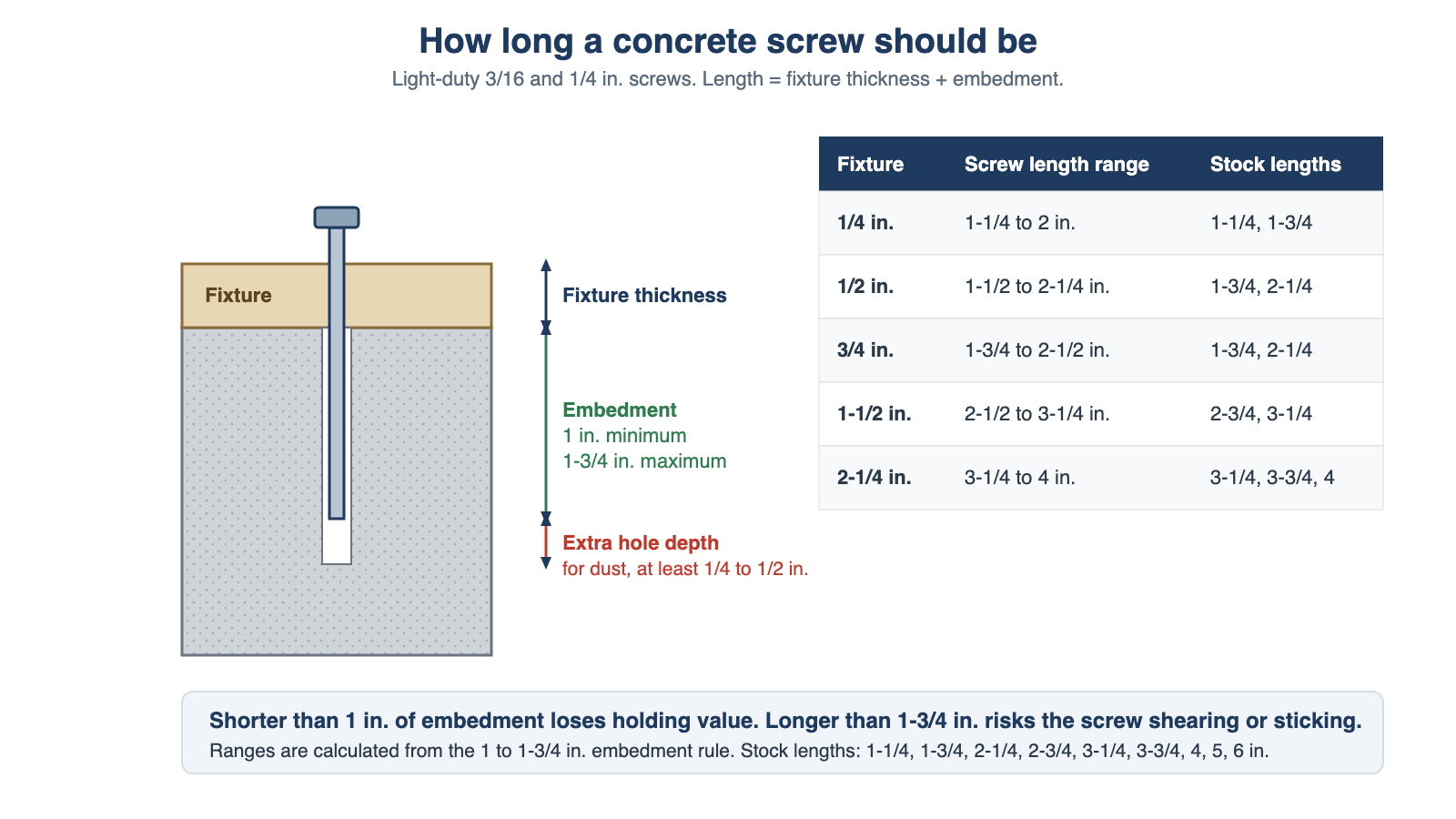
| Fixture thickness | Screw length range | Stock lengths in that range |
|---|---|---|
| 1/4 in. | 1-1/4 to 2 in. | 1-1/4, 1-3/4 |
| 1/2 in. plywood | 1-1/2 to 2-1/4 in. | 1-3/4, 2-1/4 |
| 3/4 in. furring or plywood | 1-3/4 to 2-1/2 in. | 1-3/4, 2-1/4 |
| 1-1/2 in. timber | 2-1/2 to 3-1/4 in. | 2-3/4, 3-1/4 |
| 2-1/4 in. (timber and plywood) | 3-1/4 to 4 in. | 3-1/4, 3-3/4, 4 |
The ranges are calculated from the embedment rule and the stock lengths above. Embedment shorter than 1 inch cuts the holding value and may leave none at all. Embedment deeper than 1-3/4 inches invites installation problems, such as the screw shearing off or sticking in the hole.
How deep to drill, and how long the bit must be
Drill deeper than the screw will go, to leave room for dust. Sources differ on how much deeper: the maker’s figure for the small sizes is at least 1/4 inch, and several installation guides ask for 1/2 inch. The larger allowance is the safer one.
| Screw length | Minimum bit length |
|---|---|
| 1-1/4 and 1-3/4 in. | 3-1/2 in. |
| 2-1/4 and 2-3/4 in. | 4-1/2 in. |
| 3-1/4, 3-3/4 and 4 in. | 5-1/2 in. |
| 5 in. | 6-1/2 in. |
| 6 in. | 7-1/2 in. |
Screws for concrete, brick and block
Concrete screws work in solid concrete, brick and block, but the three behave differently. Solid concrete is the benchmark, and the other two need more care about where the hole is drilled.
| Base material | Works? | Note |
|---|---|---|
| Solid concrete | Yes | The reference condition for the sizes above |
| Solid brick | Yes | Drill into the brick, not the mortar joint, which is softer |
| Concrete block | With care | Hollow cores and thin face shells limit the hold. Test, or use a sleeve anchor |
| Mortar joints | Low load only | Weaker than the masonry units either side |
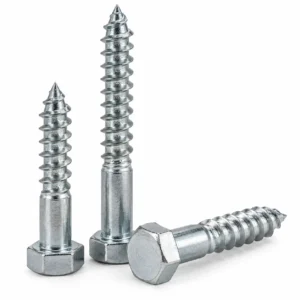
Where the base is hollow block, or the load is heavy, a different anchor is the answer, and the options are compared in types of concrete anchors. A plain lag screw has no thread for masonry, and lag screws only go into concrete with a shield, as explained in what is a lag bolt.
Heavy-duty screw anchors are a different product
Heavy-duty screw anchors, from 3/8 inch upward, are drilled with a bit the same size as the anchor, not a smaller one. The hole depth and embedment come from the product’s evaluation report, not from the light-duty rules.
The practical point is that the two families are not interchangeable in how they are drilled. A 3/8 inch screw anchor in a hole made with an undersized bit may not seat, and a 1/4 inch light-duty screw in a full-size hole may not hold. Several heavy-duty screw anchors are qualified under ICC-ES AC193 for cracked and uncracked concrete, which is a separate question answered by the report and not by the size, as {A(‘/types-of-concrete-anchors/’, ‘the concrete anchor guide’)} explains. Light-duty concrete screws should be treated as non-structural fixings unless a report says otherwise.
How to screw into concrete
Yes, you can screw into concrete with a concrete screw. The method matters more than the strength of the drill, and the holes have to be right.
- Use a hammer drill in hammer-and-rotation mode, with a carbide-tipped bit that meets ANSI B212.15. Straight rotation can misshape the hole and weaken the hold.
- Match the bit to the screw: 5/32 inch for 3/16 inch, and 3/16 inch for 1/4 inch.
- Drill deeper than the screw will penetrate, by at least 1/4 inch and preferably 1/2 inch.
- Clear the dust with a wire brush, a vacuum or compressed air.
- Drive with the right driver: a hex socket or a Phillips bit of the size in the table above, until the head seats. Do not overdrive.
- Do not reuse the screw. The lead thread wears with use and may not reach the required embedment a second time.
Concrete screw or wedge anchor?
A concrete screw is removable and quick to fit, which suits light to medium fixings that may need to be moved. A wedge or sleeve anchor is permanent and generally carries more.
| Concrete screw | Wedge anchor | Sleeve anchor | |
|---|---|---|---|
| Removable | Yes, but do not reuse | No | Bolt only |
| Hole | Smaller than the screw (light-duty) | Same as the anchor | Same as the anchor |
| Base material | Concrete, brick, block | Solid concrete only | Concrete, brick, block |
| Load | Light to medium | Highest of the three | Medium |
Materials and finishes
Concrete screws are hardened steel, and the finish decides where they can be used. A blue corrosion-resistant coating is common and suits dry interior use. Exterior, damp or coastal fixings need stainless steel or a coating rated for the exposure.
The same reasoning as for other zinc and coated fasteners applies, and the salt-spray life of the common finishes is set out in do zinc screws rust. Stainless concrete screws are available, but installation can be less forgiving than with hardened carbon steel, so follow the maker’s drilling and driving instructions closely.
What a distributor should specify and stock
For a distributor, the two families belong in separate parts of the catalogue, with the drilling rule printed on each pack. A customer who is told one rule for both will drill the wrong hole.
- Write the full specification: Concrete screw, 1/4 in. x 2-1/4 in., hex washer head, blue coated, with a 3/16 in. carbide bit.
- Stock the common sizes: 3/16 and 1/4 inch, in lengths from 1-3/4 to 3-3/4 inches, in hex washer and flat countersunk heads.
- Include or sell the bit. A pack with the matching carbide bit removes the commonest error.
- Print the rule on the pack: the bit size, the embedment of 1 to 1-3/4 inches, and “do not reuse”.
- Keep heavy-duty screw anchors separate, with their own report and drilling data.
- Do not use another maker’s brand name for your own product, or imply compatibility or approval by it.
The general screw supplier range and the fastener supplier catalogue sit alongside, and private label packs with the drilling rule printed are set up through an OEM hardware supplier service.
Final thoughts
A concrete screw is sized by diameter and length, drilled with a bit that depends on its family, and embedded 1 to 1-3/4 inches. Choose the light-duty family for light fixings in concrete, brick and solid block, and a heavy-duty screw anchor or a wedge anchor when the load matters. Whatever the size, match the bit, drill deep enough, clean the hole and use each screw once.
Frequently asked questions
What size screw do I need for concrete?
For light fixings, use a 3/16 or 1/4 inch concrete screw. The length is the fixture thickness plus 1 to 1-3/4 inches of embedment, for example a 1-3/4 or 2-1/4 inch screw for a 3/4 inch board. For heavier loads, use a heavy-duty screw anchor of 3/8 inch or more, or a wedge anchor, and take the sizes from its report.
What size drill bit for a 1/4 inch concrete screw?
A 3/16 inch carbide-tipped masonry bit. The bit is smaller than the screw, because the hardened thread cuts into the wall of the hole. Use it in a hammer drill in hammer mode, and drill deeper than the screw will go. For a 3/16 inch screw, the bit is 5/32 inch.
What size drill bit for a 3/16 inch concrete screw?
A 5/32 inch carbide-tipped masonry bit that meets ANSI B212.15, used with a hammer drill. Drill 1/4 to 1/2 inch deeper than the screw will penetrate and clear the dust from the hole. A heavy-duty screw anchor is different: it takes a bit the same size as the anchor, not a smaller one.
How deep should a concrete screw go?
Embed the screw at least 1 inch and no more than 1-3/4 inches into the base material. Less than 1 inch loses holding value, and more than 1-3/4 inches risks the screw shearing off or sticking. Drill the hole at least 1/4 inch deeper than the embedment, and 1/2 inch is safer, to leave space for dust.
Can you use concrete screws in brick?
Yes, in solid brick, with the same sizes and drilling rule as for concrete. Drill into the brick itself and not the mortar joint, which is softer and holds less. Hollow brick and block behave differently from solid brick, so test the fixing or choose a sleeve anchor made for the base material.
Can you use concrete screws in concrete block?
With care. Hollow block has thin face shells and empty cores that limit the hold, so a light-duty concrete screw may not seat in the same way it does in solid concrete. Filled block behaves more like concrete. If the load matters, a sleeve anchor or an anchor designed for masonry is the safer choice.
Can you reuse a concrete screw?
It is not recommended. The lead thread of a concrete screw wears as it cuts into the hole, and a used screw may not reach the minimum embedment a second time. Replace it with a new screw, and if the hole is oversized, move to a new hole or choose a different anchor.
What is the difference between a concrete screw and a wedge anchor?
A concrete screw is removable and cuts its own thread into a hole drilled smaller than the screw, which suits light to medium fixings. A wedge anchor is permanent, uses a hole the same size as the anchor and carries more load, in solid concrete only. Which one is acceptable also depends on the evaluation report.
What is a Tapcon screw?
Tapcon is a brand name for a concrete screw, a trademark of its owner, and it is used by many people as a general name for the product. The generic names are concrete screw and masonry screw. The sizes, bit rules and embedment in this guide apply to concrete screws of that type, whoever makes them.
Do concrete screws work in cracked concrete?
Light-duty concrete screws are normally treated as non-structural fixings. Some heavy-duty screw anchors are qualified for cracked concrete under ICC-ES AC193, and the evaluation report states it. If cracked-concrete capacity matters to the design, ask for the report and read its scope for the diameter you will use, because scope can differ between sizes of the same product.
Sourcing concrete screws
Johnny’s Hardware quotes concrete screws within its screw supplier range, in one consolidated order with the rest of our fastener supplier lines. We confirm the diameter, length, head, drive, coating and matching bit before quoting. We do not describe our products by another maker’s brand name, and we do not imply compatibility with, or approval by, any brand.
Send the diameter, length, head and drive type, finish, whether you want the drill bit in the pack, pack size and quantity, and we will come back with specifications and carton data within 12 working hours.
– Johnny’s Hardware Team, QC Engineer