A respirator is not a mask. A pack that says “dust mask” protects against dust and does nothing against gas, vapour or a lack of oxygen, and the person wearing it often cannot tell the difference. Most respirator problems start with a buyer who treats every face covering as the same product.
Respiratory protective equipment (RPE), called a respirator in the United States, is any device worn to stop harmful air being breathed in. It either cleans the air with a filter or cartridge, or supplies clean air from a separate source, and a dust mask is only the simplest version of the first kind.
What is respiratory protective equipment?
Respiratory protective equipment is protective equipment worn over the nose and mouth, or the whole face, to protect the lungs from dust, fumes, vapours, gases or oxygen-poor air. “RPE” is the British term, and “respirator” is the American one.
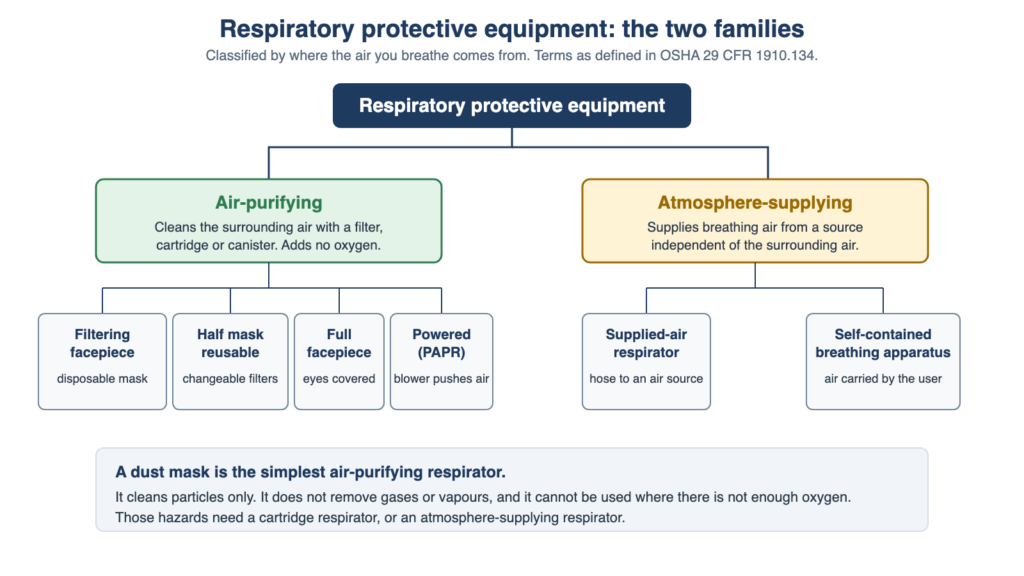
US rules divide respirators into two families, defined in OSHA 29 CFR 1910.134. An air-purifying respirator removes specific contaminants from the surrounding air with a filter, cartridge or canister. An atmosphere-supplying respirator provides breathing air from a source that is independent of the surrounding air. The difference matters because an air-purifying respirator adds no oxygen, so it can never be used where oxygen is short.
Types of respiratory protective equipment
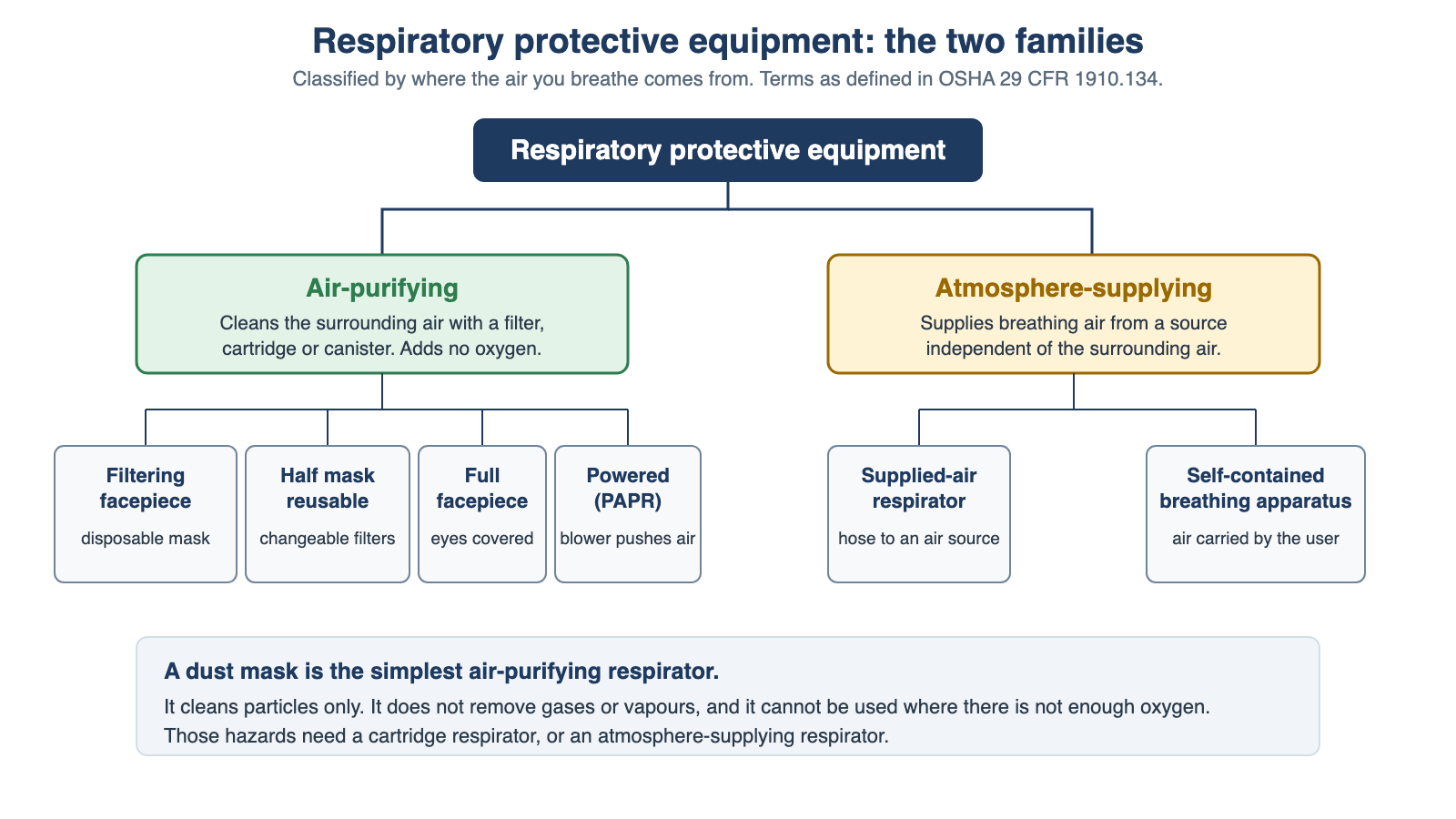
The two families split into six common types, running from a disposable mask to a self-contained air supply. Each type has an assigned protection factor, which is the level of protection the respirator is expected to give in the workplace.
| Type | How it works | Typical use | Assigned protection factor |
|---|---|---|---|
| Filtering facepiece | The whole mask is the filter. Disposable, negative pressure | Dust and particles in sanding, sweeping, demolition | 10 |
| Reusable half mask | A rubber or silicone face seal with replaceable filters or cartridges | Particles, or gas and vapour with the right cartridge | 10 |
| Full facepiece | Seals the whole face and covers the eyes, with replaceable filters | Higher exposure, eye irritants, higher protection needs | 50 |
| Powered air-purifying (PAPR) | A blower pushes filtered air to the wearer | Long shifts, higher protection, bearded wearers (loose-fitting hoods) | 25 to 1,000 by facepiece type |
| Supplied-air respirator | A hose brings clean air from a compressor or cylinder bank | Where air-purifying types are not suitable | 10 to 1,000 by mode and facepiece |
| Self-contained breathing apparatus (SCBA) | The wearer carries the air supply | Emergency work, firefighting, oxygen-poor air | 10,000 in pressure-demand mode |
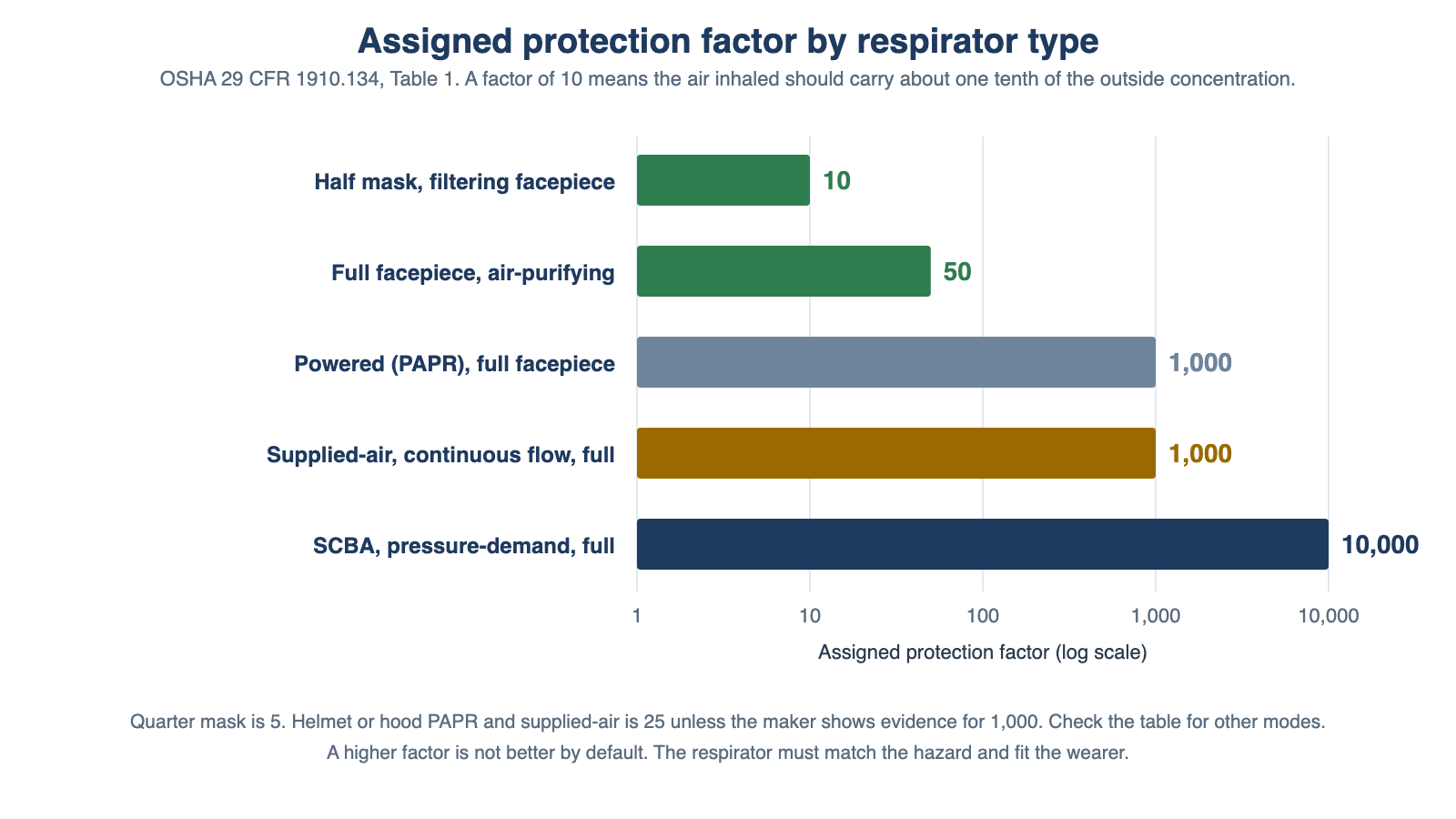
The factors come from OSHA 29 CFR 1910.134, Table 1. A factor of 10 means that, used correctly and fitted properly, the air inhaled should contain about one tenth of the outside concentration. A quarter mask is 5, and a helmet or hood powered or supplied-air respirator is 25 unless the manufacturer shows evidence for 1,000. Check the table for the other modes.
How does a respirator work?
An air-purifying respirator works by passing the air you breathe through a filter or a chemical bed before it reaches the lungs. The filter has to match the hazard, which is why a respirator that works against dust may do nothing against vapour.
- Particle filters trap dust, fumes and mists mechanically as air is pulled through the filter material. The filter’s class says how much it catches.
- Gas and vapour cartridges hold a chemical sorbent that holds specific gases and vapours. Each cartridge is made for a named group of chemicals, and it wears out.
- Combination filters add a particle filter to a cartridge, for work that produces both, such as spraying.
- Atmosphere-supplying respirators do not filter at all. They bring clean air from another source, which is why they are the answer where oxygen is short or the hazard is unknown.
The key limit follows from this. An air-purifying respirator cannot supply oxygen, so it must not be used in oxygen-deficient or immediately dangerous atmospheres, where only an atmosphere-supplying respirator is acceptable.
Particle filter classes: NIOSH and EN 149
The two main particle filter systems grade filters differently, and neither is a direct equivalent of the other. NIOSH grades by efficiency and oil resistance; the European standard grades by penetration and by how much air leaks in at the face seal.
| NIOSH, 42 CFR Part 84 | European, EN 149 | |
|---|---|---|
| Classes | N, R and P series, each at 95, 99 and 99.97% efficiency (N95, P100 and so on) | FFP1, FFP2 and FFP3 |
| Oil | N series not resistant to oil, R somewhat resistant, P strongly resistant | Tested with both salt and paraffin oil aerosols |
| Filter limit | Minimum efficiency of 95%, 99% or 99.97% | Maximum penetration of 20% (FFP1), 6% (FFP2) and 1% (FFP3) |
| Leakage test | Filter efficiency only in the class definition | Total inward leakage tested on human wearers, including the face seal |
| Approval route | Certified by NIOSH, listed with an approval number | EU type-examination and CE marking under Regulation (EU) 2016/425 |
FFP2 and N95 are often called equivalent, but they are not: they are close on filter efficiency and different on test method, and EN 149 adds a leakage test with no NIOSH counterpart. China’s GB 2626 standard, which gives the KN95 class, is a third system. A product certified to one is not thereby certified to another. Particle filter classes and their limits here come from published summaries of the standards, so check the standard text before relying on a figure.
What is required before using a respirator?
Handing a worker a respirator is not enough. In the US, OSHA 29 CFR 1910.134 requires a respiratory protection programme before a tight-fitting respirator is used, and the UK expects equivalent steps under the HSE’s guidance.
- A written programme with worksite-specific procedures, run by a trained administrator.
- A medical evaluation to determine whether the worker can use a respirator at all.
- Fit testing before first use and at least once a year for tight-fitting respirators.
- A user seal check every time the respirator is put on.
- No facial hair or other condition that interferes with the seal of a tight-fitting facepiece.
- Training before use, repeated at least annually.
- Replace or repair the respirator before the worker returns to the area if they notice breakthrough, a change in breathing resistance or leakage.
The UK picture is similar. HSE guidance (HSG53) says respiratory protective equipment must be adequate for the hazard and suitable for the wearer, and that tight-fitting facepieces should be fit tested by a competent person. Loose-fitting hoods and visors need not be fit tested but must still fit closely. OSHA also requires employers to select a NIOSH-certified respirator.
RPE is the last line of defence
Respiratory protective equipment is what is used when the hazard cannot be removed or controlled at source. The accepted order of controls puts elimination, substitution and extraction first, and the respirator last.
HSE guidance describes RPE as a last resort in the hierarchy of controls, and requires exposure to be reduced as low as reasonably practicable. The same logic applies in the US, where respirators are the fall-back when engineering controls are not feasible. For a distributor, this means a respirator should be offered alongside, and not instead of, extraction and dust control.
How to choose a respirator
Choose by the contaminant first, then by the protection factor needed, then by what the wearer can fit and tolerate. A respirator that is chosen for the wrong hazard protects nobody, whatever it is called.
| Hazard | Respirator type | Note |
|---|---|---|
| Dust from sanding, sweeping or cutting | Filtering facepiece or half mask with a particle filter | Pick the filter class for the exposure level |
| Paint spray, solvent vapour | Half or full facepiece with a vapour cartridge and particle filter | Cartridge must be made for the named chemical |
| Welding fume | Particle filter, often powered for long shifts | Check the substance’s exposure limit |
| Oxygen-poor or unknown atmosphere | Atmosphere-supplying respirator | Never an air-purifying type |
| Regulated substances such as asbestos, lead or silica | As the specific rule requires | These have their own standards and limits |
What a distributor should ask for and stock
For a distributor, a respirator is a compliance product, not a commodity. The claim on the pack is a legal statement, and a wrong one is a problem for the seller as well as the wearer.
- Ask for the certificate, not the claim. For the US, an approval number from NIOSH, which can be checked against its certified equipment list. For Europe, the EU type-examination certificate and the CE marking with its notified body number.
- Do not use a standard’s name without the certificate. A pack that says N95, FFP2 or KN95 must be backed by the matching approval.
- Keep dust masks and respirators apart. Label the first “dust only, no gas or vapour” and the second with the filter or cartridge class.
- Sell filters with the facepiece. A reusable half mask without a cartridge guide leads to the wrong cartridge being bought.
- Tell buyers about fit. A tight-fitting respirator needs a fit test, and a printed reminder on the pack costs nothing.
The respirator range sits within the wider PPE categories, and a mixed safety order is covered in safety equipment. Eye protection that goes with a half mask is compared in safety glasses vs goggles.
Final thoughts
Respiratory protective equipment is defined by where the air comes from, rated by how much protection it gives, and valid only when it matches the hazard, fits the wearer and is backed by the right certificate. A dust mask is the beginning of the range, not the whole of it. Choose the hazard first, and ask for the approval before the price.
Frequently asked questions
What is respiratory protective equipment?
Respiratory protective equipment, or RPE, is any device worn to stop harmful air being breathed in. It either cleans the surrounding air with a filter or cartridge, or supplies clean air from another source. In the United States the same equipment is called a respirator. The range runs from a disposable dust mask to a self-contained breathing apparatus.
What is the difference between a respirator and a mask?
A respirator is certified protective equipment designed to filter or supply air and to seal to the face. A mask is a looser word for any face covering. A dust mask is a simple particle respirator and does nothing against gas or vapour, while a surgical or cloth mask is not a respirator at all. Check the certification on the product.
What are the types of respirators?
The two families are air-purifying and atmosphere-supplying. Air-purifying types are filtering facepieces, reusable half masks, full facepieces and powered air-purifying respirators. Atmosphere-supplying types are supplied-air respirators and self-contained breathing apparatus. Each has an assigned protection factor, from 10 for a half mask to 10,000 for a pressure-demand SCBA, and the choice between them depends on the hazard, the protection needed and what the wearer can fit and tolerate.
How does a respirator work?
An air-purifying respirator makes the air pass through a filter or chemical cartridge before it is breathed. Particle filters trap dust and fumes mechanically, and cartridges hold specific gases and vapours on a sorbent. It adds no oxygen. An atmosphere-supplying respirator does not filter, it brings clean air from a separate source.
What is required before using a respirator?
Under OSHA 29 CFR 1910.134, a tight-fitting respirator needs a written programme, a medical evaluation, a fit test before first use and at least annually, a seal check each time it is put on, a clean-shaven seal area and training before use, repeated each year. UK employers follow equivalent HSE guidance on adequate, suitable and fit-tested equipment.
What does assigned protection factor mean?
The assigned protection factor, or APF, is the level of workplace protection a respirator or class of respirators is expected to provide. An APF of 10 means the air inhaled should carry about one tenth of the outside concentration. OSHA lists them in Table 1 of 1910.134, from 10 for a half mask to 10,000 for a pressure-demand SCBA.
Are N95 and FFP2 the same?
No. They are close on filter efficiency, at 95% against a 94% minimum, but they come from different standards with different test methods. EN 149 also tests total inward leakage on human wearers, which NIOSH’s class definition does not. A respirator certified to one is not certified to the other, so the matching certificate has to be on file.
Does OSHA approve respirators?
No. OSHA does not approve respirators. NIOSH certifies them, and OSHA requires employers to select NIOSH-certified respirators and to run a respiratory protection programme. A pack that says “OSHA approved” is making a claim that does not describe how respirators are certified, and the wording should be treated as a warning sign.
Can a dust mask be used for paint fumes?
No. A dust mask filters particles and does not remove vapours or gases. Paint spray needs a half or full facepiece respirator with a cartridge made for the solvent and a particle filter for the spray mist. Where the atmosphere is unknown or short of oxygen, only an atmosphere-supplying respirator is acceptable.
When should a respirator or its filter be replaced?
Replace a disposable respirator when it is damaged, soiled or hard to breathe through, and replace filters and cartridges as the manufacturer instructs. OSHA requires the respirator to be repaired or replaced before the worker returns to the area if breakthrough, a change in breathing resistance or leakage is detected. Cartridges wear out even when they look clean.
Sourcing respiratory protection
Johnny’s Hardware supplies protective equipment in one consolidated order with its fastener supplier and tools ranges, including safety equipment for hardware and DIY channels. Respiratory protection is quoted against the order. We state which certificates exist for each model and never describe a product as NIOSH approved, EN 149 certified or marked to any other respirator standard unless we hold the matching certificate.
Send the destination market, the standard and class you need, the type of respirator, pack size and quantity, and we will come back with specifications and carton data within 12 working hours. Private label packaging is set up through our OEM hardware supplier service.
– Johnny’s Hardware Team, QC Engineer