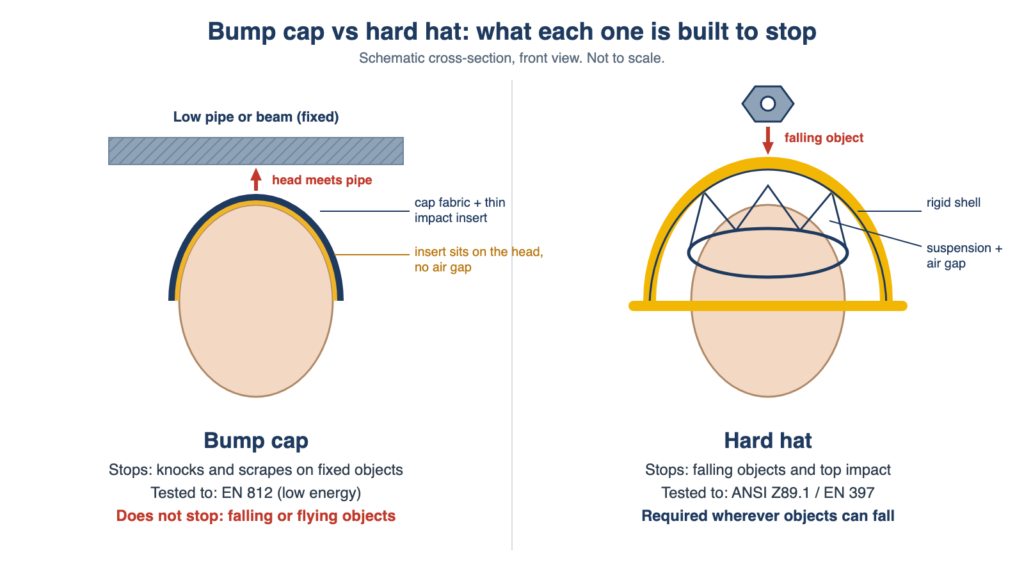
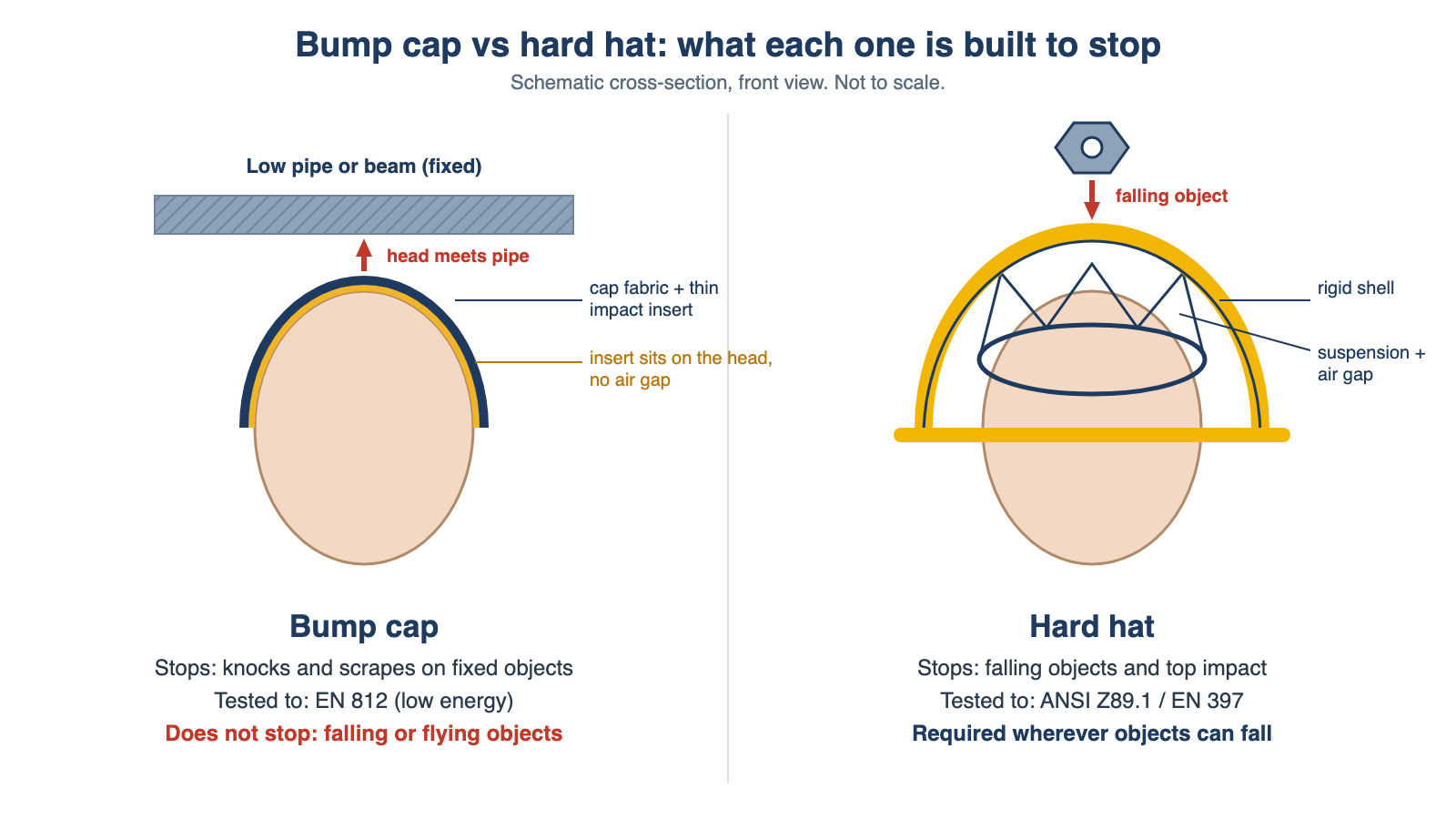
A bump cap stops you hitting your head on something that is standing still. A hard hat stops something hitting your head that is moving. They answer different risks, and a range that sells one as the cheap version of the other is wrong the day something falls.
A bump cap is not a hard hat and cannot replace one. It protects against knocks and scrapes on fixed objects, it is tested to a much lower energy, and it gives no protection from falling or flying objects.
Bump cap vs hard hat at a glance
The difference is the hazard, not the thickness of the shell. Everything else in the table follows from it.
| Bump cap | Hard hat | |
|---|---|---|
| Protects against | Knocks and scrapes on fixed objects | Falling and flying objects, top impact |
| Does not protect against | Falling, flying or swinging objects; electrical contact | Hazards outside its type and class rating. Check the label |
| Standard | EN 812 (Europe, UK). No US performance standard | ANSI/ISEA Z89.1 (US), EN 397 (Europe, UK) |
| Type-test impact energy | About 12.5 J (5 kg from 250 mm) | About 49 J under EN 397 (5 kg from 1 m) |
| Construction | Cap fabric over a thin impact insert, no air gap | Rigid shell with a suspension and air gap |
| Weight and wear | Light, cap-like, worn all shift without complaint | Heavier, warmer, more often worn badly or not at all |
| Where it belongs | Low pipework, racking beams, crawl spaces, workshops | Building sites, scaffolds, overhead work, utilities |
| OSHA position | Outside Z89.1 and not accepted in its place. OSHA approves no product | The product OSHA 1910.135 points to, by way of ANSI Z89.1 |
Hard hat types and classes, and how the standards differ from market to market, are covered in types of hard hats. This article is about the line between that product and the bump cap.
What a bump cap is built to do
A bump cap is a baseball-style cap with a thin, moulded insert in the crown. The insert spreads the force of a low-speed knock so the result is a bruise or nothing, instead of a cut scalp.
Typical bump cap use is anywhere people walk or work under fixed obstacles that they will eventually hit: racking beams in a warehouse, ducting and pipework in a plant room, the underside of a vehicle, a loft or crawl space. The risk is frequent and minor, so the product has to be comfortable enough to be worn for a full shift. A hard hat in those places is often left on a hook, and a hard hat on a hook protects nobody.
That wearability is the whole commercial case for the product. It is also why it is a different product and not a weaker one. Our own bump cap is specified for exactly this: minor knocks against fixed objects, with the insert in a lightweight cap.

EN 812 and EN 397 are not close
EN 812, the European bump cap standard, tests at roughly a quarter of the energy of EN 397, the European hard hat standard. The bump cap is not a nearly-passing hard hat. It is certified against a much lower test.
Both use a 5 kg striker on a headform. Under EN 812 the striker is dropped from 250 mm, about 12.5 J, and the force transmitted to the head must stay at or below 15 kN. Under EN 397 the drop is 1 m, about 49 J, and the limit is 5 kN. EN 812 also has a penetration test with a pointed striker, but the standard states its own limit plainly: bump caps are not intended to protect against falling or thrown objects, or moving or suspended loads.
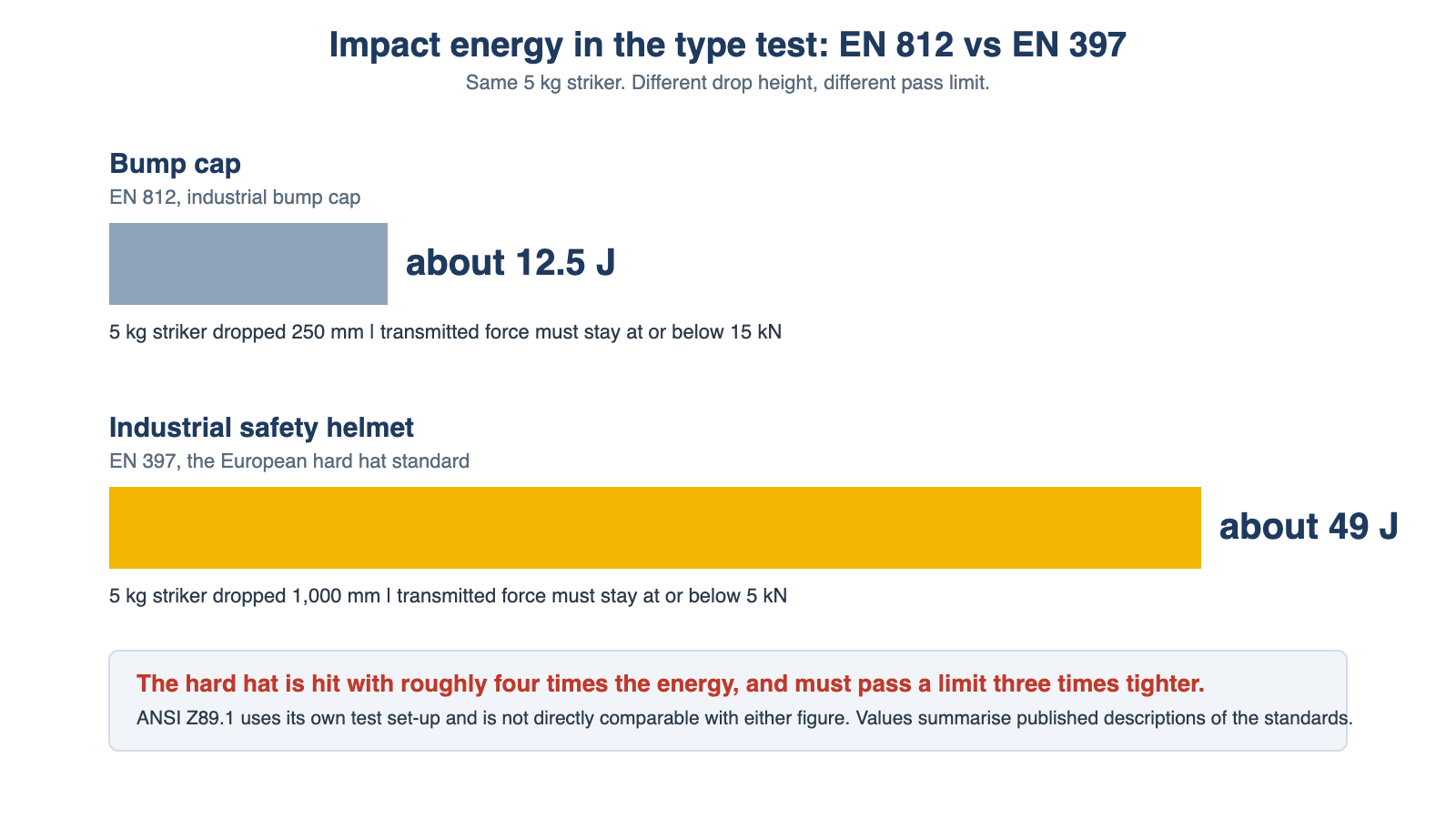
ANSI/ISEA Z89.1, the US hard hat standard, uses its own test set-up and is not directly comparable with either number. What matters for a buyer is the direction: every hard hat standard tests harder than the bump cap standard, and none of them accepts a bump cap as meeting it. The ANSI Z87.1 safety glasses article shows the same split in eye protection, where a European and a US marking look alike and are not interchangeable.
Are bump caps OSHA approved?
No bump cap is OSHA approved, because OSHA does not approve, certify or list head protection of any kind. Any pack that says “OSHA approved” is making a claim nobody can verify.
What OSHA does is set the requirement. 29 CFR 1910.135 requires head protection where there is a potential for injury from falling objects, or from electrical shock and burns, and says that protective helmets must comply with ANSI Z89.1 or be shown to be at least as effective. Construction work has its own equivalent in 1926.100. A bump cap is not covered by Z89.1, and there is no US performance standard written for bump caps.
In practice that gives the employer, not the supplier, the decision. A bump cap can be used where a written hazard assessment finds that falling objects and electrical hazards are absent and the only exposure is bumping into fixed structures. OSHA has also said in an interpretation letter about sewer work that bump caps would not give adequate head protection for all exposures in manholes. That letter is from 1980 and refers to an older edition of Z89.1, so treat it as direction of travel, not a current citation.
The same wording problem appears in footwear, and OSHA approved shoes explains why no shoe can carry that label either. The related question of what PPE stands for and which items belong in the category is covered separately.
When a bump cap is enough, and when it is not
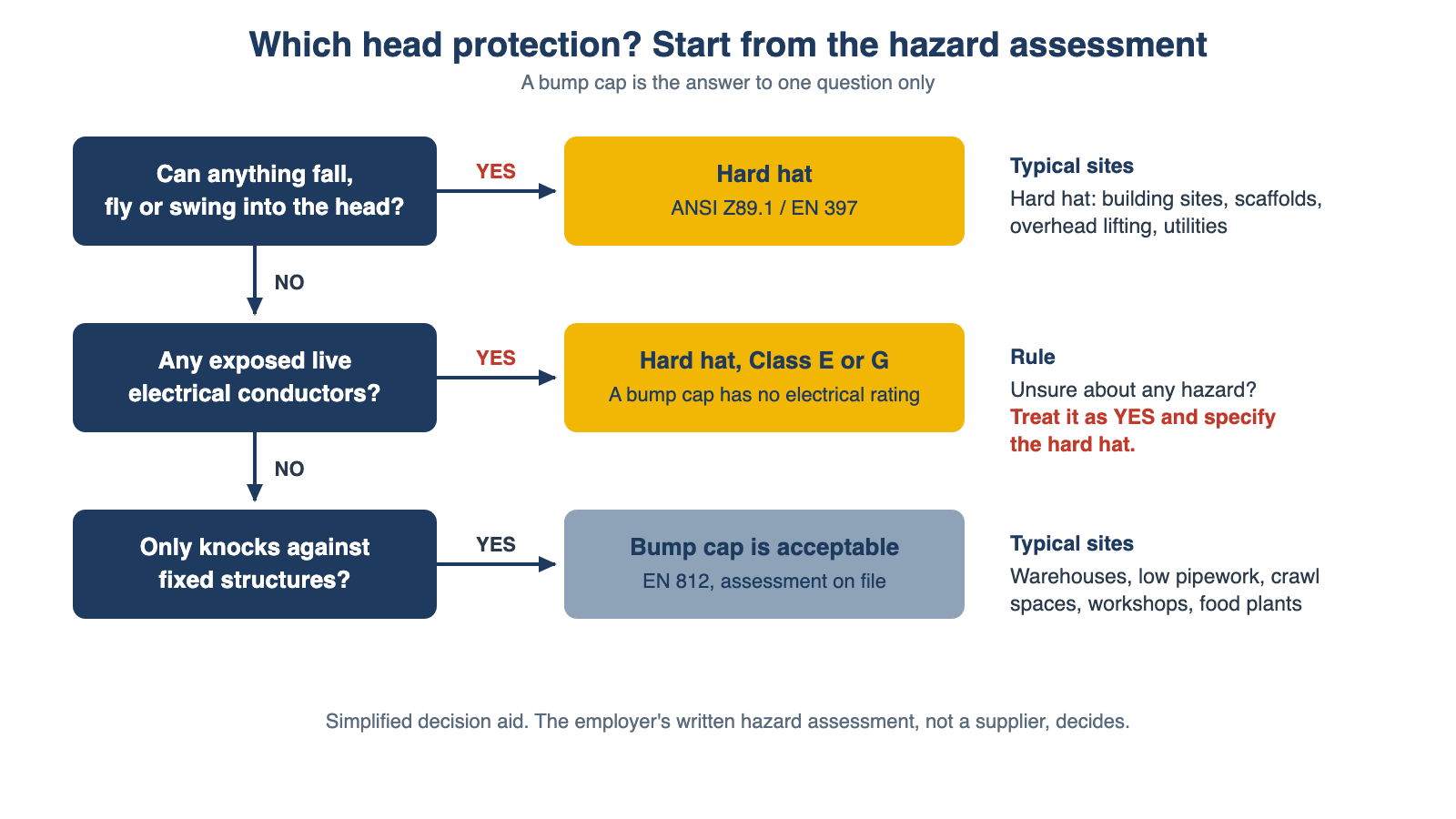
A bump cap is enough only when the hazard assessment finds nothing that can fall, fly or swing into the head, and no exposed live conductors. If any of those is uncertain, the answer is the hard hat.
| Situation | Bump cap enough? | Why |
|---|---|---|
| Warehouse aisle with low racking beams, no overhead picking | Yes | Fixed structure, nothing above to fall |
| Plant room or workshop with low pipework and ducting | Yes | Frequent minor contact with fixed objects |
| Crawl space, loft or under-vehicle work | Yes | Confined, low, and a hard hat is awkward to wear |
| Forklift zone with loads stored overhead | No | Objects can fall from racking |
| Building site, scaffold or work below other trades | No | Falling and flying object hazard |
| Work near exposed live conductors | No | A bump cap has no electrical rating |
| Sewer or manhole entry | No | OSHA has said a bump cap is inadequate for all exposures there |
Where both hazards exist on one site, the usual answer is both products in different zones, not one product for everyone. A mixed site is a reason to sell two products, not to stretch one.
How to range and label both products
Keep bump caps and hard hats as two separate lines with different names, different shelf positions and different claims. The commercial risk is not the bump cap. It is the customer who buys it believing it is a cheaper hard hat.
- Name them differently. List the product as “bump cap”, never “safety helmet” or “work cap”. The word helmet implies a standard it does not meet.
- Print the limit on the pack. “Not a hard hat. Does not protect against falling objects” belongs on the front of the pack, in the destination language.
- Drop “OSHA approved” from every listing, including supplier-provided copy. Replace it with the standard the product was actually tested to.
- Ask for the test report to the destination standard. EN 812 for Europe and the UK. For the US there is no bump cap standard, so the file that matters is the buyer’s own hazard assessment.
- Shelve by hazard, not by price. Do not position the bump cap as the entry-level option in a hard hat range. Put it with low-risk workplace items, and give the hard hat its own bay.
- Sell the question, not the product. A one-page version of the decision chart above, handed over with the order, moves a customer to the right product and protects the seller if a dispute follows.
Final thoughts
The decision is never bump cap or hard hat on cost or comfort. It is what the hazard assessment finds. Where anything can fall, fly or carry current, the answer is a hard hat, and the bump cap has no part in it. Where the only risk is walking into fixed structures, a bump cap that people actually wear beats a hard hat that stays on a hook. Range them as two products and label the difference plainly.
Frequently asked questions
Can a bump cap replace a hard hat?
No. A bump cap is tested to EN 812 at a much lower energy than a hard hat, and it has no suspension or air gap to absorb a falling object. It is acceptable only where a hazard assessment finds nothing can fall, fly or swing into the head, and no live conductors are exposed. Otherwise the standard is ANSI Z89.1 or EN 397.
Does OSHA require bump caps?
No. OSHA does not require bump protection. It requires head protection where there is a potential for injury from falling objects or electrical hazards, and that protection must meet ANSI Z89.1 or be at least as effective. A bump cap is an employer’s choice for low-risk bumping, and the choice rests on the employer’s written assessment.
Is there a US standard for bump caps?
There is no US performance standard written for bump caps, and ANSI Z89.1 does not cover them. The reference most manufacturers and buyers use is the European EN 812. A US bump cap should therefore be bought against that test report and the buyer’s own hazard assessment, not against an OSHA or ANSI claim.
What is a bump cap made of?
A bump cap is cap fabric over a thin moulded insert, usually a tough plastic, that sits against the head. There is no suspension and no air gap, which is why it can look like an ordinary cap. The insert, not the fabric, is the protective part, so a cap without a real insert is not a bump cap.
Can you wear a bump cap under a hard hat?
No. It adds no protection, because the hard hat does the work, and it disturbs the fit of the hard hat’s suspension. If a task needs a hard hat, wear the hard hat alone. If it does not, wear the bump cap alone. Wearing both usually means the hazard assessment has not been done.
Do bump caps prevent concussion?
No standard claims that. A bump cap spreads a low-speed knock so the result is a bruise or graze instead of a cut. EN 812 tests force transmitted to a headform and penetration, not concussion. Any listing that promises concussion protection from a bump cap is overstating what the product is tested for.
How long does a bump cap last?
Replace it after any significant impact, or when the insert is cracked, deformed or loose. Beyond that, follow the manufacturer’s guidance, since sweat, UV and handling wear the fabric and the foam. There is no single life figure that applies to all bump caps, so ask the factory for its recommended replacement period.
Can bump caps be made with a custom logo and packaging?
Yes. Cap colour, insert, logo position, label, hang tag, polybag, retail box and carton marks can all be set before quotation. For private label ranges, build the “not a hard hat” warning into the artwork from the first proof, not as a later sticker, so the limit travels with the product to every market.
Sourcing bump caps
Johnny’s Hardware supplies a bump cap with a moulded impact insert in a lightweight, adjustable cap, as part of the wider safety equipment range. Colour, logo position, labels, hang tags, polybags, retail boxes and export cartons can be set to your specification, and private label artwork goes through our OEM hardware supplier service. It ships with the rest of the range in one consolidated order, including safety glasses.
If the destination market needs a test report to EN 812, say so at the enquiry stage. We confirm that model by model before quoting rather than assume. Send the destination market, standard, colour, logo and packing requirements and the quantity, and we will come back with specifications and carton data within 12 working hours.
– Johnny’s Hardware Team, Sourcing Advisor